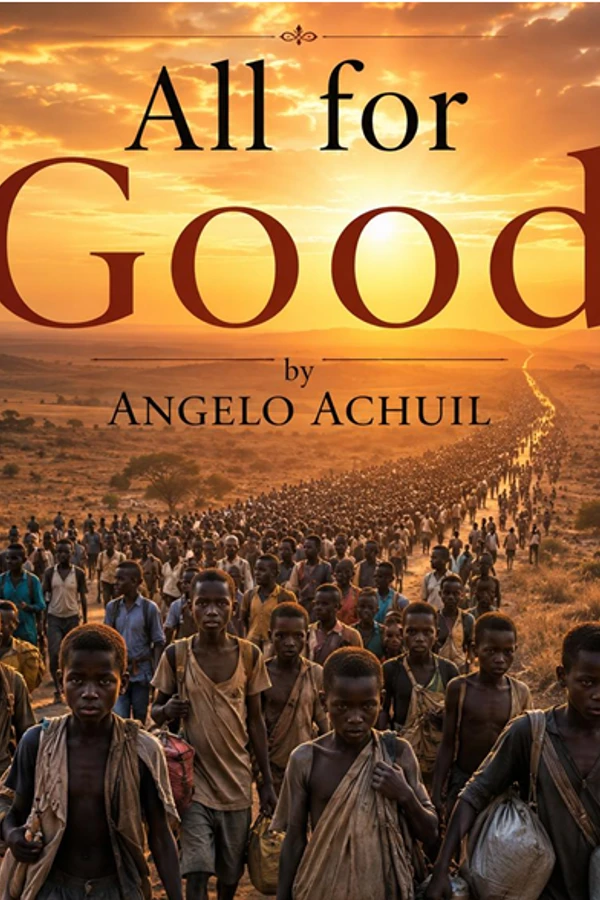
All for Good
About This Book
Three countries on foot: Sudan, Ethiopia, Kenya. Hunger hollowed him. The Gilo River swallowed the weak. Every stranger could be a rescuer or a threat. Some days, a single act of kindness was all that stood between him and the end.
Pinyudo. Kakuma. Years of waiting in camps for a door to open.
Then it did. A plane carried him across the world to America, to a city, a language and a loneliness he could not have pictured.
How does a boy walk out of the fire and live? And what if the verse he clung to the whole way was true: that all of it, even this, was working for good?
All for Good. A journey of faith, survival and grace.
In 'All for Good', Angelo Achuil recounts his harrowing journey from war-torn Sudan to America, exploring themes of faith, survival, and resilience. Through personal stories of loss and hope, he reflects on the deeper questions of existence and the role of God in times of suffering.
Who this book is for
- Readers interested in memoirs
- Those seeking stories of resilience
- Individuals exploring themes of faith
- Anyone affected by war and displacement
What you'll learn
- The impact of war on individual lives
- The journey of a refugee
- The role of faith in adversity
- Insights into Sudanese culture and conflict
- The importance of hope and kindness
Read a free sample 10 pages from the book
ALL FOR GOOD Angelo Achuil With AI support @2026
“And we know that all things work together for good to them that love God, to them who are the called according to his purpose.” Romans 8:28
1
Contents
Introduction ............................ 2 Part I — Darkness 1. Deeply Lost --------------------------- 8 2. Storm of Wrath --------------------------------10 Part II — Breaking & Shaping 3. Leaving Home Behind ------------------------15 4. Arrival in Ethiopia -----------------------126 5. Eviction from Ethiopia, later to Kenya -------------- 218 Part III — Exposure & Expansion 6. Going to America ---------------------------245 7. America’s Contribution to CPA ----------------------302 Part IV — Purpose of it all 8. The Root Cause of all Root causes ------------------------ 329 Part V — Light and Revelation 9. All for Good --------------------------------341 10. Annexes -----------------------------358
2
Introduction
"The Earth will be destroyed." Those were the words my mother spoke one day beneath our balanite tree in Ajak-Abiook village. I was only five or six years old. I did not understand what she meant. How could the earth be destroyed? The ground beneath my feet seemed permanent. The cattle moved peacefully across the grazing lands. Children laughed and played in Anyangwuot playground. The seasons came and went as they always had. The world appeared stable and secure through the eyes of a child. Yet while I could not understand her words, I could understand something else. I could see the sadness in her eyes. Years later, I would realize that some people can see storms long before the clouds become visible to everyone else. My mother was one of them. At the time, Sudan was already beginning to tremble beneath forces that would soon reshape millions of lives. Rumors traveled before armies arrived. Fear often arrived before violence. Villages spoke in whispers of attacks, raids, displacement, and uncertainty. The old order was beginning to crack. I did not know it then, but the world I had been born into was already disappearing. The earth, as I knew it, was indeed about to be destroyed. Not the planet itself. But my world. The world around cattle. The world of certainty. The world of family gathered together.
3
The world of sleeping without fear. The world of believing tomorrow would look much like today.
I didn’t know that our lives were about to be unmade in few months. The village would no longer be the center of my universe. Home would become a memory. The familiar would become unfamiliar.
And a journey would begin that would carry me farther than I could ever have imagined. I left Ajak-Abiook in 1987 and didn’t return until 2007 – two decades later. My story is too long to tell completely.
Even if I devoted a thousand pages to it, many things would remain unsaid. Some memories have faded with time. Others remain too painful to revisit in full detail. Because I have put so many things together, some works written years back, I used AI – artificial intelligence to help me not only with grammar but also the thought flow amid chapters. What appears in these pages is therefore not everything that happened. It is what can be said. It is what should be told. And perhaps most importantly, it is what must be said. The journey begins in Warrap in 1987. From there it stretches through Lakes State and Jonglei, across rivers and swamps, through fear and uncertainty, into Ethiopia and the terrible years that followed there. Then back again into Sudan. Through Jonglei. Through Eastern Equatoria. Into Kenya. Into refugee camps. Into survival.
4
Into questions. And eventually into America, Jordan, Israel and beyond.
Yet geography is only part of this story. The greater journey was taking place within. As a child I thought the greatest questions in life were practical ones. Where will we sleep? What will we eat? Will we survive? But as the years passed, deeper questions emerged. Where did I come from? Who am I? Why am I here? What am I supposed to do with this life? Why does suffering exist? Why do good people suffer? Why do children die? Why does God allow it? And perhaps the greatest question of all: What is all this for?
This book is my attempt to wrestle honestly with those questions. It is not merely the story of war. Many books have been written about Sudan war. It is not merely the story of displacement. Many people have suffered displacement. It is not merely the story of a Lost Boy – so many are already written. Hundreds have told the same Lost Boys’ story. Thousands share that description.
5
I am grateful to Valentino Achak through Dave Eggers for the book “What is the What” as it was one of the things that encouraged me to write my own. But the focus of my story is different. It is about how God saved through afflictions unto eternal life. Without God in it, I won’t been interested in re-inventing the wheel again. As much as it covered many scenes of trauma and liberation history that affected me, it’s merely part of healing. Talking or writing is healing for some of us. But it’s truly about finding the ultimate – the ruɔl (full package) of meaning of life. God almighty and his mysterious way of redemption.
The story of how suffering forced me to confront the deepest realities of existence. The story of how loss stripped away illusions we had about life. The story of how hardship exposed what truly matters.
The story of how God can be found not only in blessings, but also in deserts, refugee camps, disappointments, and unanswered questions.
There are moments in these pages that are difficult to read. Some reveal some of the worst that happened. War. Cruelty. Tribal politics as were before they exploded. Fear. Loss. Death. The ability of human beings to inflict suffering upon one another is one of the darkest realities of our world. You will encounter that darkness here. You will see the bad. You will see the ugly. You will see things that no child should ever have witnessed.
6
But that is not where the story ends.
Because alongside the darkness, there were also acts of extraordinary courage. There was friendship. There was sacrifice. There was endurance. There was faith. There was providence. There was grace. And there was a God quietly at work even when He seemed absent.
The title of this book is All for Good. Not because everything that happened was good. Much of it was not. War is not good. Starvation is not good. Death is not good. Displacement is not good. Loneliness, nakedness and homelessness are not good. The evil described in these pages should never be called good.
But this book bears that title because I have come to believe in something with all my heart: God is able to take even the worst things and weave them into a greater purpose.
What looked like chaos often concealed providence. What looked like abandonment often concealed preparation for greater trials. What looked like destruction often concealed transformation.
Looking back now, I see a pattern that I could never see while living through it.
7
I see a hand guiding events I did not understand. I see purpose emerging from pain. I see meaning emerging from mystery. Most of all, I see a God who never lost sight of me, even when I knew him not.
This book is therefore not a celebration of suffering. It is a testimony of redemption amid seemingly utter abandonment.
It is the story of a boy whose world was destroyed and who spent years trying to understand why. It is the story of questions that eventually led to answers. It is the story of a long journey home.
And it begins beneath a balanite tree in Ajak-Abiook village, with a mother whose eyes carried a sorrow that her son was still too young to understand. "The Earth will be destroyed." In many ways, she was right. But that was only a small part of a bigger and longer journey home – the heavenly home.
8
1. Deeply Lost Across the world, and in our part of Africa and Sudan, life has never been separated from belief. Every tribe, clan, and family had something they held onto—spirits, snake, animal, shrine or some effigies as gods they serve out of interest or fear. Life was shaped not only by what people saw, but by what they believed was behind what they saw. And the result, as I experienced it, was a world where people struggled constantly with each other, competing, hating, stealing, defending, attacking, and sometimes destroying one another, all in the name of survival, identity, or belief. We were so steep deep in worship and violence I believe that God allowed greater violence to wake us up from mortal darkness to realize greater potential of humanity and eternity that otherwise would be impossible to be known if left alone. Back then in 1970s and 1980s, the local Muonyjang in my area were as cows-possessed as Honey badger with the honeycomb. We were mostly not interested in any topic or idea not connected with the cows until Murahliin came – well armed, took most of the cows, rape women, kill men and razed Anyangwuot to the ground in 1986. In Sudan, war was never something far away. It was part of life. Sometimes it was between regions. Sometimes between tribes. Sometimes between clans or even families. At times, it was not even called war—it was called revenge. Later on, at a larger scale from 1955 and again in 1983 till 2005, it was fueled by politics, religiously based politics pitting Muslims against Christians and animists. We did not understand why Islam wanted to subjugate others who rejected its teachings. By the time of signing the Comprehensive Peace Agreement on 9th January 2005, over 2,500,000 were reportedly dead. In Warrap, nearly every county had its own internal conflict. One payam against another. One village against another. Violence did not always come from strangers; sometimes it came from people who spoke the same language as you.
9
In my own county of Twic, I remember hearing of almost weekly clashes between Akuar and Amiol in 1985-1987. These were not distant stories. They were close enough that we measured life by them. It was reportedly told that a young man had impregnated a girl, and what began as a dispute between two concerned families quickly escalated. The anger spread from household to household, then from boma to boma, and eventually into a wider conflict of payam against payam. What started as a personal issue became something much larger than anyone could control. The good part, if it can be called that, was that in those days fighting was still done with clubs and spears. There were no guns yet in the hands of civilians. Violence was still direct, physical, and close—something you could see, face, and sometimes even escape if you ran fast enough. When I saw my brother Wol wearing his long-colored feather and carrying a bundle of spears, I understood something without being told: another battle was underway Sometimes it was not even words or preparation that warned us. It was the sound. The drum of war. A rhythm unlike any other—fast, heavy, and threatening. When it began, even before you knew what was happening, your heart would already start to change. It was as if the body understood danger before the mind could explain it. And in that kind of world, you learned early that peace was not something you lived inside. It was something you waited for—if it ever came at all.
10
2. Storm of Wrath It was one afternoon as I was playing with mud toys while my mother was talking to her friend Abuk Bol in Ajak-Abiook. Sometime, Ajak-Abiook being so close to Anyangwuot is also called so, but are different. As I was playing, I wasn't interested in their conversation until something sounded strange. "The Earth will be destroyed," said my mother to her friend while in a conversation under the only Balanite tree standing near our house. At that time, I looked at the ground for I could not imagine how it could possibly happen. I was probably around five or six years old then. But I saw sadness in my mother's eyes. They were talking about the civil war that was brewing up in the northern part of Sudan. The president at the time, Jaafer Nimeri, had declared the dissolution of the southern autonomy and creation of Sudan as an Islamic state in 1983. It rendered the agreement he, himself, signed 11 years earlier obsolete. In the same year, the population in the south rose in protest against the north and formed Sudan People Liberation Army (SPLA). The conflict would later become one of the world's bloodiest, claiming an estimated 2.5 million lives. We heard of violence building around big cities between various tribes in 1985. In Twic county (Warrap), we heard from Ngok, our northern neighbor, about the alleged cattle rustling by the Misseriya tribe. It was not the first time to hear of these incidents, but in the past, the raiders would only target cows grazing in the bush and would mostly flog, but never kill, the herders. This time, cattle inside people's homes were raided and stolen and the men killed. The women were beaten and children were abducted. We began to host displaced persons in our community and heard increasingly horrendous stories of violence.
11
I was concerned but I did not think anybody would one day come to our home and kill people. I never thought it would be possible. A few months later, rumors went around that some nomads were "lost" -- a term people used for the Murahliin (nomads) on the war path. They were headed toward our village. It was 2 a.m. and runners were spreading the message from house to house: it was time to go. Mother had to drag me with the other children to our safety. I woke up later in a nearby bush. We later heard Deng Akech Ayiei, one of our neighbors in Anyangwuot I knew well, was killed. That's when the concept of "the Earth being destroyed" began to…
End of sample. The full book is 371 pages on Afri KDP.
Questions about this book
What is the main theme of the book?
The book explores themes of faith, survival, and the search for meaning amid suffering and displacement.
Loading reviews...
Loading…
A download link appears on this page as soon as your payment is confirmed, and a permanent copy of the link is emailed to you.
By card from anywhere. In Nigeria you can also pay by bank transfer, USSD or mobile money. Your card details are entered on Paystack's secure page, never on AfriKDP.
Yes. The file opens on phones, tablets, computers and eReaders.
Yes, with an AfriKDP reading plan, which opens every book in the online reader and pays the author for every page you read.
Write to [email protected] with your email address and we will help. See our return policy.