 AfriKDP
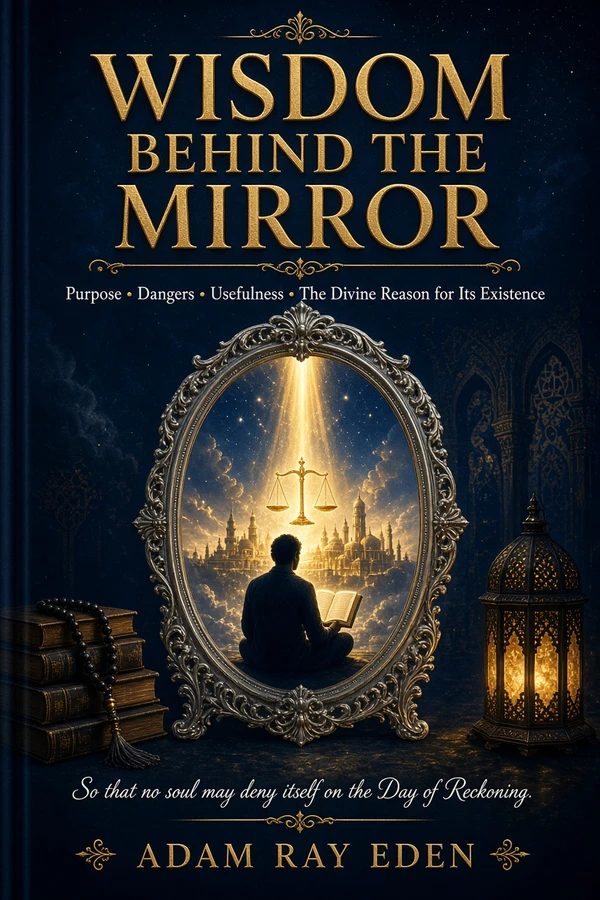
WISDOM BEHIND THE MIRROR
About This Book
* A Spiritual Journey Through Self-Examination, Character, Accountability, and the Life to Come *
What if looking into a mirror could inspire you to examine more than your appearance?
A mirror reveals the face, but it cannot reveal the condition of the heart, the intentions behind our actions, or the choices that shape our character. It shows an outward reflection while leaving the deeper questions of human existence unanswered.
In Wisdom Behind the Mirror, Adam Ray Eden explores the mirror as a powerful symbol of self-recognition, spiritual reflection, personal responsibility, and preparation for the life to come.
Through thoughtful discussions, scriptural references, and practical reflections, this book examines:
- The difference between outward appearance and inward character.
- The importance of examining our intentions and correcting our weaknesses.
- The passage of time, human mortality, and the uncertainty of tomorrow.
- Accountability, the consequences of our choices, and the Day of Judgment.
- Repentance, mercy, hope, and the possibility of personal transformation.
- The responsibility to live meaningfully before our time on earth comes to an end.
Drawing upon references from the Qur'an, authentic Islamic hadith, and the Bible, the book encourages readers to consider the spiritual and moral responsibilities that extend beyond physical appearance.
It does not present the physical mirror as an object whose special divine purpose is explicitly established in scripture. Instead, it uses the familiar experience of looking into a mirror as a symbolic invitation to deeper reflection.
This is a book about looking beyond what the eyes can see and considering what our lives truly reveal.
Use the mirror to recognize your appearance. Use wisdom to examine your character. Use the time available to prepare responsibly for the life to come.
In 'Wisdom Behind the Mirror', Adam Ray Eden encourages readers to look beyond their physical appearance and engage in deep self-reflection. The book uses the metaphor of a mirror to explore themes of character, accountability, and preparation for the life to come.
Who this book is for
- Individuals seeking personal growth
- Those interested in spirituality and religion
- Readers of devotionals and reflective literature
What you'll learn
- The importance of examining one's character
- How to recognize and correct personal weaknesses
- The significance of accountability in life choices
- Insights on the Day of Judgment and moral responsibility
- Ways to live a purposeful and meaningful life
Read a free sample 5 pages from the book
WISDOM BEHIND THE MIRROR Purpose • Dangers • Usefulness • The Divine Reason for Its Existence A Profound Spiritual Reflection on Self-Recognition, Accountability, and the Day of Judgment
Adam Ray Eden
1
Quranic passages are referenced by surah and verse number, with English renderings primarily based on Saheeh International. Hadith references are drawn from recognized Islamic collections, including Sahih al-Bukhari, Sahih Muslim, and Jamiʿ at-Tirmidhi. Biblical passages are referenced by book, chapter, and verse, with wording drawn from commonly used English translations, including the New International Version and the King James Version where appropriate.
Translations may vary between editions. Readers seeking formal religious study should consult the relevant published translations and original-language texts.
No part of this work may be reproduced, distributed, or transmitted in any form without prior written 1
2 permission from the copyright holder, except for brief quotations in reviews, criticism, or other uses permitted by applicable copyright law. 2
3
Disclaimer This book is a spiritual and reflective work intended to encourage self-examination, moral responsibility, repentance, and interfaith understanding.
It is not an official religious ruling, fatwa, theological decree, or substitute for qualified religious instruction. Its reflections on the mirror are philosophical and illustrative. Although a physical mirror provides an opportunity for self-recognition, this book does not claim that the Quran, the authentic Sunnah, or the Bible explicitly identifies the physical mirror as an object created specifically to prepare humanity for the Day of Judgment.
Instead, the mirror serves as a symbol through which readers may consider established scriptural teachings about personal responsibility, the examination of one's actions, the transience of worldly life, and accountability before God.
Hadith reports and religious quotations should be understood in their proper contexts. Where the 3
4 authenticity or precise wording of a narration requires further scholarly examination, readers are encouraged to consult qualified scholars and reliable reference editions.
The book welcomes readers from different religious backgrounds while recognizing that Islam and Christianity have distinct teachings concerning God, revelation, salvation, resurrection, and final judgment. Similarities discussed in this work do not imply that every theological belief is identical.
The author does not claim that the reflections presented here replace the need for knowledge, sincere worship, ethical conduct, or consultation with qualified religious authorities. 4
5
6
Introduction The Face We See and the Self We Must Examine Beloved reader,
Have you ever truly looked into a mirror?
Not merely glancing at your hair before leaving home. Not simply checking whether your clothes were properly arranged. Not just examining a mark on your face or confirming that your appearance was presentable.
Have you ever paused before a mirror and asked yourself a more important question?
What kind of person am I becoming?
The question may appear simple, but its answer requires more than eyesight. It requires honesty, humility, courage, and a willingness to recognize truths that may be uncomfortable.
A mirror is one of the most familiar objects in 6
7 human life. It occupies bedrooms, bathrooms, shops, offices, salons, and countless other places. People use it when preparing for work, attending ceremonies, travelling, caring for their appearance, or simply checking themselves during an ordinary day.
Its usefulness is easy to understand. Its deeper symbolism, however, is often overlooked.
The mirror shows us an image of our outward appearance. It does not explain our intentions. It cannot measure our sincerity, reveal every private struggle, or tell us whether we have treated another person fairly. It cannot show the full history of our choices or predict the final outcome of our lives.
A person may stand before a mirror with a beautiful face while carrying resentment in the heart. Another may look tired, aged, or physically imperfect while possessing extraordinary kindness, patience, generosity, and integrity.
The mirror reveals something real, but it does not reveal everything.
This distinction opens the door to a profound spiritual lesson: seeing ourselves is not the same 7
8 as understanding ourselves.
The Ordinary Object and the Extraordinary Question.
Consider the first time a child recognizes their own reflection. The child may reach toward the glass, smile at the image, or wonder why another face appears to imitate every movement.
With experience, that uncertainty disappears. The reflection becomes familiar. We learn to recognize our features, notice changes in our appearance, and distinguish ourselves from other people.
Yet familiarity can produce carelessness.
We may become so accustomed to seeing our faces that we stop asking what our lives are communicating. We may spend several minutes correcting the smallest…
End of sample. The full book is 94 pages on Afri KDP.
Questions about this book
What is the main focus of this book?
The book focuses on using the metaphor of a mirror to encourage self-examination and accountability, highlighting the distinction between outward appearance and inner character.
Loading reviews...
Loading…
A download link appears on this page as soon as your payment is confirmed, and a permanent copy of the link is emailed to you.
By card from anywhere. In Nigeria you can also pay by bank transfer, USSD or mobile money. Your card details are entered on Paystack's secure page, never on AfriKDP.
Yes. The file opens on phones, tablets, computers and eReaders.
Yes, with an AfriKDP reading plan, which opens every book in the online reader and pays the author for every page you read.
Write to [email protected] with your email address and we will help. See our return policy.