 AfriKDP
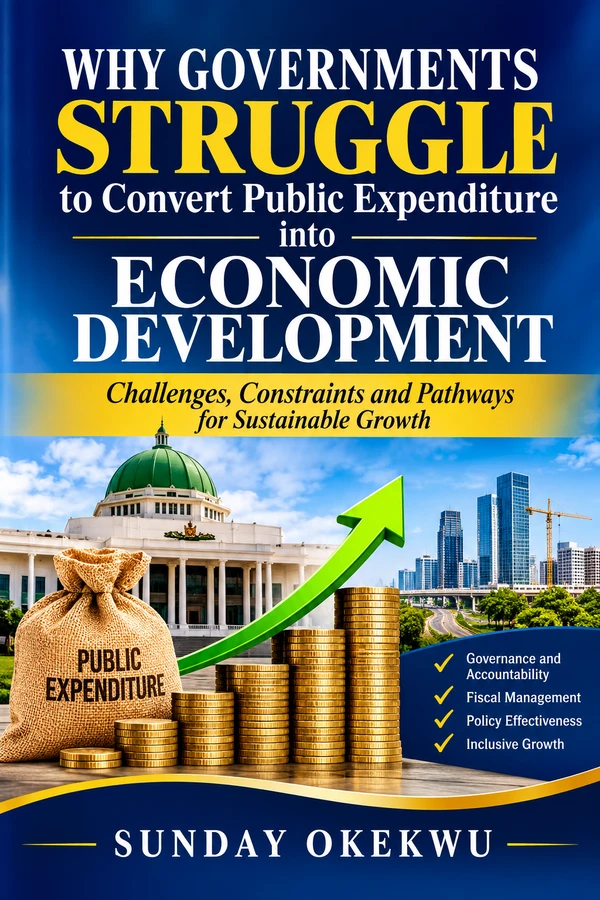
WHY GOVERNMENTS STRUGGLE TO CONVERT PUBLIC EXPENDITURE INTO ECONOMIC DEVELOPMENT
About This Book
Subtitle: Understanding Public Investment, Institutional Capacity, Economic Productivity, Infrastructure and National Development.
Book Description
Why do some countries transform public expenditure into economic prosperity, modern infrastructure and improved living standards, while others continue to experience weak productivity, inadequate infrastructure and limited development despite substantial government spending?
Governments allocate enormous financial resources to public services, infrastructure, education, healthcare, transportation and economic development. Yet, increased public expenditure does not automatically translate into measurable development outcomes.
This book investigates the institutional, economic, administrative and structural factors that determine whether government spending produces meaningful economic transformation.
Drawing on public finance, development economics, public investment management and institutional analysis, Sunday Okekwu examines the complex relationship between government resource mobilisation, budget allocation, project selection, procurement, implementation, infrastructure delivery and national productivity.
The book introduces a structured analytical perspective for understanding how public resources move through government institutions and how weaknesses at different stages can undermine development objectives.
Readers will gain insights into:
Why increased government spending does not always produce economic development.
How budget allocation and public financial management influence development outcomes.
Why poor project selection and implementation undermine public investment.
The role of procurement systems, institutional capacity and accountability.
How infrastructure investment contributes to economic productivity.
Why governance quality influences the conversion of public resources into development.
How governments can strengthen public investment and improve development outcomes.
Written for policymakers, government officials, economists, researchers, university students, development professionals and public finance practitioners, this book provides a framework for examining one of the most important questions in national development: how can governments turn public money into lasting economic and social progress?
Public expenditure is not the same as economic development. The real measure of government spending is not simply how much money is allocated or spent, but what that expenditure ultimately produces for the economy and society.
This book explores the reasons behind the varying success of governments in converting public expenditure into economic growth and development. It analyzes institutional, economic, and administrative factors that influence the effectiveness of public spending.
Who this book is for
- Policymakers
- Government officials
- Economists
- Researchers
- Development professionals
What you'll learn
- Why increased spending doesn't guarantee development
- The impact of budget allocation on outcomes
- Factors undermining public investment
- The importance of procurement systems
- How infrastructure affects productivity
- The role of governance quality
- Strategies for improving public investment
Questions about this book
What makes this book different from other books on public finance?
This book provides a structured analytical perspective on the complex relationship between public expenditure and economic development, focusing on institutional and administrative factors.
Loading reviews...

Loading…
A download link appears on this page as soon as your payment is confirmed, and a permanent copy of the link is emailed to you.
By card from anywhere. In Nigeria you can also pay by bank transfer, USSD or mobile money. Your card details are entered on Paystack's secure page, never on AfriKDP.
Yes. The file opens on phones, tablets, computers and eReaders.
Yes, with an AfriKDP reading plan, which opens every book in the online reader and pays the author for every page you read.
Write to [email protected] with your email address and we will help. See our return policy.