 AfriKDP
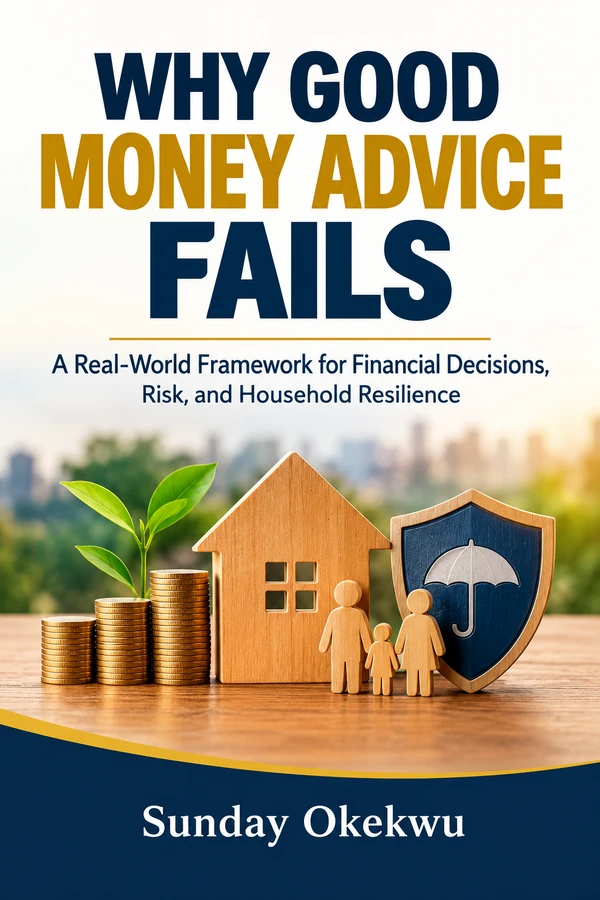
WHY GOOD MONEY ADVICE FAILS?
About This Book
By Sunday Okekwu
Why does good financial advice sometimes fail to produce good financial results?
This book examines why financial recommendations that work for one person may not work for another. It explains how income, financial obligations, household responsibilities, risk exposure, economic conditions, and personal circumstances influence financial decisions.
The book explores six important dimensions of financial management: financial resources, obligations, risk exposure, flexibility, protection, and continuity.
Readers will gain a better understanding of saving, investing, debt management, insurance, financial protection, and wealth preservation.
It is written for individuals, families, professionals, savers, investors, students, and anyone seeking to make more informed financial decisions.
Its central message is that good financial advice must be suitable, affordable, sustainable, and consistent with individual circumstances.
Sunday Okekwu Independent Research Centre
Lagos State, Nigeria.
This book examines the reasons why financial advice can lead to different outcomes for different households. It provides a framework for understanding how personal circumstances affect financial decisions, emphasizing the importance of context in applying financial principles.
Who this book is for
- Individuals seeking financial clarity
- Families managing finances
- Students of finance and economics
- Financial educators
- Insurance and financial professionals
What you'll learn
- Understand the gap between financial advice and real-world application
- Evaluate financial decisions in context
- Identify vulnerabilities in financial strategies
- Assess the impact of changing circumstances on financial plans
Read a free sample 5 pages from the book
WHY GOOD MONEY ADVICE FAILS A Real-World Framework for Financial Decisions, Risk, and Household Resilience By Sunday Okekwu Independent Researcher | Insurance Professional | Household Finance & Financial Protection Sunday Okekwu Independent Research Centre Lagos State, Nigeria ORCID: https://orcid.org/0009-0008- 1211-1177 Website: https://sundayokekwuinsurance.wordpress.com/ BOOK FOCUS AND RESEARCH POSITIONING A Question Every Household Should Ask What happens when you follow good financial advice but your circumstances make it difficult to sustain the plan? Saving regularly, reducing debt, investing for the future, and obtaining suitable protection are generally sensible financial objectives. Yet a household can understand these principles, make responsible choices, and still experience financial difficulty. Income may be irregular, essential expenses may leave little room for saving, family responsibilities may compete with long-term goals, and unexpected events may disrupt an otherwise reasonable plan. This book examines the gap between knowing what is financially desirable and being able to implement and sustain it under real-world conditions. It develops a context-sensitive approach to evaluating financial decisions without dismissing established financial principles or assuming that every adverse outcome results from poor judgement. THE CENTRAL RESEARCH QUESTION Why can the same financial advice produce different outcomes across households, and how can financial decisions be evaluated to improve their feasibility, suitability, and ability to withstand changing circumstances? SUPPORTING RESEARCH QUESTIONS The book investigates six related questions: How does the relationship between household resources and essential obligations influence the feasibility of financial strategies? Why may the same financial recommendation produce different outcomes across households with different starting positions and risk exposures? How might financial flexibility influence a household’s ability to maintain essential commitments when adverse events occur? Under what circumstances might appropriate and accessible protection arrangements reduce the financial consequences of adverse events? Can an integrated assessment of resources, obligations, risk exposure, flexibility, protection, and continuity identify vulnerabilities that single-dimension assessments overlook? How might changes in household circumstances affect the suitability and sustainability of an existing financial strategy? These questions correspond to the six provisional research propositions developed later in this section. They establish issues for investigation rather than presupposing that the proposed relationships have already been demonstrated. CENTRAL ARGUMENT A financial recommendation cannot be evaluated adequately by considering its underlying principle alone. Its application must also be assessed against the household’s circumstances, available options, competing obligations, exposure to risk, and capacity to sustain the recommended action. A strategy may be sound in principle but infeasible for a household with little disposable income. An investment may offer long-term growth potential but create difficulties if the household needs immediate access to its money. A plan that is manageable today may become unsuitable after an income loss or a substantial increase in essential expenses. These possibilities do not invalidate general financial principles. They demonstrate why responsible financial decision-making requires attention to the conditions under which a recommendation must operate. The book therefore distinguishes among three related assessments: Soundness: Is the underlying financial principle reasonable? Feasibility and
suitability: Does the proposed action fit the household’s resources, obligations, objectives, and circumstances? Sustainability and continuity: Can the strategy remain workable as circumstances change, and what might happen if it cannot? This distinction provides the basis for examining household financial decisions without judging their quality solely by their eventual outcomes or assuming that every adverse outcome could have been prevented. THE CENTRAL CONCEPTUAL CONTRIBUTION The book proposes an integrated framework for evaluating household financial decisions through six dimensions: resources, obligations, exposure to financial risks, financial flexibility, protection, and continuity. Financial advice often concentrates on the action a person should take: save more, reduce debt, invest, or obtain insurance. This book adds a related analytical question: What must be true about a household’s circumstances for the recommended action to be workable, sustainable, and compatible with its other financial commitments? The proposed framework brings together six dimensions: Resources: The financial means available to the household, including their accessibility, reliability, and timing. Obligations: The essential expenses and commitments that must be met. Exposure to Financial Risks: The events and conditions that could disrupt the household’s financial position. Financial Flexibility: The options realistically available for adjusting to changed circumstances. Protection: The arrangements that may help manage the financial consequences of adverse events. Continuity: The ability to maintain essential commitments, respond to disruption, and preserve or restore financial progress. The contribution is not a claim that each dimension is new or that their relationships have already been empirically established. It lies in organising them within one analytical structure for examining whether financial decisions fit the circumstances in which they must work. The framework is intended to guide structured analysis and generate questions for further investigation. It is not a universal formula for financial success, a validated measurement scale, or an empirically established predictive model. THE PROPOSED SIX-DIMENSION FRAMEWORK The six dimensions should be considered together rather than treated as independent factors that automatically determine an outcome. Resources Resources include income, liquid savings, assets, and other financial means available to the household. Their amount, accessibility, stability, and timing influence which financial choices are feasible. Asset ownership alone does not establish immediate financial capacity. An asset may have substantial value but be difficult to access or sell when money is urgently needed. Obligations Obligations include essential expenditure, debt repayments, housing costs, dependants, and other financial commitments. They determine how much of the household’s resources is already committed and what remains available for other purposes. Households with similar incomes may therefore have substantially different room for manoeuvre. Exposure to Financial Risks This dimension concerns events or conditions that may interrupt income, increase expenditure, damage assets, or otherwise disrupt the household’s financial position. Examples include unemployment, illness, business losses, economic instability, and unexpected family responsibilities. The consequences depend on the event, its timing, and the household’s circumstances. Financial Flexibility Financial flexibility refers to the practical ability to adjust expenditure, revise commitments, access liquidity, or change plans when circumstances differ from expectations. It does not mean that every commitment can be changed or every loss avoided. It concerns the options realistically available to the household. Protection Protection concerns arrangements intended to
manage the financial consequences of adverse events. Depending on the household’s circumstances, these may include appropriate insurance, emergency reserves, diversification, and other suitable risk-management measures. Their usefulness depends on the risks involved, affordability, accessibility, terms, exclusions, limitations, and suitability. Continuity Continuity concerns the ability to maintain essential commitments, manage disruption, recover where possible, and preserve financial progress over time. It does not imply that setbacks can always be prevented. It focuses on what may be disrupted, what can continue, and what resources or arrangements may support recovery. HOW THE DIMENSIONS WORK TOGETHER Consider a household with a reasonable income but substantial debt repayments and family obligations. Its income alone may suggest that it can afford a new investment. An assessment of obligations, liquidity, and potential income disruption may reveal that the investment could leave too little accessible money to meet essential commitments. Alternatively, a household may have emergency savings but face a risk that could substantially exceed those reserves. Its resources are relevant, but so are its exposure, protection arrangements, and capacity to recover. These examples illustrate why a single financial indicator may provide an incomplete picture. The framework encourages a broader assessment of the relationships among household circumstances and financial choices. The examples illustrate the framework’s intended analytical use; they do not establish causal relationships. Whether the proposed dimensions explain differences in outcomes, and how strongly they do so, remains a matter for further research. A PRACTICAL PATHWAY FOR APPLYING THE FRAMEWORK The framework can be applied through seven steps. This sequence is a guide to structured thinking, not a numerical score or an automatic decision rule. Step 1 — Establish resources. Identify income, accessible savings, relevant assets, liabilities, and cash-flow reliability. Step 2 — Map obligations. Identify essential expenditure, debt repayments, dependants, and other commitments. Step 3 — Identify exposures. Consider events that could reduce income, increase costs, damage assets, or interrupt essential payments. Step 4 — Assess flexibility. Examine which expenses, commitments, funds, or plans could realistically be adjusted. Step 5 — Review protection. Consider existing insurance, reserves, and other arrangements, including their limitations and suitability. Step 6 — Test continuity. Ask whether the proposed decision would remain workable under plausible adverse circumstances and what essential commitments might be disrupted. Step 7 — Compare and review. Evaluate feasible alternatives, weigh trade-offs, make an informed decision, and reassess it when circumstances materially change. Some steps may need to be revisited as new information becomes available. The pathway is not a substitute for appropriate professional advice and cannot guarantee a particular financial outcome. RESEARCH- STATUS QUALIFICATION The six-dimension framework and its practical pathway are proposed conceptual contributions. They are not presented as a validated measurement scale, a predictive instrument, an empirically established causal model, or a universal law. Their conceptual clarity, usefulness, limitations, and explanatory value require further theoretical development and empirical investigation. PROPOSITIONS FOR FUTURE RESEARCH The proposed framework generates six provisional propositions for theoretical examination and empirical investigation. Each proposition corresponds to one of the six supporting research questions. Together, they identify relationships worth investigating rather than established findings or proven causal relationships. Proposition 1:
Resource–Obligation Alignment The feasibility of a household financial strategy may depend on the relationship between available resources and essential obligations, rather than on income or asset ownership considered in isolation. Proposition 2: Contextual Variation in Financial Outcomes The same financial recommendation may be associated with different outcomes across households because their resources, obligations, starting positions, and exposure to financial risks differ. Proposition 3: Financial Flexibility and Disruption A household’s financial flexibility may influence the extent to which an adverse event disrupts its essential commitments and planned financial activities. Proposition 4: Protection and Financial Consequences Appropriate and accessible protection arrangements may reduce the financial consequences of specified adverse events, although the extent of any reduction depends on the nature of the event and the arrangements’ terms, limitations, and suitability. Proposition 5: Integrated Assessment and Vulnerability Identification Considering resources, obligations, risk exposure, flexibility, protection, and continuity together may identify financial vulnerabilities that an assessment based on a single dimension overlooks. Proposition 6: Changing Circumstances and Strategy Suitability The suitability and sustainability of a household financial strategy may change as income, obligations, risks, available resources, and protection arrangements change over time. These propositions could be investigated through appropriate conceptual, qualitative, quantitative, or comparative research. Testing them would require clearly defined constructs, suitable research designs, and evidence appropriate to each proposition. Their validity, scope, and explanatory value remain open to examination. SCOPE AND METHOD The book examines household financial decisions involving spending, saving, debt, investment, insurance, emergency preparedness, financial planning, wealth preservation, and long-term financial continuity. Its perspective is international, with attention to Nigeria and other African settings alongside research and experience from different economic and institutional environments. Households within the same country can face very different conditions. Employment security, access to financial services, public support, family structures, borrowing costs, income stability, and available financial products may influence how financial strategies work in practice. The book therefore avoids assuming that a single approach suits every household or that conclusions from one setting can automatically be transferred to another. The method is a research-informed conceptual synthesis drawing on relevant literature, critical analysis, comparative reasoning, and clearly identified hypothetical illustrations. The book does not claim to report original surveys, experiments, or newly collected empirical findings. THE READER’S PROMISE By the end of this book, readers should be better equipped to: Distinguish a sound financial principle from an application that may be unsuitable for their circumstances. Assess how resources, essential obligations, and competing priorities affect financial choices. Identify vulnerabilities that may be overlooked when financial progress is measured only by income, savings, or investment returns. Consider how unexpected events could affect a financial plan and what flexibility or protection may help manage the consequences. Apply a structured set of questions when making or reviewing financial decisions. Recognise when changing circumstances may require a financial strategy to be reconsidered. Evaluate financial advice critically without dismissing established principles or assuming that every adverse outcome could have been prevented. The book does not promise a formula for eliminating uncertainty or guaranteeing financial success. Its
practical aim is to help readers examine financial advice in context, identify important trade-offs, and make more informed decisions about the resources and risks they actually face. INTENDED AUDIENCE This book is intended for: Individuals and households seeking to make more informed financial decisions. Financial educators and financial- literacy programme designers. Researchers interested in household finance, financial capability, and financial resilience. Insurance and financial-services professionals. Students of finance, economics, development, and related disciplines. Policymakers and practitioners concerned with household financial security. Readers interested in the relationship between financial knowledge, practical constraints, risk management, and long-term outcomes. Its purpose is to provide a structured approach to analysing financial decisions, not to prescribe identical solutions for households with different circumstances. KEYWORDS Household finance; financial advice; financial decision-making; financial literacy; financial capability; household financial resilience; financial protection; financial risk management; household financial vulnerability; income and cash flow; household obligations; liquidity management; debt management; insurance; investment decisions; financial planning; emergency preparedness; wealth preservation; financial security; financial continuity. ABSTRACT Financial advice commonly recommends saving, controlling expenditure, managing debt, investing for the future, and protecting against financial risks. Although these principles can provide valuable guidance, their application does not produce identical outcomes across households. Differences in resources, obligations, risk exposure, flexibility, and available protection may influence whether a financial strategy is feasible, suitable, and sustainable. This book examines why the same financial advice can produce different outcomes and how household financial decisions can be evaluated in context. It adopts a research-informed conceptual approach drawing on relevant literature in household finance, financial literacy, behavioural decision-making, financial capability, and risk management. Through critical synthesis, comparative reasoning, and clearly identified hypothetical illustrations, it considers the relationship between financial knowledge, practical constraints, risk exposure, and the sustainability of financial progress. The book’s central conceptual contribution is a proposed six-dimension framework comprising resources, obligations, exposure to financial risks, financial flexibility, protection, and continuity. The framework provides an analytical structure for examining the feasibility, suitability, and sustainability of household financial decisions. Six provisional research propositions identify relationships for further theoretical development and empirical investigation. The framework is not presented as a validated predictive instrument or an empirically established causal theory. Rather, it offers a structured approach for households, researchers, educators, financial professionals, and policymakers to examine financial decisions in relation to the conditions under which they must work. Its central argument is that financial advice should be evaluated not only by the soundness of its underlying principle but also by the circumstances in which it must be applied and the consequences that may follow when those circumstances change. EXECUTIVE SUMMARY 1. THE PROBLEM: GOOD ADVICE DOES NOT GUARANTEE GOOD OUTCOMES Saving, managing debt, investing carefully, and preparing for emergencies can support financial well-being. Yet the same recommendation can produce different results when
households face different circumstances. A strategy may be manageable for a household with stable income and limited obligations but difficult to sustain for one facing irregular earnings, high essential expenses, or significant family responsibilities. The book examines why a sound financial principle does not, by itself, establish that its application will be feasible or sustainable for every household. 2. FROM FINANCIAL KNOWLEDGE TO PRACTICAL ACTION Knowing what to do does not guarantee that a person can act on that knowledge. A household may understand the value of saving but have little money remaining after essential expenses. Someone may understand investment risk but need accessible funds for an imminent obligation. Another person may recognise the value of insurance but face affordability or product-suitability constraints. Financial decisions must therefore be considered alongside the resources, opportunities, and constraints that shape practical action. 3. FINANCIAL CAPACITY IS BROADER THAN INCOME Income is important, but it…
End of sample. The full book is 90 pages on Afri KDP.
Questions about this book
What makes this book different from other personal finance books?
This book focuses on the context of financial decisions, exploring how individual circumstances influence the effectiveness of financial advice.
Loading reviews...

Loading…
A download link appears on this page as soon as your payment is confirmed, and a permanent copy of the link is emailed to you.
By card from anywhere. In Nigeria you can also pay by bank transfer, USSD or mobile money. Your card details are entered on Paystack's secure page, never on AfriKDP.
Yes. The file opens on phones, tablets, computers and eReaders.
Yes, with an AfriKDP reading plan, which opens every book in the online reader and pays the author for every page you read.
Write to [email protected] with your email address and we will help. See our return policy.