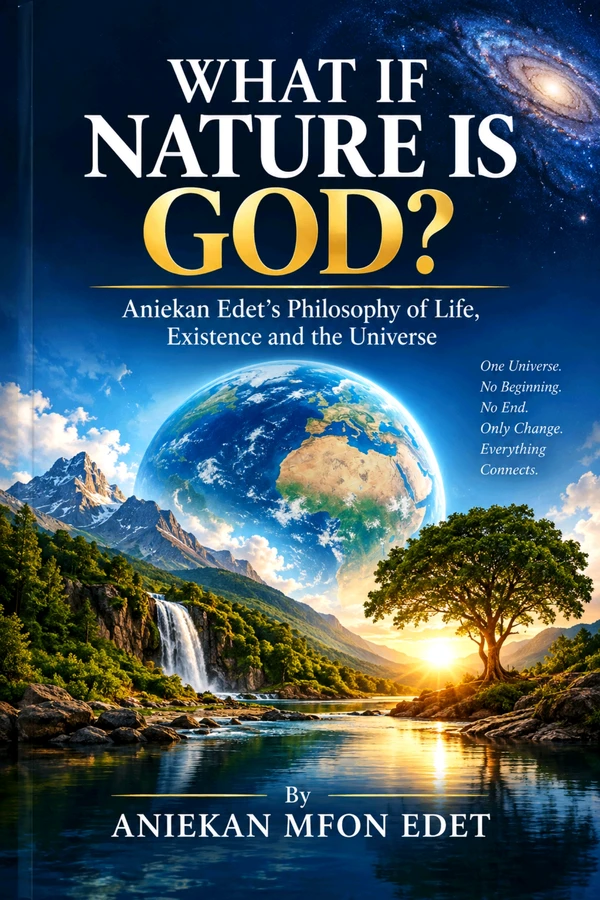
What If Nature Is God?
About This Book
Drawing from observations across science, engineering, education, physics, biology, chemistry, geography, and everyday experience, Aniekan Mfon Edet examines fundamental questions about existence and the universe.
The book explores ideas such as whether nature itself can be understood as the ultimate reality, how matter and energy are transformed and recycled, and how human beings make sense of life and existence.
Rather than presenting a religious doctrine or claiming to be a scientific theory, this work invites readers to think critically, question assumptions, examine evidence, and develop their own perspective on the nature of reality.
In 'What If Nature Is God?', Aniekan Edet presents a philosophical exploration of nature, consciousness, and ultimate reality. The book encourages readers to critically examine the relationship between humanity and the natural world, proposing that nature itself may be understood as the ultimate reality.
Who this book is for
- Philosophy enthusiasts
- Students of science and nature
- Readers interested in spirituality
- Individuals questioning existence
- Those seeking a critical perspective on reality
What you'll learn
- The definition and origin of nature
- How humans are part of nature
- The processes of life and death
- The concept of nature as ultimate reality
- The relationship between nature and consciousness
- The limitations of scientific knowledge
- Critical thinking about existence and spirituality
Read a free sample 3 pages from the book
3 I also acknowledge the philosophical tradition that has asked whether God and Nature should be understood as separate realities or whether ultimate reality may be identified with Nature itself. The history of Spinoza’s philosophy is particularly relevant to this discussion (Stanford Encyclopedia of Philosophy, 2023). This book, however, is not an attempt to reproduce another philosopher’s system. It is the development of Aniekan Edet’s Philosophy from an evidence-first and skeptical starting point. AUTHOR’S NOTE This book is not written to establish a religion, defend a religious denomination, or ask readers to accept a doctrine simply because an author has stated it. It is a skeptical philosophical investigation. The starting point is Nature. Nature is not approached here as a story, tradition or inherited religious belief. Nature is approached as the reality within which human beings live, observe, investigate, measure, experience and exist. The book therefore separates three things: Evidence — what observation, measurement and reliable investigation establish. Reasoning — what can logically be concluded from those facts. Philosophy — what those facts may mean at the deepest level.
4 The central conclusion of this book is Aniekan Edet's Philosophy: Nature is not merely something that has power. Nature is Power itself—the fundamental reality within which everything known to us exists, changes and depends. If God means ultimate reality, then Nature can be called God. This is not presented as a laboratory equation. Science can investigate natural processes. Philosophy can ask what those processes mean and whether the concept of God should refer to ultimate reality itself. The identification of God with Nature has historical philosophical parallels, particularly in discussions of pantheism and Spinoza, although interpretations of Spinoza himself remain debated (Stanford Encyclopedia of Philosophy, 2022, 2023). The reader is therefore not asked to believe. The reader is asked to examine. PREFACE Human beings have always asked fundamental questions. Where did we come from? What is life? Why does the universe exist? What happens when we die? What is consciousness?
5 Is there a God? If God exists, what does the word “God” actually mean? Religious traditions have supplied many answers. Philosophy has supplied many others. Science has transformed our understanding of the physical universe, life and the human body. Yet one question remains particularly important: Before asking whether something exists outside Nature, should we first understand Nature itself? This book begins there. Every human being depends upon Nature. We breathe Nature's atmosphere. We drink Nature's water. We eat food produced through natural systems. Our bodies are composed of chemical elements found in Nature. Our cells operate through biochemical processes. Our minds depend upon living biological systems. When we die, the biological organization that constituted the individual breaks down and…
End of sample. The full book is 68 pages on Afri KDP.
Questions about this book
What is the main argument of the book?
The central argument is that nature itself can be understood as the ultimate reality, and if God refers to ultimate reality, then nature can be called God.
Loading reviews...
Loading…
A download link appears on this page as soon as your payment is confirmed, and a permanent copy of the link is emailed to you.
By card from anywhere. In Nigeria you can also pay by bank transfer, USSD or mobile money. Your card details are entered on Paystack's secure page, never on AfriKDP.
Yes. The file opens on phones, tablets, computers and eReaders.
Yes, with an AfriKDP reading plan, which opens every book in the online reader and pays the author for every page you read.
Write to [email protected] with your email address and we will help. See our return policy.