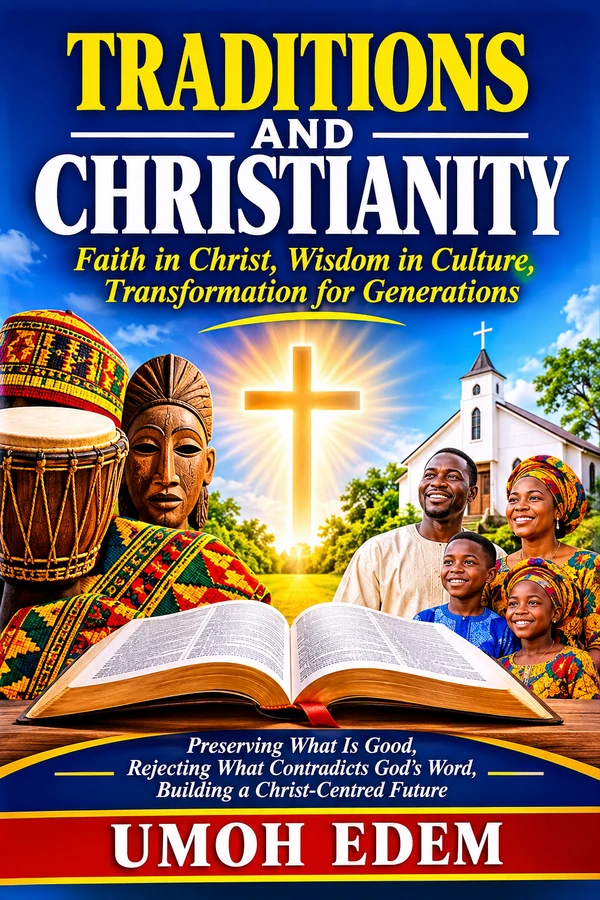
TRADITIONS AND CHRISTIANITY
About This Book
TRADITIONS AND CHRISTIANITY.
Understanding Your Cultural Heritage Without Compromising Your Faith.
**By UMOH EDEM**
Are all traditions good? Should Christians accept every custom passed down by their ancestors? Does following Jesus Christ mean abandoning your cultural identity?
These are important questions every Christian should be willing to examine.
Many people follow traditional practices simply because their parents and grandparents practised them. Some customs promote unity, respect, hospitality, and cultural identity. Others may encourage fear, superstition, idolatry, discrimination, or practices that contradict God's Word.
**TRADITIONS AND CHRISTIANITY** is a timely and thought-provoking Christian book that helps readers understand the relationship between cultural heritage and biblical faith.
WHY SHOULD YOU GET THIS BOOK?
This book will help you:
1. Understand the meaning, influence, and power of tradition.
2. Distinguish between cultural identity and idolatrous practices.
3. Examine ancestral beliefs in the light of the Lordship of Jesus Christ.
4. Understand the biblical position on traditional marriage customs, burial rites, festivals, sacrifices, and rituals.
5. Recognise how fear, superstition, and religious manipulation can influence people's decisions.
6. Honour parents and elders without disobeying God.
7. Handle family and community pressure when your Christian convictions are challenged.
8. Raise children who appreciate their cultural heritage while remaining grounded in God's Word.
9. Understand the Church's responsibility in transforming society.
10. Learn when to preserve, reform, or reject a tradition according to biblical principles.
WHO SHOULD READ THIS BOOK?
- Pastors, ministers, and Christian leaders.
- Christian parents and families.
- Young people seeking biblical understanding.
- Believers facing conflicts between family traditions and Christian convictions.
- Bible teachers, students, and Christian educators.
- Anyone interested in the relationship between African cultural heritage and Christianity.
A MESSAGE WORTH REMEMBERING.
You do not have to abandon your cultural identity to follow Jesus Christ. However, you must never allow your cultural identity to become more important than your obedience to Him.
The purpose of this book is not to encourage hatred toward culture or disrespect for our ancestors. It is to encourage biblical understanding, spiritual discernment, and the courage to distinguish between what should be preserved, what should be corrected, and what must be rejected.
**Do not follow a tradition simply because it is old. Examine it in the light of God's Word!**
GET YOUR COPY TODAY!
Invest in biblical knowledge. Strengthen your faith. Understand your heritage. Make informed spiritual decisions and help prepare the next generation.
**TRADITIONS AND CHRISTIANITY**
**AUTHOR: UMOH EDEM**
*Author • Preacher • Christian Teacher • Content Creator*
🌐 www.umohedem.com
📧 [email protected]
**READ IT. UNDERSTAND IT. APPLY BIBLICAL TRUTH.**
*Let culture preserve our identity, but let Christ transform our lives.*
This book explores the relationship between cultural traditions and Christian faith, helping readers discern which practices to embrace or reject. It provides insights into how to honor cultural heritage while remaining faithful to God's Word.
Who this book is for
- Pastors and Christian leaders
- Christian parents and families
- Young believers seeking guidance
- Bible teachers and students
- Anyone navigating cultural conflicts
What you'll learn
- Distinguish between beneficial and harmful traditions
- Examine ancestral beliefs through Scripture
- Understand the biblical view on marriage and rituals
- Navigate family pressures with confidence
- Raise children with cultural appreciation and faith
Read a free sample 9 pages from the book
TRADITIONS AND CHRISTIANITY A Revelational Book on Biblical Truth, Cultural Heritage, Spiritual Discernment, and the Christian Faith. AUTHOR: UMOH EDEM Understanding Our Cultural Heritage, Testing Every Tradition by the Word of God, and Living Out the Truth of Jesus Christ. PREFACE. Tradition is one of the strongest forces that shapes human identity. It influences how people celebrate, marry, bury their dead, raise their children, relate to their ancestors, exercise authority, and understand the world around them. Traditions are often passed from one generation to another with the expectation that they must be preserved without question. However, an important question confronts every Christian: Must everything handed down by our ancestors be accepted simply because it is traditional? Christianity calls believers to respect their heritage while remaining faithful to the Word of God. Not every tradition is evil, and not everything that is ancient is righteous. Some traditions preserve wisdom, strengthen families, promote unity, and encourage respect. Others may contradict Scripture, promote fear, encourage idolatry, or place human customs above God's commandments. Jesus Christ confronted this problem when He rebuked religious leaders who allowed their traditions to undermine the Word of God. In Mark 7:8, He said: "For laying aside the commandment of God, ye hold the tradition of men..." — Mark 7:8 (KJV) These words remain relevant today. A practice may be widely accepted by a community and still require biblical examination. Popularity does not establish truth, and age does not automatically establish righteousness. This book, Traditions and Christianity, is written to help believers, ministers, families, young people, and Christian leaders develop spiritual discernment. Its purpose is not to encourage hatred toward any culture or to condemn every traditional practice. Rather, it is to examine traditions through the light of Scripture and to encourage a Christ-centred approach to cultural identity. As Christians, we must learn to distinguish between cultural practices that can be preserved, practices that require modification, and practices that must be rejected because they conflict with the gospel. My prayer is that this book will help readers become firmly rooted in Christ, knowledgeable in the Scriptures, respectful toward people, and courageous enough to follow biblical truth even when it challenges long-established customs. May the Holy Spirit grant us wisdom to discern what is good, humility to learn, and faithfulness to obey God's Word. UMOH EDEM Author | Preacher | Christian Teacher INTRODUCTION When Culture Meets the Cross Every human society has traditions. They may be expressed through language, clothing, marriage ceremonies, burial practices, festivals, family structures, community laws, initiation rites, or beliefs about the spiritual world.
The purpose of the book and the biblical standard for examining traditions. PART ONE — UNDERSTANDING TRADITION. Chapter 1. Understanding the Meaning and Power of Tradition Chapter 2. God's Word Above Human Traditions Chapter 3. The Difference Between Culture and Idolatry Chapter 4. The Bible, Cultural Identity, and Christian Freedom PART TWO — TRADITIONS THAT CHALLENGE CHRISTIAN FAITH Chapter 5. Ancestral Beliefs and the Lordship of Jesus Christ Chapter 6. Traditional Marriage Customs and Biblical Marriage Chapter 7. Burial Rites, Mourning, and the Christian Hope Chapter 8. Festivals, Sacrifices, Oaths, and Ritual Practices Chapter 9. Fear, Spiritual Bondage, and Religious Manipulation PART THREE — LIVING AS A CHRISTIAN IN A TRADITIONAL SOCIETY Chapter 10. Honouring Parents Without Disobeying God Chapter 11. Family Pressure and the Courage to Stand for Christ Chapter 12. Raising Children Between Culture and Christianity Chapter 13. The Church's Responsibility in Cultural Transformation Chapter 14. How to Evaluate, Preserve, Reform, or Reject a Tradition Chapter 15. Christ, Culture, and the Transformation of Generations Conclusion: Let Every Tradition Be Tested by Truth Deep Spiritual Insights Questions for Personal and Group Reflection Prayer Points About the Author — UMOH EDEM CHAPTER ONE UNDERSTANDING THE MEANING AND POWER OF TRADITION ### How Inherited Beliefs Shape Our Lives, Families, Communities, and Faith. ### 1.1 Introduction: The Invisible Power of Tradition Every society has traditions. Every family has practices that have been passed down from one generation to another. Every community has beliefs, customs, ceremonies, and expectations that influence how people live, think, worship, marry, mourn, and relate to one another. Some traditions are so deeply rooted in people's lives that they rarely question them. They grow up observing certain practices, accept them as normal, and
eventually pass them on to their children without investigating their origins or understanding their implications. A child may grow up hearing, "This is how our people do it." As the child matures, the statement becomes an unquestionable rule. Eventually, the person may defend the tradition even without knowing why it began. This reveals one of the most powerful characteristics of tradition: it can influence people's decisions long before they develop the courage to examine its meaning. Tradition can preserve wisdom, strengthen relationships, and provide a sense of belonging. It can also preserve error, encourage harmful practices, and create unnecessary fear when people believe that questioning an inherited custom is an act of rebellion. For Christians, the question is not simply whether a tradition is old, popular, or respected. The more important question is whether it agrees with the truth of God's Word. The Bible teaches in 1 Thessalonians 5:21: > "Prove all things; hold fast that which is good." — 1 Thessalonians 5:21 (KJV) This instruction establishes a vital principle for Christian living. We must examine what we receive, retain what is good, and refuse to follow practices that contradict God's truth. A mature Christian does not blindly accept every tradition, nor does the Christian reject everything simply because it comes from an earlier generation. Instead, the believer develops spiritual discernment. ### 1.2 What Is Tradition? Tradition can be defined as a belief, custom, practice, value, or ceremony transmitted from one generation to another. Traditions may be cultural, social, religious, familial, or national. They influence how people celebrate important events, establish relationships, exercise authority, and understand their place in society. Consider the following examples: * A family gathers every year to remember its history. * A community welcomes visitors with traditional food and hospitality. * Parents teach their children to respect elderly people. * Families follow established customs during marriage negotiations. * Communities organise ceremonies when a member dies. * Religious groups maintain rituals that have been practised for generations. These examples do not all have the same spiritual meaning. Some express cultural identity or social responsibility. Others may involve religious beliefs that require closer biblical examination. Therefore, the word "tradition" alone does not tell us whether a practice is right or wrong. Its meaning, purpose, and implications must be understood. A Christian who fails to make this distinction may condemn good cultural practices unnecessarily or accept harmful practices without careful examination.
### 1.3 How Traditions Gain Power Over People Traditions rarely survive for generations through written rules alone. They are often sustained by family expectations, community approval, emotional attachment, fear of rejection, and the desire to belong. Several factors contribute to their influence. ### A. Family upbringing The family is one of the first places where human beings learn what is considered acceptable. Children observe their parents and imitate their behaviour. They learn how to speak, what to respect, which ceremonies to attend, and how to respond to community expectations. When a practice is repeatedly presented as the only acceptable way to behave, children may grow up believing that questioning it is wrong. Proverbs 22:6 teaches the importance of training a child in the right way. Although this verse does not specifically command the preservation of every inherited custom, it highlights the lasting influence of upbringing. Parents therefore have a responsibility to teach wisely. They should not merely transmit practices; they should help children understand the values, reasons, and consequences behind them. ### B. Community pressure Human beings naturally desire acceptance. Nobody wants to be treated as an outsider, particularly within a community where family identity and social relationships are important. Consequently, a person may participate in a practice not because of personal conviction but because of fear of criticism. Someone might say, "I do not really understand this ceremony, but if I refuse to participate, my relatives will accuse me of disrespecting them." This is where tradition can become a source of pressure rather than a meaningful expression of culture. Romans 12:2 warns believers against conforming uncritically to the patterns of the world. The passage encourages transformation through the renewing of the mind. Christians must learn to distinguish between what people expect and what God requires. ### C. Fear of consequences Some traditions are maintained through warnings that disobedience will bring misfortune, sickness, poverty, family division, or spiritual punishment. Such claims can create deep anxiety, especially when people have been exposed to them from childhood. However, a threat does not become true simply because it has been repeated for many years. Christians should examine spiritual claims carefully, avoid spreading unverified accusations, and seek sound biblical counsel when troubled by such matters.
Second Timothy 1:7 reminds believers that God gives a spirit of power, love, and a sound mind. This does not mean Christians will never experience fear. It means fear should not replace truth, wisdom, and responsible judgment. ### D. Respect for elders and ancestors Many cultures rightly value the wisdom and experience of older people. Elders often preserve family history, settle disputes, and guide younger generations. However, respect must not become unquestioning obedience. Elders can be wise, but they are still human beings. They can make mistakes, misunderstand a situation, or defend a practice simply because they inherited it. The Bible commands honour for parents and teaches respect for others. It does not establish every human tradition as an unquestionable command from God. Acts 5:29 provides a clear principle: > "We ought to obey God rather than men." — Acts 5:29 (KJV) When a human demand directly contradicts God's will, the believer must remain faithful to God while seeking to respond with humility and respect. ### 1.4 Not Every Tradition Is Evil One of the mistakes Christians must avoid is assuming that every traditional practice is spiritually dangerous. Such an approach can create unnecessary conflict between Christianity and cultural identity. Many traditions encourage values consistent with biblical teaching. Hospitality, care for elderly relatives, support for grieving families, community cooperation, respect for parents, and the preservation of history can contribute positively to society. Hebrews 13:2 encourages hospitality, while Romans 12:10 teaches believers to show honour to one another. These biblical values may be expressed through different cultural practices in different communities. For example, a community may demonstrate hospitality by preparing traditional meals for visitors. Another may express it by offering accommodation or assisting strangers with transportation. The outward expressions differ, but the underlying value of welcoming others can be consistent with Christian faith. Similarly, traditional clothing, local languages, cultural music, storytelling, and community celebrations are not automatically sinful. The important question is whether a particular practice involves something contrary to Christian conviction or biblical morality. Deep revelation: God does not require every nation to lose its cultural identity before its people can follow Christ. The gospel calls people from every nation to worship God faithfully while submitting their lives to His truth.
Revelation 7:9 presents a vision of people from every nation, tribe, people, and language standing before God's throne. This reminds us that cultural diversity and Christian faith are not inherently incompatible. ### 1.5 When Tradition Becomes Dangerous Tradition becomes spiritually or morally dangerous when it is used to justify conduct that contradicts God's truth or harms human beings. The following situations require careful attention. ### A. When tradition is placed above Scripture Jesus confronted religious leaders who allowed their traditions to undermine God's commandments. Mark 7:8 records His words: > "For laying aside the commandment of God, ye hold the tradition of men..." — Mark 7:8 (KJV) In the surrounding passage, Jesus addresses practices through which religious leaders avoided the responsibilities God had commanded them to fulfil. His criticism reveals that religious activity does not automatically make a practice righteous. A custom may be widely respected and still be wrong if it encourages disobedience to God. ### B. When tradition promotes injustice A practice must be examined if it humiliates widows, exploits children, denies people dignity, encourages forced marriage, or imposes harmful obligations on vulnerable members of society. The claim that "this is our culture" does not remove the need for moral responsibility. James 1:27 highlights care for orphans and widows in their distress as an important expression of pure religion. Christianity must therefore be concerned not only with ceremonies but also with how people are treated. ### C. When tradition creates spiritual fear Some individuals live under constant anxiety because they believe their family history makes them permanently vulnerable to supernatural punishment. Christians should not dismiss every person's concern without listening. Nevertheless, neither should they automatically affirm every claim about ancestral curses or spiritual retaliation. The Bible teaches both personal moral responsibility and the sufficiency of God's grace. Ezekiel 18:20, for example, emphasises that a child does not automatically bear the guilt of a parent's sin. Family patterns can influence later generations, but they can also be confronted through repentance, accountability, wise decisions, and transformed behaviour. A believer should not assume that every personal difficulty is caused by an
ancestral covenant. ### D. When people are forbidden to ask questions One of the warning signs of unhealthy traditional authority is the insistence that no one may ask what a practice means or why it is performed. Questions are not automatically rebellion. They can be a responsible part of learning and discernment. Proverbs 18:13 warns against answering a matter before hearing it fully. The principle encourages careful understanding rather than premature judgment. A healthy community should be able to explain its practices honestly and discuss legitimate concerns without relying on threats or intimidation. ### 1.6 Jesus Christ and the Problem of Human Tradition Jesus did not oppose every established custom. He challenged traditions when they conflicted with God's purposes. In Mark 7:1–13, religious leaders questioned Jesus' disciples about their failure to observe a particular handwashing tradition. Jesus responded by exposing a deeper problem: some religious practices had become more important to the leaders than the moral responsibilities God had commanded. The lesson is profound. People can become so committed to preserving religious customs that they neglect justice, mercy, obedience, and love. A person may defend a ceremony passionately while ignoring the suffering of a neighbour. Another may insist on outward religious purity while practising dishonesty or mistreating family members. Jesus directs attention beyond appearances to the condition of the heart and the obedience of one's life. This principle remains relevant to the relationship between traditions and Christianity today. A Christian should ask: * Does this practice honour God? * Does it agree with the teaching of Scripture? * Does it promote truth and righteousness? * Does it treat people with dignity? * Does it require spiritual allegiance contrary to faith in Christ? These questions help believers examine traditions without becoming hostile toward their communities. ### 1.7 The Difference Between Inheritance and Personal Conviction One of the greatest responsibilities of Christian maturity is learning to distinguish between what we inherited and what we genuinely believe. A person may inherit a belief from parents without ever examining it. The belief
may remain part of the person's thinking for years simply because it is familiar. But familiarity is not the same as truth. Consider a young Christian who is told that a particular family ceremony must be performed because previous generations have always done it. The young Christian asks what the ceremony means and discovers that it involves an act of worship contrary to the person's Christian convictions. The individual now faces a decision. Should the person participate simply because the practice is old? Or should the person examine the practice, explain the concern respectfully, and seek an alternative? The biblical principle is that inherited customs must not replace personal responsibility before God. Romans 14:12 teaches that each person will give an account of himself to God. Christian maturity therefore requires more than repeating what others have taught us. It requires a growing understanding of Scripture and a willingness to live according to its truth. ### 1.8 A Practical Biblical Test for Every Tradition Before accepting or rejecting a tradition, consider the following five questions. 1\. What does the tradition mean? Understand its purpose, history, and actual practice before drawing conclusions. 2\. What does Scripture teach about the issue? Read relevant passages in context. Do not rely on isolated verses or rumours. 3\. Does the practice involve worship or spiritual allegiance? Determine whether the practice is simply cultural or requires religious participation that conflicts with Christian faith. 4\. What effect does the practice have on people? Consider whether it promotes dignity, justice, love, and responsibility or causes coercion, exploitation, and unnecessary suffering. 5\. Can the good purpose be preserved in a better way? Some customs can be modified without losing their positive cultural value. Others may need to be rejected entirely if they require wrongdoing. First Thessalonians 5:21 provides the guiding principle: test everything and hold on to what is good. ### 1.9 Biblical Case Study: Daniel's Conviction in a Foreign Culture Daniel 1 provides a helpful example of maintaining conviction within a different cultural environment. Daniel and his companions were taken into Babylonian captivity and placed within a system that sought to train them according to the expectations of the royal court.
Daniel 1:8 says: > "But Daniel purposed in his heart that he would not defile himself..." — Daniel 1:8 (KJV) Daniel did not respond by becoming careless about his convictions. Neither did he begin by insulting everyone around him. He communicated his concern and sought permission for an alternative arrangement. The narrative describes how he and his companions were tested and how God enabled them to prosper in their learning. Although Daniel's immediate situation concerned the royal food and wine, rather than African ancestral traditions, the account illustrates a transferable principle: faithfulness to God can require resisting certain expectations while exercising wisdom in how we respond. Christians who face pressure to participate in questionable customs can learn from Daniel's example. They should understand the issue, remain firm in their convictions, communicate respectfully, and seek a responsible way forward. ### 1.10 Practical Lessons for Christians Today The…
End of sample. The full book is 182 pages on Afri KDP.
Questions about this book
How can I balance my cultural traditions with my Christian faith?
This book provides guidance on examining traditions in light of Scripture, allowing you to honor your heritage while prioritizing obedience to God.
Loading reviews...

Loading…
A download link appears on this page as soon as your payment is confirmed, and a permanent copy of the link is emailed to you.
By card from anywhere. In Nigeria you can also pay by bank transfer, USSD or mobile money. Your card details are entered on Paystack's secure page, never on AfriKDP.
Yes. The file opens on phones, tablets, computers and eReaders.
Yes, with an AfriKDP reading plan, which opens every book in the online reader and pays the author for every page you read.
Write to [email protected] with your email address and we will help. See our return policy.