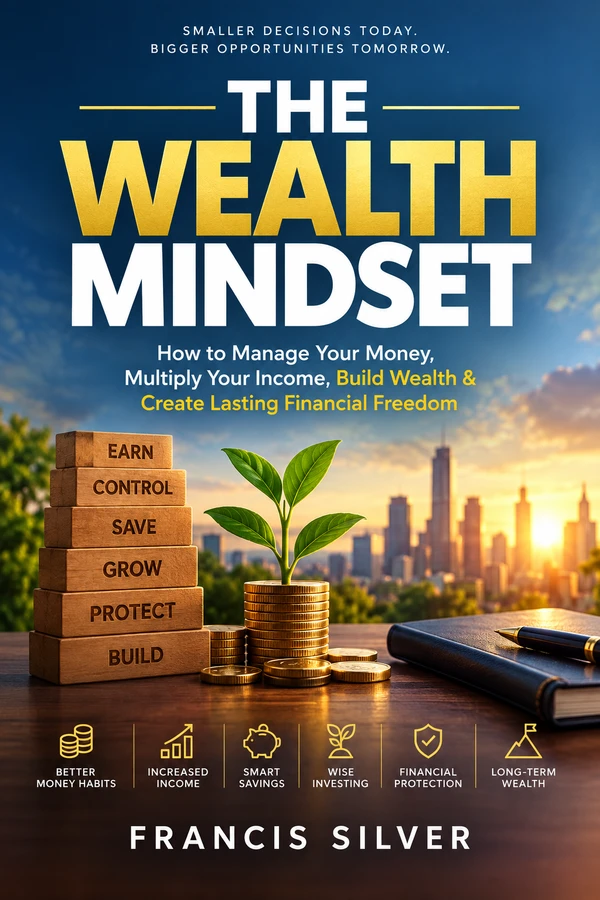
The wealth mindset
About This Book
They stay stuck because they never learn how to turn the money they already earn into lasting strength.
THE WEALTH MINDSET is a practical 30-chapter guide for anyone who wants to stop living from payday to payday and start building real financial capacity — without waiting for a perfect income or a miracle opportunity.
Francis Silver takes you through a clear, step-by-step system that covers:
How to change your relationship with money
Why earning more is not enough if your system is weak
How to stop the payday-to-payday cycle
Building a simple budget that actually works
Saving even when your income is small
Creating an emergency fund that protects you
- Turning skills into income and building side streams
- Understanding assets, investing, and compound growth
- Creating recurring income and reinvesting with discipline
- Protecting what you build from lifestyle pressure and poor decisions
- Designing your 5-year vision and a practical 12-month wealth-building plan
This book is written for real life. It uses clear Nigerian Naira examples with approximate US Dollar equivalents so the lessons remain useful whether you live in Nigeria or anywhere else in the world. The focus is not on get-rich-quick schemes. It is becoming harder to destabilize, better at earning, better at managing, and better at building over time.
If you are tired of working hard and still feeling financially exposed, this book gives you a complete system you can start using immediately — from the money you have today.
Start where you are.
Use what you have.
Build with intention.
That is the wealth mindset.
In The Wealth Mindset, Francis Silver provides a practical guide to achieving financial stability and growth. Through 30 chapters, readers learn to manage their money effectively, build savings, and create multiple income streams.
Who this book is for
- Individuals living paycheck to paycheck
- Beginners seeking financial freedom
- Anyone wanting to improve money management skills
- People interested in building wealth gradually
What you'll learn
- How to change your relationship with money
- The importance of budgeting and saving
- Ways to create emergency funds
- Strategies for building multiple income streams
- Understanding assets and investments
- How to design a personal wealth-building plan
Read a free sample 8 pages from the book
THE WEALTH MINDSET Build Financial Strength from the Money You Have Today
Francis Silver
Disclaimer This book is for educational and informational purposes only. It does not constitute financial, investment, tax, or legal advice. All ₦ amounts include approximate USD equivalents based on a consistent rate of roughly ₦1,330 = $1 (as of September 2026). Exchange rates fluctuate. Readers should consult qualified professionals before making financial decisions.
Introduction Chapter 1 – Your Relationship With Money Chapter 2 – Why Earning More Isn’t Enough Chapter 3 – Stop Living From Payday to Payday Chapter 4 – Think Like a Wealth Builder Chapter 5 – Give Your Money a Purpose Chapter 6 – Know Where Your Money Goes Chapter 7 – Build a Simple Budget Chapter 8 – Needs, Wants and Lifestyle Inflation Chapter 9 – How to Save When Your Income Is Small Chapter 10 – Building Your Emergency Fund Chapter 11 – Your Ability to Earn Is an Asset Chapter 12 – Turn Your Skills Into Income Chapter 13 – Building a Side Income Chapter 14 – Multiple Income Streams Chapter 15 – From Side Hustle to Business Chapter 16 – What Is an Asset? Chapter 17 – Understanding Investing Chapter 18 – The Power of Compound Growth Chapter 19 – Risk, Patience and Long-Term Thinking Chapter 20 – Putting Your Money to Work Chapter 21 – What Financial Freedom Really Means
Chapter 22 – Building Income-Producing Assets Chapter 23 – Creating Recurring Income Chapter 24 – Reinvesting Instead of Consuming Everything Chapter 25 – Protecting What You Build Chapter 26 – Stop Chasing Quick Riches Chapter 27 – Your 5-Year Financial Vision Chapter 28 – Your Personal Wealth-Building System Chapter 29 – The 30-Day Money Reset Chapter 30 – Your 12-Month Wealth-Building Plan Conclusion
Introduction
Most people want a better financial life. They want more stability, more options, and less pressure. Yet many remain stuck in the same cycle: earn, spend, wait for the next payday, and repeat.
This book is not about getting rich overnight. It is about changing the way you relate to money so that the income you already have — and the income you will create — begins to serve your future instead of disappearing into the present.
You will learn how to manage what you have, increase what you earn, protect what you build, and gradually turn ordinary financial decisions into lasting strength. The examples use Nigerian Naira (₦) with approximate US Dollar equivalents so the principles remain clear whether you live in Nigeria or anywhere else in the world.
Start where you are. Use what you have. Build from there.
That is the wealth mindset.
Chapter 1 Your Relationship With Money
Money is more than the amount sitting in your bank account. It is connected to the way you think, the choices you make, the habits you repeat, and the future you are preparing for.
Two people can earn the same amount of money and experience completely different financial lives. One may spend everything that comes in, constantly waiting for the next payday. The other may use that same income to cover necessities, save a portion, develop valuable skills, create additional income, and gradually build assets.
The difference is not always how much they earn. Sometimes the difference is how they relate to money.
Money Is a Tool, Not the Destination
Money itself is not the final goal. Money is a tool that can help you create options. It can help you pay for your needs, prepare for emergencies, support people you care about, develop your skills, build a business, invest for the future, and create greater freedom in the decisions you make.
But a tool is only useful when you know how to use it.
A person can earn a large income and still have little financial security if every increase in income is immediately followed by an increase in spending. Another person can start with a modest income and gradually become financially stronger by learning how to manage what they have, increase their earning ability, and consistently direct part of their money toward future goals.
This is why your financial journey should not begin with the question: “How can I become rich quickly?”
A better question is: “How can I become better at managing, growing and protecting money?”
That question changes everything.
Your First Financial Education Happens Through Your Habits
You may have never taken a formal class on money, but you have probably already learned financial habits from somewhere.
Perhaps you watched how your parents handled money. Perhaps you learned from friends. Perhaps your environment taught you that money disappears as soon as you receive it. Maybe you learned to spend first and think about tomorrow later. Or perhaps you learned to save every coin because you grew up watching people struggle when unexpected expenses appeared.
Whatever your background, one important truth remains: You can learn new financial habits. Your past does not have to become your financial future.
If you grew up without learning how to budget, you can learn. If you have never saved consistently, you can begin.
If you have always depended on one source of income, you can develop another skill. If you have made poor financial decisions, you can learn from them without allowing them to define the rest of your life.
Financial growth begins when you become willing to learn.
Earning Money and Building Wealth Are Not the Same Thing
Getting paid is important. But income alone does not automatically create wealth.
Imagine someone receives a salary increase. Instead of saving or investing any of the additional money, they immediately upgrade their phone, move into a more expensive apartment, increase entertainment spending, and take on new financial obligations.
Their income increased. But their financial position may not have improved much.
Now imagine another person receives the same increase. They improve their lifestyle slightly, but they also increase their savings, develop a valuable skill, and begin putting some money toward long-term financial goals.
Both people earned more. But they gave the additional money different jobs.
This is why wealth-building requires more than earning. You need to learn how to direct money intentionally.
Give Every Amount of Money a Job
When money enters your hands, it should not immediately disappear without a plan.
Before you spend, ask: What is this money supposed to accomplish?
Some of it may need to take care of today’s necessities. Some may need to go toward savings. Some may be used to develop your skills or business. Some may eventually be directed toward investments or other long-term assets.
The exact percentages will differ from person to person because everyone’s income, responsibilities, and circumstances are different.
The important principle is this:
Don’t let your spending decisions happen entirely by accident.
A financial plan does not need to be complicated. Even a simple plan can create awareness.
For example: Income → Necessities → Savings → Growth → Personal spending
The proportions can change as your circumstances change. What matters is that you know where your money is going.
Don’t Let Lifestyle Consume Your Progress
One of the easiest ways to remain financially stuck is to increase your spending every time your income increases.
You earn more. You spend more. You earn more again. You upgrade again.
Eventually you may discover that although your income is much higher than it was years ago, you still feel like you are struggling.
This is sometimes called lifestyle inflation.
There is nothing wrong with enjoying the rewards of your hard work. The problem comes when every increase in income is immediately converted into additional expenses.
Financial progress becomes easier when your income can grow faster than your lifestyle. That creates room — room to save, room to invest, room to build, room to handle unexpected situations, and room to pursue opportunities.
Stop Comparing Your Financial Journey
Someone else’s lifestyle can make you feel poor even when you are making progress.
You see a new car. A beautiful house. An expensive vacation. A successful business. A luxury phone. A large social-media following.
But you rarely see the complete financial picture behind the appearance.
You don’t know their obligations, debts, income, savings, investments, or private struggles. Comparison can push people into spending money they cannot comfortably afford simply to look successful.
Don’t build your financial life for an audience. Build it for your future.
Your goal is not to look wealthy today while sacrificing tomorrow. Your goal is to become financially stronger over time.
Your Financial Future Is Built in Small Decisions
Wealth-building can sound like something reserved for people with large salaries, successful businesses, or significant amounts of capital. But many financial improvements begin with ordinary decisions:
- Tracking your spending - Saving before spending everything - Learning a valuable skill - Avoiding unnecessary debt - Starting a small side income - Reading about investing before putting money into an investment - Reinvesting part of a business profit - Resisting an unnecessary purchase - Planning for a future expense instead of waiting until it becomes an emergency
None of these decisions may look dramatic. But repeated over years, small decisions can produce very different outcomes.
Your financial life is not created in one day. It is created through repeated choices.
The Wealth-Building Mindset
A wealth-building mindset does not mean believing that you will become rich simply because you think positively. It means developing a different relationship with money.
Instead of asking “What can I buy?” you sometimes ask “What can this money help me build?”
Instead of asking “How quickly can I become wealthy?” you ask “What financial system can I build that becomes stronger over time?”
Instead of thinking only about today’s income, you begin thinking about your earning ability five years from now. Instead of spending every increase, you consider whether part of it can strengthen your future.
That is the beginning of financial maturity.
Your First Assignment
Before moving to the next chapter, take a piece of paper or open the notes app on your phone and answer these questions honestly:
1. How much money comes into my hands in an average month? 2. Where does most of it go? 3. What expenses could I reduce without harming my essential needs? 4. Do I currently save consistently? 5. Do I have more than one source of income? 6. What valuable skill could increase my earning ability? 7. What financial goal do I want to accomplish within the next 12 months? 8. What financial goal do I want to accomplish within the next five years?
Don’t worry if your answers are not impressive. This exercise is not about judging where you are. It is about discovering where you are starting from.
You cannot create a useful financial plan without first understanding your current position.
The Decision That Changes the Journey
You may not be able to control every financial circumstance that comes your way. You may not control the economy. You may not control every opportunity that appears. You may not control unexpected expenses.
But you can improve your financial knowledge. You can learn to manage what you have. You can work on increasing your earning ability. You can develop better habits. You can make plans. You can become more intentional with your money.
And that is where your journey begins.
End of sample. The full book is 158 pages on Afri KDP.
Questions about this book
What if I have a low income?
This book emphasizes that financial strength can be built regardless of income level by learning to manage what you have and making intentional financial decisions.
Loading reviews...
Loading…
A download link appears on this page as soon as your payment is confirmed, and a permanent copy of the link is emailed to you.
By card from anywhere. In Nigeria you can also pay by bank transfer, USSD or mobile money. Your card details are entered on Paystack's secure page, never on AfriKDP.
Yes. The file opens on phones, tablets, computers and eReaders.
Yes, with an AfriKDP reading plan, which opens every book in the online reader and pays the author for every page you read.
Write to [email protected] with your email address and we will help. See our return policy.