 AfriKDP
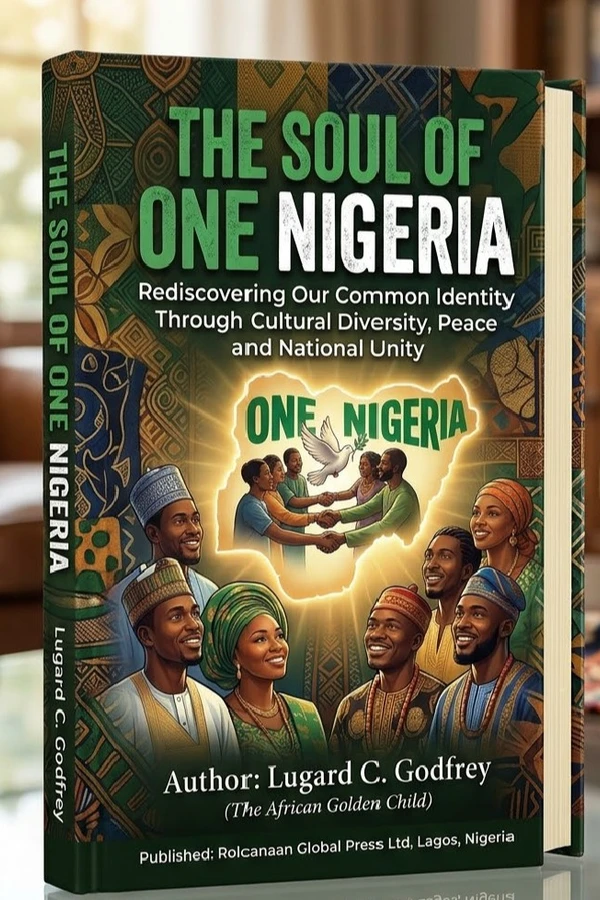
The Soul of One Nigeria
About This Book
In The Soul of One Nigeria, Authored by: Lugard C. Godfrey
The Africa Golden Child.
confronts this dangerous myth head-on, dismantling the narrative of national despair and replacing it with a brilliant, historically grounded, and deeply hopeful vision of unity in diversity.
this landmark work takes readers on an extraordinary journey through time, from the ancient terracotta sculptors of Nok and the thriving Sahelian trade hubs of Kano and Katsina, to the sacred crown of Ile-Ife, the republican village councils of Igboland, and the millennial majesty of the Kanem-Borno Empire.
Rather than viewing Nigeria’s incredible diversity as a weakness, Godfrey presents the nation as a mosaic, a breathtaking picture composed of distinct pieces, each with its own unique colour, texture, and brilliance, harmoniously arranged into a shared civic nationality!
'The Soul of One Nigeria' challenges the myth of Nigeria as a colonial contraption, presenting a narrative of unity through its diverse cultures and histories. The book takes readers on a historical journey, showcasing ancient civilizations and their interconnectedness, ultimately advocating for a shared national identity.
Who this book is for
- Students of Nigerian history
- Cultural enthusiasts
- Political science scholars
- Advocates for national unity
- Readers interested in African heritage
What you'll learn
- The historical foundations of Nigeria
- The significance of ancient civilizations
- The impact of colonialism on unity
- The philosophy of unity in diversity
- Cultural contributions of various ethnic groups
Read a free sample 8 pages from the book
THE SOUL OF ONE NIGERIA Rediscovering Our Common Identity Through Cultural Diversity, Peace and National Unity L U G A R D C . G O D F R E Y (The African Golden Child)
THE SOUL OF ONE NIGERIA Rediscovering Our Common Identity Through Cultural Diversity, Peace and National Unity Lugard C. Godfrey (The African Golden Child) Published: Rolcanaan Global Press Ltd, Lagos, Nigeria
C O N T E N T S PART ONE: THE FOUNDATIONS OF A MULTICULTURAL NATION1 1The Land Before Nigeria , A Mosaic of Ancient Civilisations2 2The Nok Culture and the Earliest Nigerians8 3The Trans-Saharan Crucible – Trade, Ideas, and the Rise of the Sahel11 4The Forest and the River – The Civilisations of the South14 5The 1914 Amalgamation – The Birth of a Nation by Decree17 6The Colonial Legacy – “Divide and Rule” and the Roots of Disunity19 7The First Republic – The Promise and the Pitfalls of Independence21 8One Geographical Home, Many Cultural Identities – The Philosophy of Unity in Diversity23 PART TWO: THE HAUSA – A HERITAGE OF HISTORY, COMMERCE, AND FAITH 25 9The Bayajidda Legend and the Seven Hausa States (Hausa Bakwai)26 10Kano – The Commercial Capital of the Sahel29 11Katsina, Zazzau, and the Legacy of Queen Amina32 12The Sokoto Caliphate and the 19th-Century Jihad35 13Hausa Islamic Scholarship and the Written Word38 14Hausa Proverbs, Poetry, and Philosophy – The Wisdom of the Ancestors40 PART THREE: THE IGBO – A HERITAGE OF ENTERPRISE, REPUBLICANISM, AND RESILIENCE43 15The Igbo-Ukwu Bronzes and the Antiquity of Igbo Civilisation44 16The Kingdom of Nri – The Sacred Centre of Igboland47 17The Igbo Village Republic – Decentralised Democracy and the Philosophy of Igwebuike50 18The Igbo Apprenticeship System (Igba-boi) – An Indigenous Model of Wealth Creation53 19The Aro Confederacy and the Oracle of Arochukwu56 20Igbo Art, Music, and the Resilience of Culture58 PART FOUR: THE YORUBA – A HERITAGE OF WISDOM, CIVILISATION, AND DIVINE KINGSHIP60 21Ile-Ife – The Cradle of Yoruba Civilisation and the Myth of Oduduwa61 22The Oyo Empire – The Rise of an Imperial Power64 23Ifa Divination – A System of Philosophy, Ethics, and Knowledge66 24Yoruba Art and Bronze Casting – The Ife and Benin Heads68 25The Oyo Mesi and the Balance of Power – Yoruba Political Thought70 26Yoruba Proverbs, Ifa Poetry, and the Philosophy of Omoluabi72 PART FIVE: THE FORGOTTEN VOICES – THE MINORITY COMMUNITIES OF NIGERIA 74 27The Kanuri and the Ancient Borno Empire75 28The Tiv – The “Black Byzantium” of the Middle Belt77
29The Ijaw – Masters of the Niger Delta79 30The Edo and the Great Benin Kingdom81 31The Efik and Ibibio – The Cross River Civilisation83 32The Nupe – The “Black Byzantium” of the Niger-Benue Confluence85 33The Gbagyi (Gwari) – The Original Inhabitants of the Federal Capital Territory 87 34The Middle Belt Mosaic – The Berom, Idoma, and Other Communities89 PART SIX: THE WOUNDS THAT THREATEN OUR UNITY91 35When Ethnicity Becomes a Weapon – The Psychology of Prejudice92 36The Nigerian Civil War – The Road to Conflict (1966–1967)94 37The Nigerian Civil War – The Human Cost and the Lessons (1967–1970)96 38The Wounds of Historical Distrust – From the Kano Riots to the Present98 39The Politics of Division – How Ethnicity is Weaponised for Power100 40The Danger of Ethnic Superiority – Challenging the Myth of “Born to Rule” 102 41The Burden of Stereotypes – A Practical Guide to Challenging Prejudice104 42The Cost of Disunity – How Division Undermines Security and Development 106 PART SEVEN: THE MUSIC, CULTURE, AND PHILOSOPHY OF ONE NIGERIA108 43When Music Spoke the Language of One Nigeria – The “Unity Music” Tradition 109 44Sonny Okosun – Which Way Nigeria? and the Prophetic Voice112 45Onyeka Onwenu – One Love and the Elegant Stallion of Unity115 46King Sunny Adé – The Way Forward and the Ethic of Harmony117 47Fela Anikulapo-Kuti – The Struggle for Justice and Human Dignity119 48The Golden Era – Other Voices of National Consciousness122 49The Philosophy of Humanity – Ubuntu, Omoluabi, and the Common Good 124 50Equity Before Unity – The Foundation of Lasting Peace127 PART EIGHT: THE NIGERIA WE MUST BUILD130 51One Country, Equal Citizenship – Beyond the Indigene/Settler Divide131 52Political Leadership and the Responsibility of National Unity134 53Economic Cooperation Across Ethnic Boundaries136 54The Nigerian Youth – Custodians of Tomorrow138 55Education for National Integration – A New Curriculum for a New Nigeria 140 56The Media and National Peace – Combating Hate Speech and Misinformation 142 57Rebuilding Trust – Practical Steps for Individuals and Communities144 58A New National Consciousness – Forging a Shared Narrative of Destiny146 59The Giant of Africa – Our Responsibility to the Continent and the World148 60One Nation, Many Roots, One Shared Destiny – A Final Declaration150
P A R T O N E THE FOUNDATIONS OF A MULTICULTURAL NATION Understanding the ancient roots and the making of Nigeria. 1
C H A P T E R 1 The Land Before Nigeria , A Mosaic of Ancient Civilisations There is a persistent and dangerous myth that Nigeria is an artificial country—a mere colonial contraption with no historical legitimacy. This myth, often repeated in casual conversation and sometimes in serious political discourse, holds that before the British arrived, the peoples who would become Nigerians had nothing in common; that they were strangers forced into a single house by a foreign landlord; that the country has no soul of its own. This myth is not only false. It is a weapon. It is the intellectual foundation upon which ethnic division, secessionist agitation, and national despair are built. And like all weapons, it must be confronted, examined, and dismantled. The truth is far more beautiful and far more hopeful. The land that would become Nigeria was not an empty stage waiting for European actors. It was a vibrant, teeming, sophisticated world of ancient civilisations—kingdoms, empires, city-states, and republics—each with its own political systems, economies, spiritual traditions, and artistic achievements. These civilisations traded with one another. They fought with one another. They intermarried. They influenced one another. They were not isolated islands. They were part of a complex, interconnected continental network that stretched from the Sahel to the forest belt, from the Niger Delta to the shores of Lake Chad. To understand Nigeria, we must first understand the world that existed before Nigeria. We must travel back in time, before the British flag was raised, before the boundaries were drawn, before the name “Nigeria” was even invented. 2
The Savanna Civilisations of the North In the vast savanna belt that stretches across the northern portion of what is now Nigeria, the Hausa city-states emerged as early as the 11th century CE. These were not primitive settlements. They were walled cities—Kano, Katsina, Zazzau, Gobir, Daura, Rano, and Biram—each governed by a king (Sarki) and supported by a sophisticated economy based on agriculture, craft production, and trans-Saharan trade. The Kano Chronicle, a written record of the city’s rulers, lists kings who reigned for centuries before European contact. The Hausa city-states were part of a wider commercial network that connected them to the Kanem-Borno Empire around Lake Chad, to the great empires of Mali and Songhai to the west, and to the Islamic world of North Africa and the Mediterranean. Goods from Kano—leather, textiles, and agricultural produce—were exchanged for salt, horses, and books from the Sahara. Along with goods came ideas. Islam arrived in the region as early as the 11th century, and by the 14th century, Kano had become a centre of Islamic scholarship, attracting students and jurists from across West Africa. The Empires of the Lake Chad Basin To the east, the Kanem-Borno Empire rose to prominence as one of the longest-lasting political entities in African history. Founded by the Sayfawa dynasty in approximately 774 CE, the empire endured for over a millennium. At its height, it controlled a vast territory encompassing parts of modern-day Nigeria, Chad, Niger, and Cameroon. The rulers of Kanem-Borno adopted Islam in the 11th century and established diplomatic relations with the sultans of Egypt and the kings of Morocco. The empire’s greatest ruler, Mai Idris Alooma (r. 1571–1603), is remembered for his military innovations, including the introduction of firearms and the recruitment of Turkish military instructors. He was also a devout Muslim who undertook the pilgrimage to Mecca and built mosques across the empire. Under his rule, Kanem-Borno became a 3
centre of Islamic learning, producing scholars, jurists, and poets whose works are still studied today. The Forest Kingdoms of the Southwest In the forest belt to the southwest, the Yoruba developed a civilisation of extraordinary sophistication. The sacred city of Ile-Ife is regarded by the Yoruba as the place where Oduduwa, the progenitor of the Yoruba people, descended from the heavens to create the earth. Archaeological evidence confirms that Ife was a flourishing urban centre by the 11th century CE, with a complex society, specialised crafts, and a remarkable artistic tradition. The naturalistic bronze and terracotta heads of Ife, discovered in the 20th century, astonished the world. Their delicate modelling, their idealised features, and their technical mastery challenged the racist assumption that African art was primitive or derivative. These are masterpieces of world art, created by African hands, in African cities, centuries before European contact. From Ife, the Yoruba civilisation spread outward. The Oyo Empire rose to dominance in the 17th century, becoming a major military power with a cavalry-based army and a sophisticated administrative system. The Oyo Mesi, a council of seven elders, provided a system of checks and balances on the power of the Alaafin (king), reflecting a deep Yoruba commitment to constitutional governance. The Republican Societies of the Southeast In the southeast, the Igbo developed a very different but equally sophisticated form of social organisation. The Igbo had no kings. Their society was organised around councils of elders, age-grade systems, title societies, and women’s institutions. Decisions were made through deliberation and consensus. This was not a lack of political organisation —it was a different form of political genius. 4
The Kingdom of Nri, one of the oldest states in Nigeria, exercised influence through ritual authority rather than military might. The Eze Nri was a priest-king who performed rituals to cleanse the land and maintain harmony. Nri’s itinerant ritual specialists spread the Ozo title system and a distinctive cultural order across Igboland. The Igbo-Ukwu archaeological site, dated to the 9th century CE, reveals a culture of extraordinary artistic and technical achievement. The bronze and copper artefacts found there—elaborate pendants, chieftaincy paraphernalia, and over 100,000 beads—demonstrate a sophisticated understanding of metalworking and a complex symbolic culture. The River Civilisations of the Delta and Cross River Along the Niger Delta, the Ijaw (Izon) people developed the House System—a network of trading corporations that dominated the region’s commerce. The Ijaw had a deep spiritual connection to the water and the environment, and their traditional livelihoods of fishing and trade were central to their identity. To the east, the Efik and Ibibio peoples of the Cross River basin developed a distinctive civilisation centred on the Ekpe (Leopard) Society. The city-states of Calabar became major trading hubs, and the Ekpe society structured social, legal, and spiritual life. In the Niger-Benue confluence area, the Nupe Kingdom emerged as a powerful military and commercial state. The Tiv people of the Benue Valley developed a decentralised, egalitarian social order based on kinship. The Edo of Benin created one of West Africa’s most powerful kingdoms, famed for its bronze casters and its massive earthworks. One Land, Many Peoples, Many Histories What emerges from this survey is not a picture of primitive tribes waiting to be civilised. It is a picture of rich, diverse, sophisticated 5
civilisations, each with its own genius, each contributing to the cultural heritage of the region. These civilisations were not isolated. They traded…
End of sample. The full book is 157 pages on Afri KDP.
Questions about this book
What is the main argument of the book?
'The Soul of One Nigeria' argues against the perception of Nigeria as an artificial entity, highlighting its rich tapestry of interconnected cultures and histories.
Loading reviews...

Loading…
A download link appears on this page as soon as your payment is confirmed, and a permanent copy of the link is emailed to you.
By card from anywhere. In Nigeria you can also pay by bank transfer, USSD or mobile money. Your card details are entered on Paystack's secure page, never on AfriKDP.
Yes. The file opens on phones, tablets, computers and eReaders.
Yes, with an AfriKDP reading plan, which opens every book in the online reader and pays the author for every page you read.
Write to [email protected] with your email address and we will help. See our return policy.