 AfriKDP
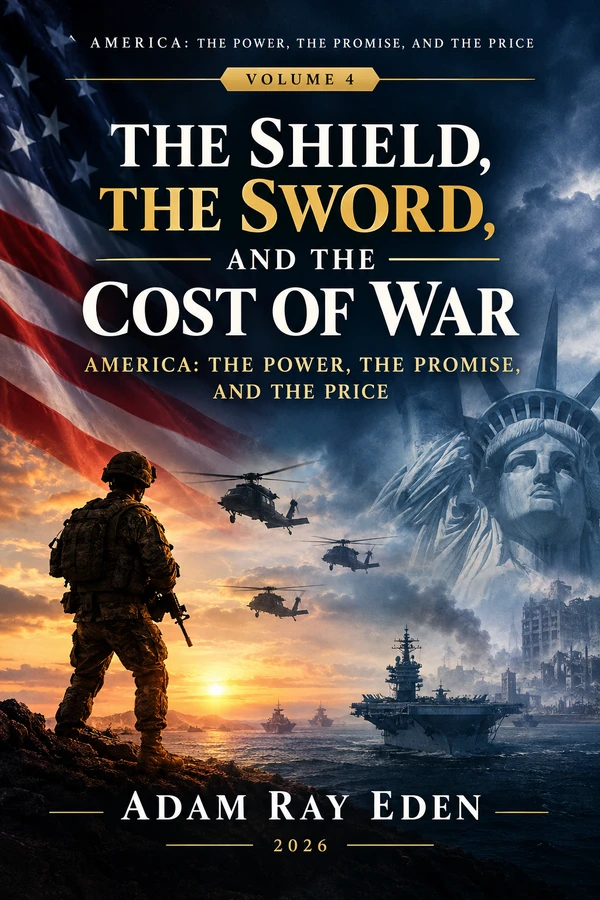
THE SHIELD, THE SWORD, AND THE COST OF WAR
About This Book
AMERICA: THE POWER, THE PROMISE, AND THE PRICE
Volume 4
America's military strength has long stood as one of the most powerful instruments of its global influence. Its armed forces have defended national interests, shaped international alliances, confronted perceived threats, and transformed the political landscape of nations. Yet behind every military victory lies a deeper story of sacrifice, controversy, responsibility, and consequence.
The Shield, the Sword, and the Cost of War examines the complex relationship between American military power, national security, foreign policy, and the human consequences of armed conflict.
From the development of America's military institutions to its involvement in major international wars, this volume explores the decisions, ambitions, strategic calculations, and political pressures that have influenced the nation's use of force. It considers the promises made in the name of freedom, the arguments advanced in defence of national security, and the difficult questions that emerge when military objectives collide with human lives and national interests.
Beyond battlefields and military victories, this book examines the economic burdens of warfare, the experiences of soldiers and civilians, the consequences of intervention, the challenges of reconstruction, and the long-term effects of conflict on American society and international relations.
It also raises important questions about the limits of military power. Can a nation secure lasting peace through overwhelming strength? Where should the boundary lie between defending freedom and pursuing influence? And what responsibilities accompany the power to wage war beyond one's borders?
Neither a celebration of military dominance nor a simplistic condemnation of American foreign policy, this volume invites readers to examine the historical record, consider competing perspectives, and understand the difficult balance between security, power, principle, and responsibility.
The shield represents protection. The sword represents power. But the cost of war reminds us that neither comes without consequences.
Part of the eight-volume series:
AMERICA: THE POWER, THE PROMISE, AND THE PRICE
A thoughtful exploration of the nation, its ambitions, its contradictions, and the consequences of its influence on the world.
This book examines the intricate relationship between American military strength, national security, and the human costs of war. It provides a historical analysis of major conflicts, the decisions behind military actions, and their lasting impacts on society and international relations.
Who this book is for
- History enthusiasts
- Students of military strategy
- Policy makers
- Veterans and military families
- General readers interested in American foreign policy
What you'll learn
- The evolution of American military power
- Key military conflicts and their implications
- The human and financial costs of war
- The balance between military action and political outcomes
Read a free sample 5 pages from the book
First edition, 2026
Published independently
Disclaimer This book is a work of historical, military, political, and strategic analysis. It examines the development of American military power, major wars, military operations, international alliances, and the human, economic, political, and strategic consequences of armed conflict.
It is intended for educational and informational purposes. It does not constitute legal, military, political, financial, or government policy advice.
The author has sought to distinguish established historical facts from disputed interpretations, official assessments, estimates, and personal analysis. Casualty figures, financial estimates, and assessments of military effectiveness may differ among institutions because of variations in definitions, reporting periods, accounting methods, and available evidence.
The consequences of war are not always immediately measurable. Some effects become visible only years or decades after hostilities end. Readers should therefore understand that historical judgments may evolve as additional documents become available and further research is conducted.
The author has made every reasonable effort to ensure accuracy using credible historical publications, official records, academic research, and publicly available evidence. Any errors or omissions are the responsibility of the author.
Series Note This book is Volume 4 of the series AMERICA: THE POWER, THE PROMISE, AND THE PRICE.
The series examines the historical foundations, political institutions, economic influence, military capabilities, international relationships, achievements, contradictions, and future challenges of the United States.
Each volume explores a distinct dimension of the American experience while contributing to a broader examination of the relationship between national power and national responsibility.
The present volume concentrates on military power: how the United States developed its armed forces, how it employed them in major conflicts, what those forces accomplished, and what the country and the wider world paid for their use. Author's Note on Method The history of American military power cannot be understood through battlefield victories alone.
A military campaign may achieve its immediate operational objectives while producing an uncertain political settlement. A country may win a war but discover that the peace requires more resources, patience, and diplomatic judgment than the military campaign itself.
This volume therefore evaluates military history through several connected dimensions:
1. Historical circumstances: The political, economic, and international conditions that preceded each conflict.
2. Political objectives: The reasons governments gave for entering or continuing a war.
3. Military strategy: The relationship between national objectives, military plans, operational decisions, and available resources.
4. Operational performance: The conduct of campaigns, logistics, intelligence, technology, command, and coalition coordination.
5. Human consequences: Military deaths, injuries, civilian casualties, displacement, destruction, and long-term suffering. 6. Economic consequences: Direct expenditure, borrowing, reconstruction, veterans' obligations, and opportunity costs.
7. Political consequences: Changes in public opinion, constitutional debates, civil-military relations, and government legitimacy.
8. Strategic consequences: Changes in international relationships, regional security, deterrence, and the position of the United States in the international system.
The book distinguishes between four concepts that are frequently confused.
Tactical success concerns the outcome of an individual engagement or battlefield action.
Operational success concerns the achievement of a military campaign's objectives through coordinated actions.
Strategic success concerns whether military operations contribute to the broader political and security objectives for which force was employed.
Political success concerns whether the resulting settlement produces an outcome that can be sustained and accepted by the relevant political communities.
These distinctions are essential. Capturing territory does not automatically create a legitimate government. Destroying an enemy's military formations does not necessarily eliminate the political grievances or movements that sustain resistance. Removing a government does not establish that the replacement will be stable.
The analysis gives priority to primary documents, official military histories, government investigations, academic research, and reputable historical institutions. Where sources disagree, the disagreement is acknowledged rather than concealed.
The objective is not to glorify war, condemn every military operation, or defend every decision made by American leaders. It is to understand the capabilities and limitations of military power.
The European theater The Pacific theater Atomic Weapons and the End of the War The Emergence of a Global Military Power 1.4 Cold War Force Structure and Doctrine The Decision to Maintain Permanent Peacetime Forces Containment and the Strategic Role of Military Power Nuclear Weapons and Deterrence Conventional Forces and the Possibility of Limited War Overseas Bases and Forward Defence The Military-Industrial Complex Vietnam and the Limits of Cold War Doctrine The End of the Cold War The Continuing Cold War Legacy Chapter 2 The Second World War 2.1 Pearl Harbor and the American Entry into the War 2.2 mobilization: Turning Industry into Military Power 2.3 The European theater : North Africa, Italy, and Normandy Germany surrendered in May 1945. 2.4 The Pacific theater : Island Warfare and the Defeat of Japan 2.5 The Manhattan Project and the Atomic Bomb 2.6 The Human and Political Consequences of Victory Chapter 3 Korea and the Limits of Limited War 3.1 The Division of Korea 3.2 The North Korean Invasion 3.3 Chinese Intervention and the Reversal of the War 3.4 Stalemate and Armistice 3.5 What the Korean War Revealed Chapter 4 Vietnam 4.1 Historical Background and the Origins of Conflict 4.2 From Advisers to Major Military Intervention 4.3 Search-and-Destroy, Air Power, and the Problem of Strategy 4.4 The Tet Offensive 4.5 The War at Home 4.6 Vietnamization and Withdrawal 4.7 The Human Cost and Historical Lessons Chapter 5 The 1990–1991 Gulf Crisis 5.1 Iraq's Invasion of Kuwait 5.2 Operation Desert Shield 5.3 Operation Desert Storm 5.4 Military Victory and Political Restraint 5.5 Civilian Consequences and the Limits of Precision 5.6 Case Study: What the Gulf War Teaches Chapter 6 Afghanistan and Iraq (2001–2021)
6.1 The September 11 Attacks 6.2 Afghanistan: The Initial Military Campaign 6.3 State-Building and the Expansion of the Mission 6.4 The Iraq Invasion of 2003 6.5 The Occupation and the Insurgency 6.6 The Surge and the Changing Security Environment 6.7 Afghanistan's Long War and the 2021 Withdrawal 6.8 The Human and Financial Costs 6.9 What the Post-9/11 Wars Revealed Chapter 7 The Human and Financial Cost of War 7.1 The Meaning of Military Casualties 7.2 Civilian Deaths and Displacement 7.3 The Economic Cost of Military Operations 7.4 The Military-Industrial Relationship 7.5 Veterans and the Long-Term Cost of Service 7.6 Environmental Damage 7.7 A Framework for Measuring the True Cost of War Chapter 8 When…
End of sample. The full book is 97 pages on Afri KDP.
Questions about this book
What major wars does the book cover?
The book discusses significant conflicts including World War II, the Korean War, Vietnam, the Gulf War, and the wars in Afghanistan and Iraq.
Loading reviews...
Loading…
A download link appears on this page as soon as your payment is confirmed, and a permanent copy of the link is emailed to you.
By card from anywhere. In Nigeria you can also pay by bank transfer, USSD or mobile money. Your card details are entered on Paystack's secure page, never on AfriKDP.
Yes. The file opens on phones, tablets, computers and eReaders.
Yes, with an AfriKDP reading plan, which opens every book in the online reader and pays the author for every page you read.
Write to [email protected] with your email address and we will help. See our return policy.