 AfriKDP
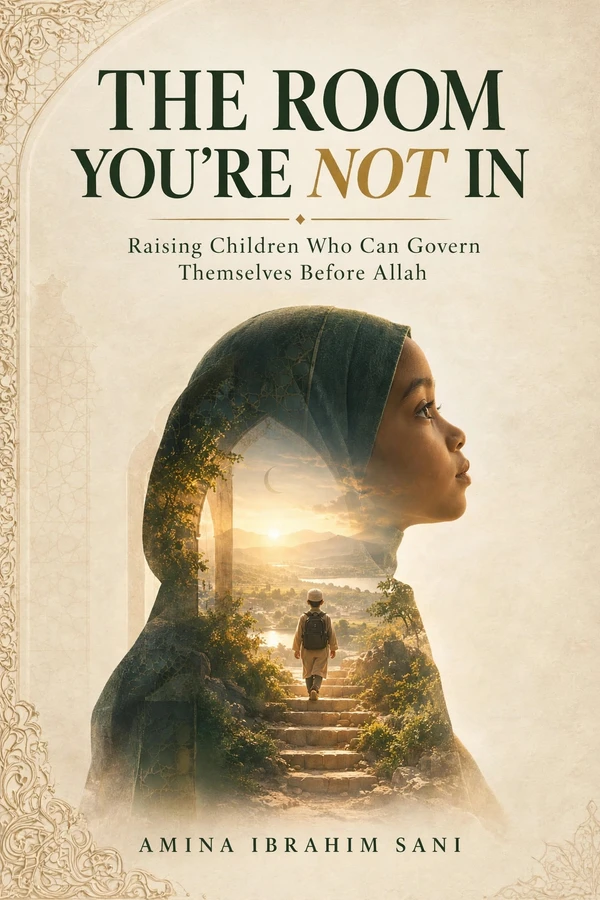
THE ROOM YOU’RE NOT IN-Raising Children Who Can Govern Themselves Before Allah
About This Book
Rooted in Islamic principles, the book encourages mothers to look beyond obedience and focus on nurturing faith, conscience, good character, independent judgment, and accountability before Allah. It examines how everyday parenting, personal example, conversations, and discipline shape a child's ability to distinguish right from wrong and make responsible choices.
The book reminds mothers that parenting is not simply about controlling a child's behaviour or ensuring obedience under supervision. It is about instilling values that remain meaningful when a child faces difficult decisions alone.
Ultimately, The Room You’re Not In invites mothers to reflect on the kind of people they are raising and the legacy their parenting will leave behind. Its central message is simple: the true measure of guidance is not only how a child behaves when you are watching, but also the choices they make when you are absent and their awareness that Allah is always present.
The Room You’re Not In guides parents, particularly mothers, on nurturing children who can make sound decisions independently. Rooted in Islamic values, it emphasizes the importance of instilling moral character and accountability before Allah, rather than merely enforcing obedience.
Who this book is for
- Mothers seeking guidance
- Parents of young children
- Educators in Islamic values
- Anyone interested in child development
- Individuals exploring self-governance in parenting
What you'll learn
- How to foster independent judgment in children
- The role of personal example in parenting
- Strategies for nurturing moral character
- The importance of accountability before Allah
- How to create a truthful home environment
Read a free sample 4 pages from the book
6 PART I WHAT WE INHERIT
7 Chapter One Who Taught You How to Parent? ا ً ر ا نَ ْ م ُ كي ِ ل ْ هَأ َ و ْ م ُ ك َ س ُ فنَأ او ُ ق او ُ ن َ مآ َ ني ِ ذ َّ لا ا َ ه ُّ يَأ ا يَ "O you who believe, protect yourselves and your families from a Fire..." Qur'an 66:6 Long before a woman becomes a mother, she has already been taught something about motherhood. Not in a classroom, and rarely through direct instruction. She learned it the way most important things are learned in childhood by watching. She watched how her own mother responded to her crying. She watched what happened when a question was welcomed and what happened when it was treated as disrespect. She noticed what a household did with a child who failed, or disobeyed, or simply became difficult to manage. Without anyone sitting her down to explain it, she absorbed what love looked like, what authority looked like, and what a "good child" was supposed to be. Years later, when she has children of her own, some of that absorbed material resurfaces without her noticing. She reaches for a phrase because it's the one she always heard. She reacts a certain way because that is how things were handled in the house she grew up in. She insists on something without ever asking herself why it matters to her so much. This is one of the quieter facts about parenting: long before we examine it, we are usually just repeating it. Which is why the more honest first question isn't how should I raise my child. It's who raised me and how much of that am I still running on? The Things We Carry I started noticing this most clearly through my mother, and the way my grandmother kept surfacing in her stories without ever being named directly. My grandmother was a quiet woman who taught mostly through example rather than explanation through work, through observation, through the occasional question that made you think rather than simply comply. My mother didn't copy her exactly. She kept certain things, revised others, and consciously refused to repeat a few. That, more than the inheritance itself, is the part worth paying attention to: we don't only receive what our parents intended to give us. We inherit their habits and their fears alongside their wisdom, their assumptions alongside their strengths, and often their unfinished work along with everything they resolved. What we do with all of it afterward is the actual choice. There is a real difference between saying this is how my mother raised us and asking why did she raise us this way, and is it still the wisest way to raise mine. The second question takes more out of a person, because it requires admitting that someone you love and respect could have taught you something valuable without being right about all of it and that honoring them doesn't require reproducing every part of how they did things. You can say, my mother gave me this, and I intend
8 to keep it, and in the same breath say, my mother gave me this too, and I understand exactly why she became this way, but I don't think I should hand it to my own child unexamined. That isn't disrespect. It's what responsibility actually looks like once a person stops treating inheritance as something automatic. I have noticed something similar when I listen to older women talk about raising their children. In informal conversations, some of them gave me an answer that was less a defence than a description: this is how it was done, so this is how they did it. What they described did not sound like a method weighed against others and chosen. It sounded like something that had come with the role. I do not want to make too much of a handful of conversations, or turn them into a verdict on a generation, and a method that has never been examined is not, for that reason alone, a bad one. But it shows how deeply a practice can settle when nobody around it asks for its reasons. What goes unexamined for long enough stops looking like a choice. It starts to look like parenting itself. Research that follows families over time suggests the pattern is real but not fixed. In a New Zealand study of more than two hundred parents from the Dunedin birth cohort, researchers videotaped each parent with a three-year-old and compared what they saw with what had been recorded about how those parents were raised. Mothers whose own childhoods had included more warm, sensitive, stimulating parenting tended to parent that way themselves. The same link did not appear for the fathers, and the study can show association, not cause (Belsky et al., 2005). The finding is modest, and it describes tendencies in one group of families in one country. It is still a fair reminder that what we absorb as children often shows up in us whether or not we meant to carry it. Mercy Before Method There's a hadith, narrated by Aisha, that has stayed with me since I first came across it. Some Bedouins visited the Prophet صلى الله عليه وسلم and asked whether he kissed his children. When he said he did, they told him plainly that they did not kiss theirs. His response wasn't a lecture on affection. He simply asked what he could do if Allah had removed mercy from their hearts (Sahih al-Bukhari, 5998; Sahih Muslim). It's a small exchange, but it unsettles an assumption a lot of parents carry without quite admitting to it that warmth and authority are somehow in competition, and that a household run on tenderness will produce a child who cannot be corrected. The Prophet صلى الله عليه وسلم, whose authority nobody in his household questioned, was also, by every account of those closest to him, exceptionally affectionate with children. The two were never in tension. Which suggests the tension many of us feel between being loving and being firm may say more about how we were raised than about what parenting actually requires. This matters because it's easy to become so focused on producing an obedient child that we lose sight of what obedience is actually for. A child who complies because someone is standing over them has learned compliance. A child who understands why something matters, and chooses it when no one is watching, has started developing something closer to character. The difference between those two outcomes doesn't show up much while a child is small. It shows up later, in every room a parent is
9 no longer in. And a parent is, eventually, no longer in most of the rooms that matter. She can manage a five-year-old's behavior with real precision. She cannot follow a fifteen-year-old into her private thoughts, or stand beside a young adult through every friendship, every workplace decision, every quiet moment of temptation nobody else will ever know about. At some point the parent leaves the room not metaphorically, but literally, permanently, as a simple fact of a child growing up and whatever is going to guide that child from then on has to already be inside them. Which means the more useful question was never how do I make my child obey me. It's what will this child rely on when I'm not there to be obeyed. That question changes what discipline looks like. It changes whether a child is allowed to solve a problem before being handed the solution, and whether they're taught only what to do or also why. It changes whether we're raising someone who waits for instructions, or someone capable of exercising judgment when no instructions are coming. None of this happens by dropping a child into independence too early. It happens gradually deciding for them, then explaining, then involving them, then letting them choose inside real boundaries, then letting them live with what those choices produce until eventually they can stand on their own. That isn't the end of parenting. It may be its clearest success. There's a further reason this kind of examination matters, and it's less comfortable than the rest. A parent who has never questioned what she inherited can end up passing on convictions she doesn't actually hold. Maybe she was raised to believe children should never question an adult, or that a daughter's worth is measured by how well she serves others, or that mistakes are something to be ashamed of rather than something to learn from. Some of these ideas made a certain kind of sense inside the circumstances that produced them. Circumstances change, though, and even where a principle genuinely holds up, the way it gets applied usually needs more thought than the version we absorbed as children. None of this is an argument for discarding what we were given. Most of what a person inherits from their upbringing is not a defect to be corrected it's the best material most of us have to work with. The task isn't rejection. It's closer to what my mother did with her own mother's example: keeping the discipline while separating it from humiliation, keeping the respect while making clear it was never meant to require silence in the face of real wrongdoing, keeping the obedience without mistaking it for the whole point. That is the difference between a parent who is simply a product of her own upbringing and one who has started to become something more deliberate. She pauses long enough to notice what she's about to repeat. She asks why it's there before deciding whether it stays. And she accepts, somewhere along the way, that the child in front of…
End of sample. The full book is 78 pages on Afri KDP.
Questions about this book
What is the main focus of this book?
The book emphasizes raising children who can make responsible choices independently, guided by Islamic principles and moral character.
Loading reviews...
Loading…
A download link appears on this page as soon as your payment is confirmed, and a permanent copy of the link is emailed to you.
By card from anywhere. In Nigeria you can also pay by bank transfer, USSD or mobile money. Your card details are entered on Paystack's secure page, never on AfriKDP.
Yes. The file opens on phones, tablets, computers and eReaders.
Yes, with an AfriKDP reading plan, which opens every book in the online reader and pays the author for every page you read.
Write to [email protected] with your email address and we will help. See our return policy.