 AfriKDP
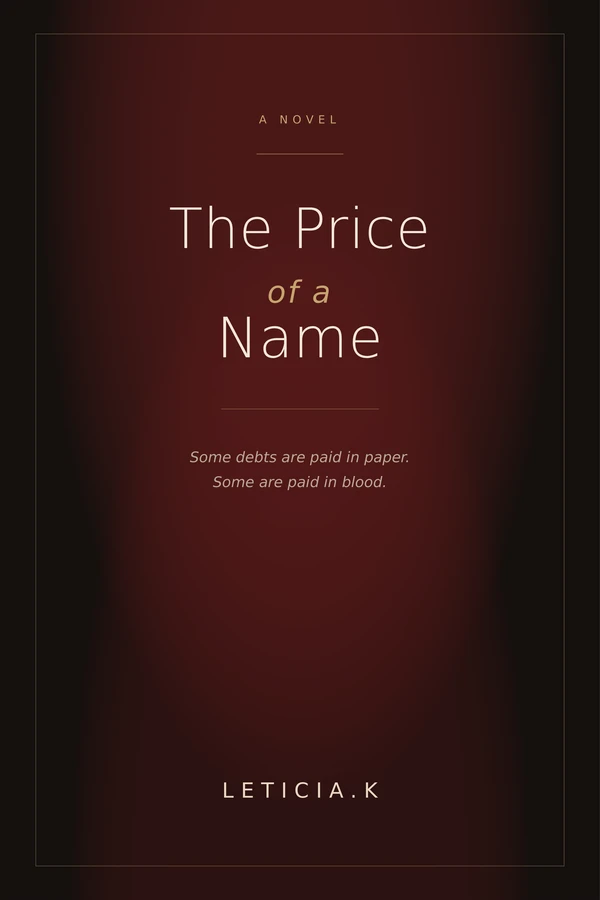
The Price of a Name
About This Book
In 'The Price of a Name', Nokuthula Maseko faces a forced marriage to settle her brother's gambling debts, only to uncover a dark family secret. This psychological thriller weaves themes of love, betrayal, and the weight of names against the backdrop of South Africa's vibrant streets.
Who this book is for
- Fans of dark romance
- Readers of psychological thrillers
- Those interested in mafia narratives
- Lovers of African fiction
- Readers seeking strong female protagonists
What you'll learn
- The impact of family loyalty on personal choices
- The consequences of financial desperation
- How love can be intertwined with power dynamics
- The significance of names and legacies
- The complexities of forced relationships
Read a free sample 9 pages from the book
A NOVEL The Price of a Name Some debts are paid in paper. Some are paid in blood. LETICIA.K
A NOVEL The Price of a Name Leticia.k Maseko & Daughter
6 16 22 29 38 43 49 55 60 66 73 82 91 98 104 109 114 117 122 125 128 134 Contents One Two Three Four Five Six Seven Eight Nine Ten Eleven Twelve Thirteen Fourteen Fifteen Sixteen Seventeen Eighteen Nineteen Twenty Twenty-One Twenty-Two
140 145 148 150 155 163 167 172 175 Twenty-Three Twenty-Four Twenty-Five Twenty-Six Twenty-Seven Twenty-Eight Twenty-Nine Thirty Thirty-One
T CHAPTER ONE he glue pot is the only thing in my life that has never lied to me. It sits on the corner of my bench, squat and black and older than I am, and it smells like rabbit skin and hot dust. When it is ready it says so. A small bubble, a thread of steam, a smell like the inside of an old church. It has no opinions about my brother, or my father's blood pressure, or the fact that I am twenty-six years old and my entire social life is a Wednesday-night choir practice I have not attended since March. I am gluing a spine. The book is a 1938 deed register from a magistrate's office in Piet Retief, water-damaged, the sewing perished, the boards warped like a bad knee. The lawyer who brought it in told me it was worthless. He said it the way people say things they are ashamed of wanting. "Then why are you paying me to fix it?" I asked. He looked at the floor. "Because it's the only record of a farm my grandfather lost." I know that look. I have built a whole business on that look. People come to me with paper that has outlived every‐ one who could explain it, and they want me to make it speak again. I am a bookbinder. I am also, though nobody puts it on a business card, a person who is paid to listen to docu‐ ments. The workshop is on the ground floor of a building on Commissioner Street, in Jeppestown, where the city leans on 6
you from all sides. The windows are tall and filthy and beau‐ tiful. The light comes through them the colour of weak tea. There is a sign above the door that my grandfather painted in 1979 and that I have never repainted, because his hand‐ writing is the only thing of his I have left that isn't a debt. ✦ There is no son. There is me. There was a son, once, in the sense that my father worked here for thirty years and hated every minute of it, and there is a son now, in the sense that my brother Kagiso is a son, and Kagiso has never once in his life repaired anything. At four o'clock the light goes orange and the city starts to make its evening noises. Somewhere above me a woman is shouting at a man about money. A taxi hoots. The lift in the passage groans like a cow. I am pressing the spine into its case with the flat of my hand when my phone lights up on the bench. Kagiso. I let it ring. It rings again. On the third call I pick up be‐ cause I am weak and because he is my brother and because the last time I ignored him for two days he turned up at the workshop with his lip split and said, see, Thuli, this is what happens when you don't answer. "Thuli." "Kagiso." "Are you at the workshop?" "I'm always at the workshop." "Don't be like that." His voice is doing the thing it does. The bright, fast, charming thing. The thing that has been 7
getting him out of trouble since he was six and broke the Nkosi boy's window with a cricket ball. "I need a favour." "No." "You haven't heard it." "I've heard it. It's the same favour. It's always the same favour." "It's not." A pause. A car door. He is outside somewhere, and there is traffic behind him, and he has lowered his voice. "Thuli, I need you to come to the house. Tonight. Not tomorrow. Tonight." Something in his voice makes my hand stop. "What did you do?" "Nothing. I didn't do anything. Just—" He breathes out. "Just come. Please. And don't tell Dad." I close my eyes. Kagiso is twenty-nine. He has a diploma in logistics that he has never used, a smile that could sell sand in the Saha‐ ra, and a talent for finding the exact wrong man to trust in any room. He has been in and out of jobs. He has been in and out of love. He has never been in and out of prison, which I used to think was luck and now think is a kind of ac‐ counting. Somebody has been keeping a ledger on him. I have known that for a year. I have been waiting for the day the ledger came due. "Thuli." "I'm here." "Come at seven." He hangs up before I can say no properly. I stand there with the bone folder in my hand and the light going from orange to red, and I think about the fact that I have four hundred rand in my savings account and a 8
father with a heart that beats wrong and a brother who has just used the voice he uses when he is frightened. Then I finish the spine. Because the glue is still hot, and because a book left half-bound will warp, and because I am the kind of person who finishes things. That is, I am learning, exactly the kind of person the world likes to use. --- The house is in Troyeville, on a street that used to be re‐ spectable and is now mostly a place where people park things they intend to fix. It is small and red-brick and my mother planted a lemon tree in the yard the year I was born. The tree is still there. It has never once given a lemon. My father waters it every Sunday like a man keeping a promise to someone who isn't listening. I park the bakkie and sit for a minute. There is a car I don't know outside the gate. A black BMW, very clean, very wrong for this street. It has the kind of shine that costs more than the house. My stomach goes cold. I walk in without knocking because it is my father's house and I have a key, and the moment I step into the lounge I un‐ derstand that I have walked into a room that has already de‐ cided something about me. Kagiso is on the couch. He is not hurt. That is the first thing I check, and the relief is so sharp it makes me angry. There are two men. One is standing by the window with his hands behind his back, looking out at the lemon tree like it personally offends him. He is enormous in the way that certain quiet men are enormous — not fat, not muscle-bound, just large , like a 9
door that has learned to stand still. The other is sitting in my father's chair. My father's chair. "Thuli," Kagiso says, and stands up too fast. "Thuli, this is —" "Sit down," says the man in the chair. Kagiso sits down. The man in the chair is not what I expected. I expected a thug. I have seen enough of Kagiso's friends to know the type — gold chains, bad cologne, a gun they keep touching to make sure it's still there. This man is wearing a charcoal suit with no tie, and his shoes are the colour of dark honey, and his hands are folded in his lap like a man waiting for a bus. He is also, and I hate that this is the first thing my brain offers me, the most beautiful human being I have ever stood in the same room with. Not handsome. Beautiful. The way a knife is beautiful. High cheekbones, a wide mouth, a nose that has been broken once and set well. His skin is the colour of strong tea. His eyes are the colour of the sea before a storm, which is a stupid thing to think, and I think it anyway. He is maybe thirty-five. He is looking at me the way I look at a book I am about to take apart: with total attention and no affection. "Nokuthula Maseko," he says. "Who are you?" "My name is Sanele Gwala." He says it plainly, the way you'd say it's going to rain, and then he waits, because he knows the name will do the work for him. 10
It does. Everybody in this city knows the name Gwala. You know it the way you know where the potholes are — not because anyone told you, but because you learned. The Gwalas run trucks. That is the official story. The Gwalas run trucks the way a shark runs a swimming school. I keep my face still. I have had a lot of practice keeping my face still. "I don't know you," I say. "No." He tilts his head slightly. "But your brother does." "Kagiso." "Thuli, just let me—" "Kagiso, shut up." I don't look at him. I look at Gwala. "What does he owe you?" "Two point four million rand." The number goes through me like a wire. "That's not possible." "It's entirely possible. He's been placing bets with a book‐ maker who works for a man who works for me. He's been doing it for eleven months. He's been paying with money that wasn't his, from a company that wasn't his, and when the company found out, he came to me for a loan to cover it." Gwala's mouth moves, very slightly. It is not a smile. "To cover a debt. With a loan. From me." I turn and look at my brother. Kagiso is staring at his own hands. "Two point four million," I say. "It was eight hundred at first," Kagiso says, very quietly. "It just—" "It just what? It just grew? Like a plant? Like a plant , Kagiso?" 11
"Thuli—" "You put the house up." My voice is coming out flat and strange. "Tell me you didn't put the house up." He doesn't answer. "He didn't put the house up," Gwala says. "The house is in your father's name and your father has a bond on it. There's nothing in it. I had it checked." He says this without any par‐ ticular cruelty, which is somehow worse. "What he put up was your father's signature. As guarantor. On a document your father signed in February without reading it, because his son told him it was for a vehicle." The room tilts. I think about February. I think about my father coming home from the bank, tired, pleased with himself, saying Kagiso was finally getting a bakkie for a delivery business. I think about how I said that's good, Dad, and how I did…
End of sample. The full book is 178 pages on Afri KDP.
Questions about this book
What is the central conflict in the story?
The central conflict revolves around Nokuthula's forced marriage to a powerful man to settle her brother's gambling debt, leading her to uncover a family secret that could change everything.
Loading reviews...

Loading…
A download link appears on this page as soon as your payment is confirmed, and a permanent copy of the link is emailed to you.
By card from anywhere. In Nigeria you can also pay by bank transfer, USSD or mobile money. Your card details are entered on Paystack's secure page, never on AfriKDP.
Yes. The file opens on phones, tablets, computers and eReaders.
Yes, with an AfriKDP reading plan, which opens every book in the online reader and pays the author for every page you read.
Write to [email protected] with your email address and we will help. See our return policy.