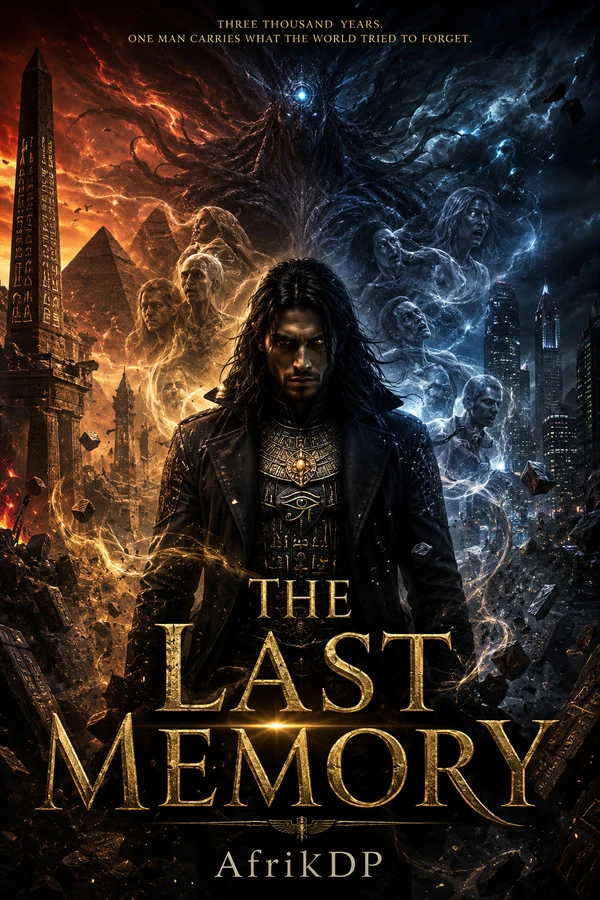
The Last Memory
About This Book
Born Kha-em-waset in Thebes during the reign of Ramesses III, he died an ordinary death at nineteen — and woke up. Since that night in the reeds by the Nile, he has lived, died, and returned under a hundred names across three millennia, watching empires rise and vanish while he alone remains. He now calls himself Zane. He has learned to disappear into history. But something from that first death has finally caught up with him, and the immortality he's spent three thousand years trying to understand is about to demand an answer.
A sweeping tale that moves from ancient Egypt to the present day, The Last Memory is for readers who love immortal protagonists, richly researched historical settings, and slow-burn mysteries about identity, memory, and what it truly costs to live forever.
In 'The Last Memory', follow Zane, who has lived for three thousand years since his first death in ancient Egypt. As he grapples with his immortality and the memories of countless lives, he faces a new threat that demands answers about his past.
Who this book is for
- Fans of historical fantasy
- Readers interested in reincarnation stories
- Those who enjoy epic tales of immortality
- Lovers of richly detailed settings
- Mystery enthusiasts
What you'll learn
- The complexities of immortality
- The impact of memory on identity
- Historical insights into ancient Egypt
- The emotional weight of past lives
- The nature of existence and death
Read a free sample 3 pages from the book
THE LAST MEMORY ──────────────────────── Hehas carried three thousand years of dying. Now the thing that made him carry them has returned. AFRIKDP OFFICIAL LIBRARY
Chapter1 Egypt, 1200 BC THEBES — THEEIGHTEENTH YEAR OF THE REIGN OF RAMESSES III The night Zane died for the first time, the Nile smelled of copper and flood sediment, and the stars above Thebes were so bright and so close that a man lying on his back in the reeds might have believed he could reach up and rearrange them. He was not lying in the reeds by choice. He had been put there by three soldiers of a garrison he had stumbled upon in the dark — soldiers who had mistaken him for a scout from a rival faction, which he was not, and had driven a spear through his chest, which they had. He remembered the sensation of it clearly, even now, three thousand years later. Not the pain — the pain was brief, shockingly brief, a single bright note before the silence — but the cold that followed. The way the stars blurred. The sound of the soldiers walking away, already forgetting him, already talking about something else, the way living people do when death happens nearby and does not take them. He had lain there for what he estimated was several hours. He had expected to die. He had made peace with this, in the clumsy, incomplete way of a nineteen-year-old boy who had not yet understood what he was making peace with. Instead, he had woken up. The spear was still in his chest. He pulled it out, which was unpleasant. The wound beneath it was already closing, the flesh knitting itself back together with a faint heat that had no name in his language and no explanation in any framework available to him in 1200 BC. He stood. He breathed. He looked down at the blood soaking his tunic — his blood, an enormous quantity of it, clearly fatal — and felt the specific and profound confusion of a young man whose understanding of the world has just been quietly destroyed. He walked back to his village. He told no one. He did not know what he would have said. ◆ His name then was not Zane. It would be many centuries before he settled on that particular arrangement of sounds. He had been born Kha-em-waset, the third son of a grain merchant who had died of fever when Kha-em-waset was eleven, leaving behind a wife, four children, and a debt to a temple administrator that would take eight years to repay. He had been, before that night in the reeds, an ordinary young man. Not remarkable in any way that the world had yet noticed. He worked. He ate. He had a girl he thought about more than was probably productive. He had hopes that were small enough to be
realistic and dreams that were large enough to keep him awake some nights, staring at the ceiling of the house he shared with his mother and two younger sisters. After that night, he was something else. He did not yet know what. It would take him decades to understand the full shape of what had happened to him, and centuries before he stopped being surprised by the edges of it. But the first thing — the first real thing, the thing that told him this was not a gift but a sentence — came three weeks later. An old man collapsed in the market. A stranger. Zane caught him as he fell, holding him by instinct, his hands on the old man's face. The man looked up at him with eyes that were already going distant, already focused on something beyond the market stalls and the noise and the living world. And then the memories came. A rush of images, sensations, fragments — not his own. Not Kha-em-waset's ordinary nineteen years but eighty years of a stranger's life flooding into him like water through a broken dam. A wife. Children. A journey up the Nile thirty years before. The smell of bread baking in a house that no longer existed. The sound of a laugh belonging to a person long dead. Fear. Joy. Grief. The precise and devastating texture of a life fully lived, compressed into a single moment of transfer, downloaded into Zane's mind as the old man breathed his last. The man died. Zane sat in the dust of the market for a long time. He had the old man's entire life inside him now, alongside his own. Every moment. Every face. Every feeling. He did not know then that this would happen every time. He did not know then how many times there would be. If he had known, he might have found somewhere very remote and very quiet and stayed there, alone, for three thousand years. He did not do this. This is either his great virtue or his great flaw, depending on who you…
End of sample. The full book is 24 pages on Afri KDP.
Questions about this book
What is the main theme of the book?
The main theme revolves around immortality, identity, and the consequences of living through multiple lifetimes, as Zane navigates his past and present.
Loading reviews...

Loading…
A download link appears on this page as soon as your payment is confirmed, and a permanent copy of the link is emailed to you.
By card from anywhere. In Nigeria you can also pay by bank transfer, USSD or mobile money. Your card details are entered on Paystack's secure page, never on AfriKDP.
Yes. The file opens on phones, tablets, computers and eReaders.
Yes, with an AfriKDP reading plan, which opens every book in the online reader and pays the author for every page you read.
Write to [email protected] with your email address and we will help. See our return policy.