 AfriKDP
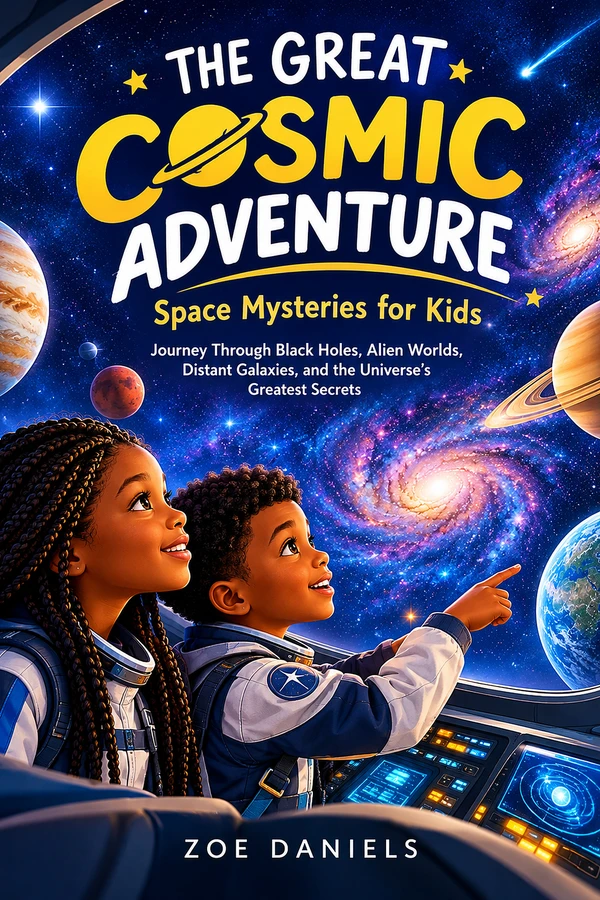
THE GREAT COSMIC ADVENTURE
About This Book
When a mysterious message arrives, Amara and Mateo find a silver spaceship waiting in a quiet observatory. Its computer, Beacon, has one rule: always explain how we know. Together they travel from the strange moons of our Solar System to black holes, alien worlds, distant galaxies and the very beginning of the universe.
Along the way, kids discover:
Whether there is life beyond Earth, and why scientists are careful about saying so
What happens near a black hole, and why it doesn’t “suck everything in”
Why most of the universe is made of dark matter and dark energy that nobody understands yet
Why looking at far-away stars means looking into the past
Why we can’t travel faster than light, and how scientists dream of reaching another star
Every chapter is real science explained for children aged about 8 to 12. It marks clearly what is proven, what is still being investigated, and what is only imagination. There are twelve illustrated chapters, an investigator challenge in each one, a glossary, a 30-question final quiz with answers, and a Young Explorer’s Observation Journal. It’s a perfect gift for curious kids, and a good read-aloud for parents and teachers.
Join Amara and Mateo as they embark on an exciting journey through the universe aboard the Starlight Explorer. This engaging book combines an adventurous story with real scientific concepts, making complex topics accessible for children aged 8 to 12.
Who this book is for
- Curious kids ages 8-12
- Parents looking for educational reads
- Teachers seeking science resources
- Young explorers interested in space
- STEM enthusiasts
What you'll learn
- The size and scale of the universe
- What black holes are and how they work
- The search for alien life
- The concept of dark matter and dark energy
- How light travels and its importance in astronomy
- The mysteries of the Big Bang
- Methods scientists use to measure distances in space
Read a free sample 5 pages from the book
“Please sit,” said Beacon. A small, floating sphere of teal light drifted down between them. “Before we begin, I must be honest about three things. “First: the Starlight Explorer is fictional. It is a ship from a story. Real spacecraft are wonderful, but none of them can do what this one can. “Second: the Starlight drive, which lets us jump from place to place, is also fictional. In real science, nothing we know of can carry a spacecraft faster than light. We will talk about why later in this book. “Third: everything we explain on our travels is real science. When scientists are sure, I will say so. When they are still investigating, I will say that too. And when something is only a guess, I will say that, loudly.” Mateo grinned. “A computer that admits when it’s guessing. I like it.” “Guessing is how science begins,” said Beacon. “But it is never where science ends. The best explorers ask, How do we know?” Amara sat up straighter. That was exactly the question she wrote in her notebook more than any other. “So what is the message?” she asked. “That is the first mystery. It is made of twelve parts, and each part is hidden at a different place in the universe. We shall travel from your own Solar System, past strange moons and stars, to the edges of what anyone has ever seen. Along the way you will meet black holes, glowing 8
nurseries of newborn stars, invisible forces nobody has yet explained, and questions that have puzzled scientists for generations.” “And at the end?” “At the end,” said Beacon, “I hope you will know how to find out answers for yourselves.” Mateo patted the arm of his seat. “How fast does this thing go?” “Please do not touch the large teal button.” “I wasn’t going to.” “You were.” He took his hand away. Amara opened her Mystery Log to a fresh page and wrote at the top: Mission One: Understand the Universe. Then she added underneath, in smaller letters: Remember to ask how we know. Outside the curved window, the observatory roof slid open. Real stars, quiet and ancient, shone through the gap. “Hold on,” said Beacon. “Here we go.” Investigator’s Note: All through this book, look for the Mystery Question at the start of each chapter and the Investigator Challenge at the end. Keep your own Mystery Log, just like Amara. A notebook and a pencil are all you need. 9
Chapter 1: Beyond the World We Know ✦ ✦ ✦ How Big Is the Universe? An artistic view looking outward from Earth through the Solar System, the Milky Way and distant galaxies. Distances are not to scale. Mystery Question: Just how big is everything? 10
The first stop was so close that Mateo thought nothing had happened. “We’ve only moved a little,” he said, squinting out of the window. “We have gone about four hundred thousand kilometres,” said Beacon. “That is the distance to the Moon.” Mateo’s eyebrows shot up. A pale, cratered Moon hung beside them, bright as a lantern. Behind it, a small blue and white marble floated in the dark. “That’s Earth,” whispered Amara. “It looks tiny.” “It is about 12,700 kilometres wide,” said Beacon. “That is huge to us. But watch.” The ship drifted outwards, and Earth shrank from a marble to a pea to a pinprick. A glowing ball of fire swelled in the window instead. “The Sun,” said Beacon. “You could fit about 109 Earths side by side across its face. Its light takes just over eight minutes to reach your home. That sunshine on your face this morning left the Sun about eight minutes before it arrived.” Amara scribbled in her Mystery Log. “So light has a speed. It takes time to travel.” “Yes, and light is the fastest thing we know. It moves about 300,000 kilometres every second. In one second, a beam of light could circle the Earth more than seven times.” Beacon paused. “Keep that number in mind. It will become your ruler for measuring the universe.” 11
Space is so big that kilometres soon become silly. Saying how far away a star is in kilometres is like measuring a journey across a country in centimetres. So astronomers invented a new unit. A light-year is the distance that light travels in one year. It is about nine and a half trillion kilometres. A light-year is a measure of distance, not time, which is a very common mix-up. “How do we know how big space is?” asked Amara. “Nobody has been out there with a tape measure.” “A good question,” said Beacon. “Astronomers use many methods, built up like steps on a ladder. For nearby objects, they bounce radio waves off them and time how long the echo takes. For nearby stars, they use a trick called parallax. Hold up one finger and close one eye, then the other. Your finger seems to jump against the background. Astronomers watch a nearby star appear to shift against faraway stars as Earth moves around the Sun. The size of…
End of sample. The full book is 100 pages on Afri KDP.
Questions about this book
What age group is this book suitable for?
This book is designed for children aged 8 to 12, making complex scientific concepts accessible and engaging for young readers.
Loading reviews...
Loading…
A download link appears on this page as soon as your payment is confirmed, and a permanent copy of the link is emailed to you.
By card from anywhere. In Nigeria you can also pay by bank transfer, USSD or mobile money. Your card details are entered on Paystack's secure page, never on AfriKDP.
Yes. The file opens on phones, tablets, computers and eReaders.
Yes, with an AfriKDP reading plan, which opens every book in the online reader and pays the author for every page you read.
Write to [email protected] with your email address and we will help. See our return policy.