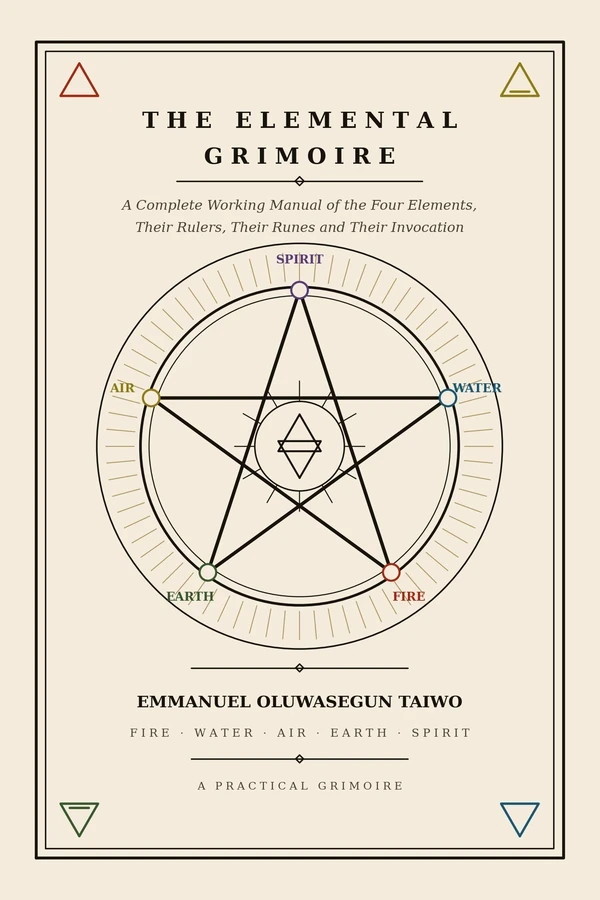
The Elemental Grimoire
About This Book
The Elemental Grimoire is a 217-page working manual of Fire, Water, Air, Earth and Spirit — their doctrine, their rulers, their runes, and their invocation. It is arranged in the order the work is actually done, not the order of interest, because almost every failure in elemental magic comes from a student who begins at the invocations.
Forty-five chapters across nine parts take you from the ground up:
The Doctrine — what the four elements are, the qualities and triplicities, the sixteen sub-elements, the fifth element, and the elemental beings as Paracelsus described them: gnomes, undines, sylphs and salamanders, with their kings Ghob, Nichsa, Paralda and Djin.
The Preparation — the Four Powers of the Sphinx, purification, the elemental breaths after Bardon, the soul mirror, and the training of concentration and the astral senses.
The Temple — the circle, the altar, the four weapons and their consecration, planetary hours, moons and seasons, and full tables of incenses, herbs, stones and colours.
The Foundational Rites — the Qabalistic Cross, the Lesser Banishing Ritual of the Pentagram, the Middle Pillar, the Rose Cross, and the elemental hexagrams, each given word by word and gesture by gesture.
The Invocations — complete seven-fold rites for Fire, Water, Air, Earth and Spirit, with divine names, archangels, angels, kings, pentagram forms, spoken conjurations, offerings, the licence to depart, and an honest account of what to expect in the days after.
The Runes — the Elder Futhark by element, galdr, the rune postures, bindrunes, and the Rune Rite of the Four Winds.
The Higher Invocations — the Supreme Invoking Ritual, the Watchtowers and the Enochian names, godform assumption, the Bornless Rite, and scrying by the tattvas.
The Book of Workings — thirty practical operations arranged by element, each with its purpose stated plainly, its timing, its materials, and the counterpart act without which no working lands.
Mastery and Safeguard — banishing and grounding, the correction of error, a full twelve-month curriculum, and the Great Work.
Illustrated throughout with more than thirty original diagrams drawn for this edition: pentagram and hexagram forms, archangelic sigils, the seals of the four kings, the Tree of Life, the Middle Pillar, the temple plan, the Watchtower structure, and a complete Elder Futhark chart.
The book names its sources — Empedocles, Aristotle, Agrippa, Paracelsus, Dee and Kelley, the Golden Dawn, Bardon, the rune poems — and says plainly where tradition is attested and where it is modern reconstruction. It also says plainly when to stop, when to ground, and when to see a doctor.
Written for the reader who wants one book that goes all the way through.
The Elemental Grimoire is a detailed working manual that guides readers through the principles and practices of elemental magic. It covers the doctrine of the elements, preparation for magical work, foundational rites, invocations, and practical workings, all arranged in a logical order for effective practice.
Who this book is for
- Practitioners of magic
- Students of Western esotericism
- Those interested in elemental magic
- Readers of grimoires
- Spiritual seekers
What you'll learn
- Understanding the four elements
- Performing elemental invocations
- Using runes in magic
- Conducting practical magical workings
- Establishing a personal magical practice
- Grounding and banishing techniques
- The significance of elemental beings
Read a free sample 10 pages from the book
T H E E L E M E N T A L G R I M O I R E
T H E E L E M E N T A L G R I M O I R E A Complete Working Manual of the Four Elements, Their Rulers, Their Runes and Their Invocation E M M A N U E L O L U W A S E G U N T A I W O
A N O T E T O T H E R E A D E R This book describes practices drawn from the Western esoteric tradition, the Hermetic and Rosicrucian currents, and the runic revival. It is offered for study and for personal spiritual practice. Nothing in this volume is medical, psychological, legal or financial advice, and nothing in it is a substitute for professional care. The rites described here involve open flame, blades, burning incense, fasting and prolonged concentration. Handle each with the ordinary care you would use outside a temple, ventilate any room in which charcoal or resin is burned, and do not fast if you are unwell, pregnant, diabetic, under eighteen, taking medication that requires food, or if you have any history of disordered eating. If any practice in this book leaves you sleepless, agitated, unable to concentrate, or distressed in a way that does not settle within a few days, stop, close your working properly as described in Chapter Forty-Two, ground yourself, and seek ordinary help from a doctor. Magic sits on top of a functioning life. It is a poor substitute for medicine, for therapy, or for human company, and no genuine tradition has ever claimed otherwise. The author and publisher accept no liability for any loss or injury arising from the use or misuse of the material in this book. The reader is an adult and is responsible for their own practice. Where traditions disagree, this book says so. Where the author gives his own practice, it is marked as his. Readers are encouraged to check every claim that matters to them against the primary sources listed in Appendix G.
For those who did the daily practice when nothing seemed to be happening.
How to Use This Book This is a working manual. It is not a history of magic, though it rests on history; it is not a book of theory, though it teaches theory where theory is needed. It was written to be used — opened on an altar, read aloud, marked, argued with, and worked through from the first page to the last. Read it once from beginning to end without performing anything. Then return to the beginning and start work. The order of the work The nine parts of this book are arranged in the order in which the work must actually be done, and not in the order of interest. Almost every failure in elemental magic comes from a student who begins at Part Five. Part One gives the doctrine: what the elements are, what they are not, and what stands behind them. Without this, invocation is theatre. Part Two prepares the operator. The magician is the instrument. A cracked bell rings badly no matter how well it is struck. Part Three builds the temple and the tools. Part Four teaches the foundational rites — the Qabalistic Cross, the Lesser Banishing Ritual of the Pentagram, the Middle Pillar, the Rose Cross. These four are the alphabet. Everything after Part Four is written in that alphabet. Part Five gives the full invocations of Fire, Water, Air, Earth and Spirit, with their kings, archangels, seals and elemental hierarchies. Part Six opens the Northern current — the Elder Futhark, the sung rune, the rune postures and the bindrune — and shows how the staves are worked as elemental instruments. Part Seven gives the high operations: the Supreme Invoking Ritual, the Watchtowers, godform assumption, the Bornless Rite, and scrying by the tattvas. 1
Part Eight is the book of workings — practical operations arranged by element, each with its purpose stated plainly. Part Nine closes the circle: banishing, grounding, the correction of error, a year-long curriculum, and the end toward which all of it points. The three rules There are three rules that govern everything in this volume. They are short. They are not negotiable. First: you banish before, and you banish after. Every operation in this book opens and closes with a banishing. No exceptions, no shortcuts, no "just this once." The Lesser Banishing Ritual of the Pentagram in Chapter Sixteen is learned before any invocation in Part Five is attempted. Second: you record everything. Buy a hardbound book. Date every entry. Write the time, the moon, the weather, your physical and mental condition before the rite, the exact words used, what you perceived, and what followed in the days after. The magical record is not sentiment. It is the only evidence you will ever have that distinguishes a real result from a wish. Third: you do not invoke what you have not first learned to banish. This is the same as the first rule stated from the other side, and it is repeated because it is the rule most often broken. On safety and sense Elemental work uses fire, water, blades, incense smoke, fasting and prolonged concentration. Handle each with the ordinary care you would use outside a temple. Do not perform fire rites in an unventilated room. Do not fast if you are unwell, pregnant, diabetic, or on medication that requires food. Do not substitute this book, or any book, for medical or psychiatric care. Magic and medicine are not rivals; they answer different questions. If a working leaves you disordered — sleepless, agitated, unable to concentrate, flooded with a mood that will not lift — stop, banish, ground, eat, sleep, and seek out ordinary help. Chapter Forty-Three treats this at length. The mark of a competent magician is not what they can raise. It is what they can put down. 2
On the sources Everything technical in this book has a lineage, and I have named it where I can. The doctrine of the four elements comes from Empedocles, Plato and Aristotle, transmitted through the Arabic and Latin traditions. The elemental beings and their kings come from Paracelsus, principally the Liber de Nymphis, Sylphis, Pygmaeis et Salamandris, with the Rosicrucian additions of the Comte de Gabalis. The correspondences, the pentagram forms, the Qabalistic Cross, the Middle Pillar, the Rose Cross and the Watchtower material come from the Hermetic Order of the Golden Dawn, largely as preserved by Israel Regardie. The systematic training of Part Two follows Franz Bardon's Initiation into Hermetics. The Enochian names come from the diaries of John Dee and Edward Kelley. The runic material draws on the Old English Rune Poem, the Icelandic and Norwegian poems, and the twentieth-century revival. Where traditions disagree — and they disagree often — I say so rather than pretending to a false unanimity. Where I give my own practice, I mark it as mine. 3
A Note on Pronunciation and Names Divine and angelic names in this book are given in transliteration. There is no single correct pronunciation, and no lineage agrees with any other. What matters is consistency and intention: choose a pronunciation, learn it, and never change it mid-operation. Hebrew names NameWrittenSounded TetragrammatonYHVHYod-Heh-Vav-Heh, spelled out letter by letter in ritual AdonaiADNIAh-doh-NYE EheiehAHIHEh-heh-YEH AglaAGLAAh-GAH-lah ElohimALHIMEh-loh-HEEM Shaddai El ChaiSHDI AL ChIShah-DYE El KHYE (ch as in Scots loch) Adonai ha-AretzADNI HARTzAh-doh-NYE ha-AH-retz Yod Heh Vav Heh Eloah ve- Daath Yod-heh-vav-heh El-OH-ah veh-DAH-ath The Tetragrammaton is never pronounced as a word in this system. It is vibrated letter by letter: Yod. Heh. Vav. Heh. Archangelic names Raphael — Rah-fah-EL. Michael — Mee-kah-EL. Gabriel — Gah-bree-EL. Auriel or Uriel — Ow-ree-EL. In each, the final syllable El carries the stress and is held longest; it is the divine name within the angelic one. 4
Enochian names Enochian, the language recorded by Dee and Kelley, is conventionally sounded by pronouncing every letter, with a short vowel inserted between consonants where necessary. NameSounded EXARPEx-ar-pay HCOMAHay-coh-mah NANTANah-en-tah BITOMBee-toh-em ORO IBAH AOZPIOh-roh Ee-bah-hay Ah-oh-zohd-pee MPH ARSL GAIOLEm-pay-hay Ar-es-el Gah-ee-ohl OIP TEAA PDOCEOh-ee-pay Tay-ah-ah Pay-doh-kay MOR DIAL HCTGAMor Dee-ahl Hay-cay-tay-gah Vibration To vibrate a name is not to shout it. Draw a full breath into the belly. Begin the sound low in the chest. Push it forward until you feel the bones of the face — the bridge of the nose, the upper teeth, the forehead — buzzing with it. Let the name run out to the very end of the breath. Done rightly, a vibrated name is felt in the room after the sound has stopped. That silence afterward is part of the name. Practise vibration on a single word for ten minutes a day, out of ritual, until the buzz comes reliably. It is the single most useful physical skill in ceremonial magic. 5
P A R T O N E THE DOCTRINE OF THE ELEMENTS 6
C H A P T E R O N E The Four Roots of All Things Around 450 BCE, in the Greek colony of Akragas in Sicily, a physician and philosopher named Empedocles wrote that all things are made from four rhizomata — four roots. He called them by the names of gods: Zeus, Hera, Aidoneus, Nestis. Later writers called them fire, air, earth and water. He was not proposing chemistry. He was proposing that the endless variety of the world could be reduced to four principles, mixed in different proportions by two great forces which he named Love and Strife. Everything that is, is a blend. Everything that changes, changes because the blend changes. Two and a half thousand years later this remains the operative doctrine of Western magic, and it remains useful for exactly the reason Empedocles offered it: not because the world is literally built from four substances, but because experience divides naturally into four, and magic is a technology of experience. What the elements are not Clear this away first, because nearly everyone begins by getting it wrong. The magical Fire is not combustion. The magical Water is not H O. The₂ magical Air is not the mixture of nitrogen and oxygen you are breathing. The magical Earth is not soil. Physical fire, water, air and soil are signatures — visible, touchable emblems that the corresponding principle has stamped upon matter so that we can recognise it. They are enormously useful in ritual precisely because they are the clearest available images of the thing itself. But the thing itself is a mode of force and a mode of consciousness, and it exists as fully in a decision, a grief, an argument or a debt as it does in a candle flame. When Paracelsus says that the salamander lives in fire, he does not mean that a small lizard is sitting in your fireplace. He means that a certain order of intelligence has its native density in the fiery mode of being, and that a flame is the doorway nearest to hand. 7
What the elements are Each element is best understood as three things at once. A mode of force. Fire expands and consumes. Water contracts,…
End of sample. The full book is 217 pages on Afri KDP.
Questions about this book
What prior knowledge do I need to use this book?
This book is designed to be a complete manual, starting from foundational concepts. No prior knowledge is required, but a willingness to engage with the material is essential.
Loading reviews...

Loading…
A download link appears on this page as soon as your payment is confirmed, and a permanent copy of the link is emailed to you.
By card from anywhere. In Nigeria you can also pay by bank transfer, USSD or mobile money. Your card details are entered on Paystack's secure page, never on AfriKDP.
Yes. The file opens on phones, tablets, computers and eReaders.
Yes, with an AfriKDP reading plan, which opens every book in the online reader and pays the author for every page you read.
Write to [email protected] with your email address and we will help. See our return policy.