 AfriKDP
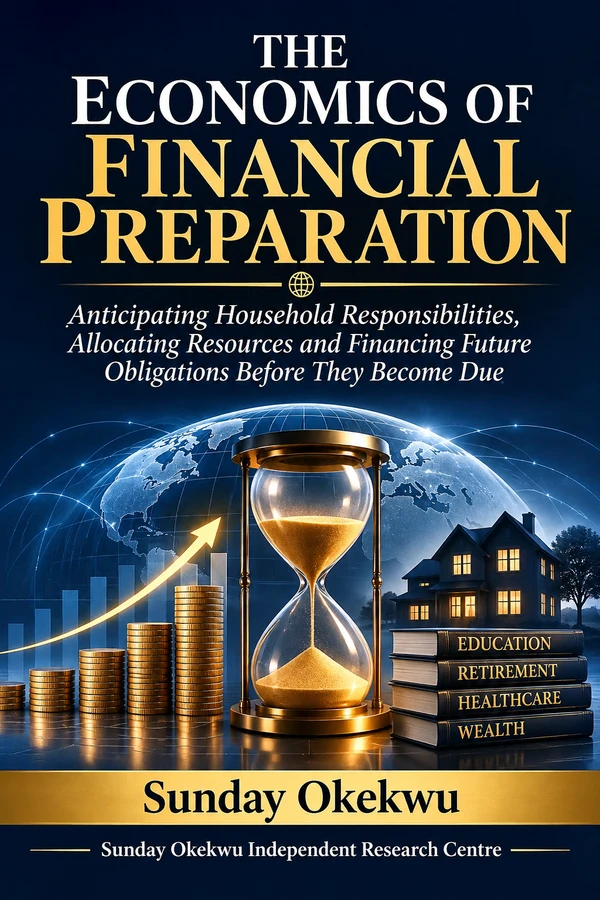
THE ECONOMICS OF FINANCIAL PREPARATION
About This Book
THE ECONOMICS OF FINANCIAL PREPARATION
Anticipating Household Responsibilities, Allocating Resources and Financing Future Obligations Before They Become Due
Financial preparation is a fundamental dimension of household economic organisation. While conventional financial analysis focuses on income, consumption, saving, investment and wealth accumulation, less attention is given to how households organise present resources to meet future financial obligations.
This book examines financial preparation as a distinct dimension of household economic decision-making. It investigates how individuals and households anticipate future responsibilities, allocate resources, coordinate financial commitments and structure financial assets to meet obligations without compromising current consumption or long-term financial stability.
The central research problem concerns the relationship between future obligations and the timing, availability and allocation of financial resources. Households may possess substantial income, savings and investments yet remain financially vulnerable when their resources are not appropriately structured to meet foreseeable commitments. Financial capacity must therefore be assessed not only by accumulated wealth but also by the ability to finance responsibilities when they become due.
The analysis explores intertemporal resource allocation, household consumption, liquidity management, precautionary saving, investment horizons, financial risk, opportunity costs and financial responsibilities across the life cycle. It considers the economic implications of preparing for children's education, housing, healthcare, family obligations and retirement.
A central contribution of this research is its examination of financial preparation as a process connecting anticipated obligations with present economic decisions. It challenges the assumption that increased income, savings or investment growth automatically produce financial security. Instead, it argues that financial resources must be appropriately allocated, accessible and positioned to meet the responsibilities they are intended to finance.
The book also examines how delayed preparation, inadequate liquidity and poorly coordinated investment decisions can expose households to unnecessary borrowing, forced asset liquidation and declining financial resilience.
Integrating principles from household economics, financial planning, investment theory and risk management, this research provides an analytical framework for understanding financial preparation as an essential component of long-term household economic stability.
Its central proposition is that financial security depends not only on the resources households accumulate, but also on how effectively those resources are prepared, allocated and positioned to meet future obligations.
Author: Sunday Okekwu
Publisher: Sunday Okekwu Independent Research Centre Press
Research Institution: Sunday Okekwu Independent R
This book explores the concept of financial preparation within household economics, emphasizing the importance of organizing present resources to meet future obligations. It provides an analytical framework for understanding how households can effectively allocate their financial resources to enhance long-term economic stability.
Who this book is for
- Household financial planners
- Students of economics
- Individuals preparing for future financial obligations
- Investors
- Financial advisors
What you'll learn
- The importance of anticipating future financial responsibilities
- How to allocate resources effectively
- Strategies for managing liquidity and saving
- The impact of delayed financial preparation
- The relationship between income and financial security
Read a free sample 10 pages from the book
THE ECONOMICS OF FINANCIAL PREPARATION Sunday Okekwu
THE ECONOMICS OF FINANCIAL PREPARATION 1. THE ECONOMICS OF FINANCIAL PREPARATION 2. COPYRIGHT 3. RESEARCH AND ACADEMIC DISCLAIMER 4. INSTITUTIONAL NOTE 5. RESEARCH FOCUS 1. Central Research Question 2. Research Background 3. Research Questions 6. RESEARCH OBJECTIVES 1. Principal Objective 2. Specific Objectives 7. KEYWORDS 8. BOOK SUMMARY 9. ABSTRACT 10. ORIGINAL THEORETICAL CONTRIBUTION 11. PREFACE 12. SCOPE AND METHODOLOGICAL NOTE 13. ABOUT THE AUTHOR 14. CHAPTER ONE — The Economics Of Financial Preparation 1. 1.1 Introduction 2. 1.2 The Household as an Intertemporal Economic Unit 3. 1.3 Defining Financial Preparation as an Economic Process 4. 1.4 The Economic Nature of Future Household Responsibilities
5. 1.5 Established Economic Foundations of Financial Preparation 6. 1.6 The Timing Dimension of Financial Preparation 7. 1.7 The Structure of Household Financial Preparation 8. 1.8 Financial Preparation Under Different Household Conditions 9. 1.9 Financial Preparation and Related Economic Concepts 10. 1.10 A Working Analytical Proposition 11. 1.11 The Boundaries of Financial Preparation 12. 1.12 The Research Direction: Anticipatory Household Financial Responsibility Theory 13. 1.13 The Theoretical Structure of AHFRT 14. 1.14 The Proposed Theoretical Contribution of AHFRT 15. 1.15 Limitations and Further Development of the Theory 16. 1.16 Chapter Conclusion 17. REFERENCES 15. CHAPTER TWO — The Economics Of Future Household Obligations 1. 2.1 Introduction 2. 2.2 The Economic Meaning of Household Obligations 3. 2.3 Classification of Future Household Obligations 4. 2.4 Future Obligations and Present Household Income 5. 2.5 The Life-Cycle Hypothesis 6. 2.6 The Permanent Income Hypothesis 7. 2.7 Keynesian Consumption Theory and Motives for Saving 8. 2.8 Precautionary Saving and Uncertainty 9. 2.9 Behavioural Life-Cycle Theory and Financial Procrastination 10. 2.10 Human Capital Theory and Education 11. 2.11 Timing of Obligations and Cost of Preparation 12. 2.12 Inflation and Future Financial Cost 13. 2.13 Economic Consequences of Unfunded Obligations
14. 2.14 Household as a System of Competing Financial Responsibilities 15. 2.15 Future Household Obligations in Different Economic Environments: Nigerian Context 16. 2.16 Theoretical Synthesis 17. 2.17 The Anticipated Household Obligation and Proposed Theoretical Constructs 18. 2.18 Conclusion 19. REFERENCES 16. CHAPTER THREE — Present Consumption And Future Financial Capacity 1. 3.1 Introduction 2. 3.2 The Economic Meaning of Present Household Consumption 3. 3.3 Consumption, Income and Household Financial Capacity 4. 3.4 Essential, Discretionary and Commitment-Based Consumption 5. 3.5 Intertemporal Consumption Decisions 6. 3.6 Consumption Growth and Household Wealth Accumulation 7. 3.7 Lifestyle Expansion, Income Growth and Financial Commitments 8. 3.8 Consumption Habits and Behavioural Influences on Financial Decisions 9. 3.9 The Opportunity Cost of Present Consumption 10. 3.10 Household Debt and the Reduction of Future Disposable Income 11. 3.11 Consumption Smoothing and the Limits of Household Adjustment 12. 3.12 Present Consumption, Financial Flexibility and Future Obligations
13. 3.13 Present Consumption and Future Household Wealth 14. 3.14 The Economics of Consumption Commitments Across Household Life Stages 15. 3.15 Present Consumption Decisions in Developing Economies: The Nigerian Context 16. 3.16 An Analytical Framework for Present Consumption and Future Financial Capacity 17. 3.17 Integration of the Three Proposed Constructs 18. 3.18 Conclusion 19. REFERENCES 17. CHAPTER FOUR — The Economics Of Delayed Financial Preparation 1. PART ONE — THE ECONOMICS OF FUTURE HOUSEHOLD RESPONSIBILITIES 2. 4.1 Introduction 3. 4.2 Understanding Delayed Financial Preparation 4. 4.3 The Economics of Time in Household Financial Decisions 5. 4.4 The Opportunity Cost of Starting Late 6. 4.5 Inflation and the Rising Cost of Future Obligations 7. 4.6 The Cost of Compressed Financial Preparation 8. 4.7 Delayed Preparation and the Economics of Compounding 9. 4.8 Income Uncertainty and the Consequences of Late Preparation 10. 4.9 Emergency Financing and the Financial Penalties of Delay 11. 4.10 Delayed Preparation, Household Debt and Financial Fragility 12. 4.11 The Cost of Delayed Financial Protection 13. 4.12 Delayed Preparation Across Household Life Stages 14. 4.13 Intergenerational Consequences of Delayed Preparation
15. 4.14 Delayed Financial Preparation in Developing Economies: The Nigerian Context 16. 4.15 The Economic Measurement of Delayed Financial Preparation 17. 4.16 An Analytical Framework for the Cost of Delayed Preparation 18. 4.17 Theoretical Foundations and Implications for the Anticipatory Household Financial Responsibility Theory 19. 4.18 Conclusion 20. REFERENCES 21. Research Qualification 18. CHAPTER FIVE: HOUSEHOLD SAVING AND THE ECONOMICS OF RESOURCE ALLOCATION 1. PART TWO: ECONOMIC AND BEHAVIOURAL FOUNDATIONS 2. 5.1 INTRODUCTION 3. 5.2 THE ECONOMIC MEANING OF HOUSEHOLD SAVING 4. 5.3 THE RELATIONSHIP BETWEEN INCOME, CONSUMPTION AND SAVING 5. 5.4 THEORETICAL FOUNDATIONS OF HOUSEHOLD SAVING 6. 5.5 SAVING AS AN INTERTEMPORAL RESOURCE- ALLOCATION DECISION 7. 5.6 THE DIFFERENCE BETWEEN RESIDUAL SAVING AND PURPOSE-DIRECTED SAVING 8. 5.7 THE ECONOMICS OF COMPETING HOUSEHOLD RESPONSIBILITIES 9. 5.8 PRECAUTIONARY SAVING AND HOUSEHOLD ECONOMIC UNCERTAINTY
10. 5.9 THE EFFECT OF INFLATION ON HOUSEHOLD SAVING 11. 5.10 SAVING, INVESTMENT AND THE PRESERVATION OF FINANCIAL CAPACITY 12. 5.11 FINANCIAL ALLOCATION ACROSS DIFFERENT TIME HORIZONS 13. 5.12 THE OPPORTUNITY COST OF SAVING 14. 5.13 WHY HIGHER INCOME DOES NOT AUTOMATICALLY PRODUCE HIGHER FINANCIAL PREPARATION 15. 5.14 THE LIMITATIONS OF CONVENTIONAL SAVING MEASURES 16. 5.15 AN OBLIGATION-BASED APPROACH TO HOUSEHOLD SAVING 17. 5.16 HOUSEHOLD SAVING AND FINANCIAL VULNERABILITY 18. 5.17 IMPLICATIONS FOR HOUSEHOLD FINANCIAL DECISION-MAKING 19. 5.18 CONCLUSION 20. REFERENCES 21. RESEARCH QUALIFICATION 19. CHAPTER 6 — LIFE-CYCLE ECONOMICS AND HOUSEHOLD FINANCIAL PREPARATION 1. 6.1 INTRODUCTION 2. 6.2 THE ECONOMIC MEANING OF THE LIFE-CYCLE PERSPECTIVE 3. 6.3 THE LIFE-CYCLE HYPOTHESIS OF CONSUMPTION AND SAVING 4. 6.4 THE PERMANENT INCOME HYPOTHESIS 5. 6.5 HOUSEHOLD RESPONSIBILITIES ACROSS THE LIFE CYCLE
6. 6.6 PRECAUTIONARY SAVING THEORY AND INCOME UNCERTAINTY 7. 6.7 BUFFER-STOCK SAVING AND THE NEED FOR LIQUIDITY 8. 6.8 HOUSEHOLD ECONOMICS AND THE ROLE OF FAMILY RELATIONSHIPS 9. 6.9 THE NIGERIAN ECONOMIC ENVIRONMENT AND LIFE-CYCLE PREPARATION 10. 6.10 HOUSEHOLD FINANCIAL CAPACITY, AGE, INCOME AND OBLIGATIONS 11. 6.11 THE DIFFERENCE BETWEEN LIFE-CYCLE SAVING AND LIFE-CYCLE FINANCIAL PREPARATION 12. 6.12 INTEGRATING THE ESTABLISHED THEORIES 13. 6.13 THE FOUNDATIONS OF ANTICIPATORY HOUSEHOLD FINANCIAL RESPONSIBILITY THEORY 14. 6.14 THE FIVE ANALYTICAL DIMENSIONS OF AHFRT 15. 6.15 THE ECONOMICS OF PREPARATION TIME 16. 6.16 LIFE-CYCLE WEALTH AND LIFE-CYCLE FINANCIAL READINESS 17. 6.17 RESEARCH PROPOSITIONS AND EMPIRICAL INVESTIGATION 18. 6.18 CONCLUSION 19. REFERENCES 20. RESEARCH QUALIFICATION 20. CHAPTER 7 — BEHAVIOURAL ECONOMICS AND FINANCIAL PROCRASTINATION 1. 7.1 INTRODUCTION: THE PROBLEM OF CONVERTING FINANCIAL INTENTION INTO ACTION
2. 7.2 BEHAVIOURAL ECONOMICS AND THE LIMITS OF THE FULLY RATIONAL HOUSEHOLD 3. 7.3 BOUNDED RATIONALITY, LIMITED ATTENTION AND COGNITIVE COSTS 4. 7.4 INTERTEMPORAL CHOICE, PRESENT BIAS AND TIME INCONSISTENCY 5. 7.5 HYPERBOLIC DISCOUNTING AND FINANCIAL PROCRASTINATION 6. 7.6 SELF-CONTROL, COMMITMENT DEVICES AND PRECOMMITMENT 7. 7.7 MENTAL ACCOUNTING, EARMARKING AND RESOURCE DIVERSION 8. 7.8 LOSS AVERSION, REFERENCE DEPENDENCE AND FINANCIAL AVOIDANCE 9. 7.9 OPTIMISM, PLANNING ERRORS AND MISJUDGMENT OF FUTURE CAPACITY 10. 7.10 STATUS QUO BIAS, DEFAULTS AND ADMINISTRATIVE FRICTION 11. 7.11 SOCIAL PREFERENCES, FAMILY BARGAINING AND HOUSEHOLD FINANCIAL DECISIONS 12. 7.12 FINANCIAL LITERACY, CAPABILITY AND THE LIMITS OF INFORMATION 13. 7.13 FINANCIAL PROCRASTINATION IN THE NIGERIAN HOUSEHOLD CONTEXT 14. 7.14 THE THEORETICAL GAP: WHY A RESPONSIBILITY- CENTRED CONVERSION FRAMEWORK IS NECESSARY 15. 7.15 PROPOSED ANTICIPATORY FINANCIAL ACTION CONVERSION THEORY (AFACT) 16. 7.16 THE SEVEN-STAGE CONVERSION MECHANISM
17. 7.17 THE DISTINCTIVE THEORETICAL CONTRIBUTION OF AFACT WITHIN AHFRT 18. 7.18 THEORETICAL ASSUMPTIONS, CONSTRUCTS AND BOUNDARY CONDITIONS 19. 7.19 RESEARCH PROPOSITIONS 20. 7.20 OPERATIONALISATION AND EMPIRICAL TESTING 21. 7.21 POLICY AND INSTITUTIONAL IMPLICATIONS 22. 7.22 CONCLUSION 23. REFERENCES 24. RESEARCH QUALIFICATION 21. CHAPTER 8 — INCOME UNCERTAINTY, INFLATION AND HOUSEHOLD FINANCIAL PREPARATION 1. 8.1 Introduction: The Economic Instability of Future Household Preparation 2. 8.2 Income Uncertainty and the Household Budget Constraint 3. 8.3 Types of Income Risk: Temporary, Persistent, Permanent, Seasonal and Correlated Shocks 4. 8.4 Income Volatility, Liquidity Constraints and Consumption Smoothing 5. 8.5 Precautionary Saving and Buffer-Stock Behaviour 6. 8.6 The Limits of Precautionary Saving Under Low and Irregular Income 7. 8.7 Inflation and the Erosion of Household Purchasing Power 8. 8.8 Nominal Income, Real Income and the Measurement of Financial Capacity 9. 8.9 Inflation, Future Obligation Costs and the Financing Gap 10. 8.10 Nominal Returns, Real Returns and the Preservation of Financial Resources
11. 8.11 Inflation Expectations, Uncertainty and Household Decision- Making 12. 8.12 The Interaction Between Income Uncertainty and Inflation 13. 8.13 Debt, Interest Rates and Household Financial Fragility 14. 8.14 Household Risk Exposure, Diversification and Income Continuity 15. 8.15 Application to Nigerian Household Economic Conditions 16. 8.16 Implications for Anticipatory Household Financial Responsibility Theory 17. 8.17 Income-Adjusted Preparation Capacity: A Conceptual Analytical Construct 18. 8.18 Research Propositions 19. 8.19 Operationalisation and Empirical Testing 20. 8.20 Policy and Institutional Implications 21. 8.21 Conclusion 22. References 23. Research Qualification 22. CHAPTER 9 — The Case For An Anticipatory Theory Of Household Finance 1. 9.1 Introduction: The Need for a Responsibility-Centred Theory of Household Finance 2. 9.2 The Research Problem: Financial Activities Are Connected but Future Responsibilities Are Not Always the Organising Principle 3. 9.3 What Established Economic Theories Explain 4. 9.4 Contemporary Research on Financial Planning, Household Finance and Financial Resilience 5. 9.5 Why an Anticipatory Theory Is Necessary
6. 9.6 The Central Premise of Anticipatory Household Financial Responsibility Theory 7. 9.7 The Scope and Analytical Boundaries of AHFRT 8. 9.8 The Relationship Between AHFRT and Established Economic Foundations 9. 9.9 Anticipatory Financial Action Conversion Theory: From Recognition to Sustained Preparation 10. 9.10 Future Obligation Funding Alignment Theory: Matching Resources to Future Requirements 11. 9.11 Household Financial Continuity and Resilience Theory: Preserving Preparation Through Financial Disruption 12. 9.12 The Integrated AHFRT Architecture 13. 9.13 Research Questions and Propositions for Theoretical Investigation 14. 9.14 Implications for Household Finance Research and Practice 15. 9.15 Originality, Theoretical Contribution and Research Boundaries 16. 9.16 Conclusion: Establishing the Case for an Anticipatory Theory of Household Finance 17. REFERENCES 18. RESEARCH QUALIFICATION 23. CHAPTER 10 — Foundations Of Anticipatory Household Financial Responsibility Theory 1. 10.1 Introduction 2. 10.2 The Theoretical Position of AHFRT 3. 10.3 Established Theoretical Foundation One: Human Capital Theory 4. 10.4 Established Theoretical Foundation Two: Modern Portfolio Theory
5. 10.5 Established Theoretical Foundation Three: Expected Utility Theory 6. 10.6 Integration of the Three Established Theories 7. 10.7 The Proposed Theoretical Architecture of AHFRT 8. 10.8 Proposed Companion Theory One: Anticipatory Financial Action Conversion Theory 9. 10.9 Proposed Companion Theory Two: Future Obligation Funding Alignment Theory 10. 10.10 Proposed Companion Theory Three: Household Financial Continuity and Resilience Theory 11. 10.11 Relationship Among AHFRT, AFACT, FOFAT and HFCRT 12. 10.12 The Conceptual Distinction Between Theories and Analytical Constructs 13. 10.13 The Principal Constructs of AHFRT 14. 10.14 Assumptions of Anticipatory Household…
End of sample. The full book is 1063 pages on Afri KDP.
Questions about this book
What is the main focus of this book?
The book focuses on how households can organize their current resources to meet future financial obligations without compromising their current consumption.
Loading reviews...

Loading…
A download link appears on this page as soon as your payment is confirmed, and a permanent copy of the link is emailed to you.
By card from anywhere. In Nigeria you can also pay by bank transfer, USSD or mobile money. Your card details are entered on Paystack's secure page, never on AfriKDP.
Yes. The file opens on phones, tablets, computers and eReaders.
Yes, with an AfriKDP reading plan, which opens every book in the online reader and pays the author for every page you read.
Write to [email protected] with your email address and we will help. See our return policy.