 AfriKDP
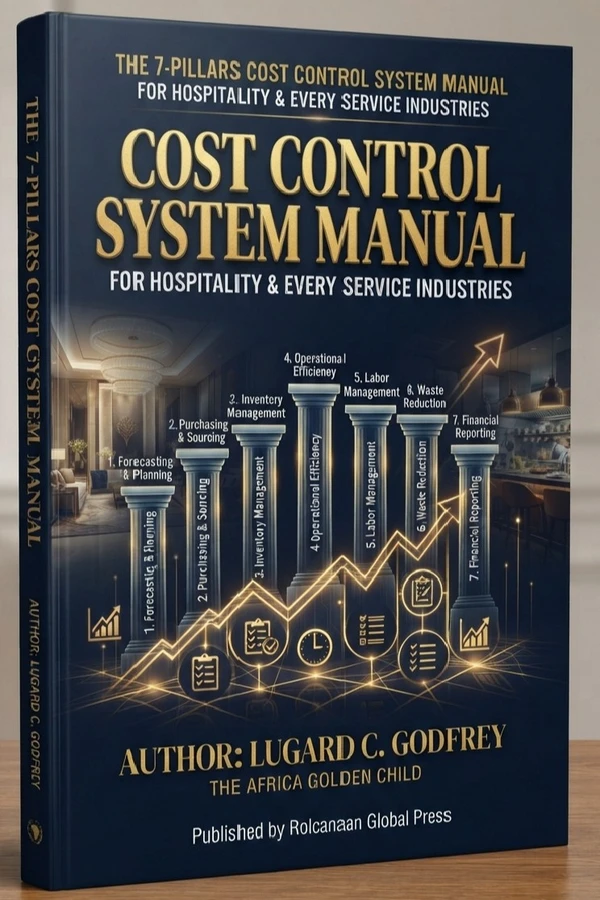
THE 7 PILLARS COST CONTROL SYSTEM MANUAL
About This Book
rigorous operational framework designed to control costs,
protect revenue, and drive sustainable performance across hospitality and all service-oriented industries.
While originally conceived for the high-pressure environment of hospitalitycharacterized by perishable stock, long operating hours, extensive cash handling, and large teams.
the manual's control logic is universally applicable to restaurants, healthcare facilities, corporate offices, logistics and transport, retail, education, and event management.
1. Core Philosophy & Governing Principles
The manual rejects the notion that cost control is merely a policing exercise. Instead, it treats cost control as a core management discipline.
Four Foundational Convictions
Every cost has an owner: A cost that belongs to everyone belongs to no one.
NOTE: EVERY COST HAS A DRIVER, AND EVERY DRIVER REQUIRES A GOOD MANAGEMENT SKILL!
IF YOU FAIL TO CONTROL THE DRIVER, YOU WILL STRUGGLE TO CONTROL THE COST!!!
By: Lugard C. Godfrey
The 7-Pillar Cost Control System Manual provides a structured approach to managing costs and enhancing performance across various service sectors. It emphasizes the importance of accountability and standardized processes in controlling expenses and protecting revenue.
Who this book is for
- Hospitality managers
- Financial controllers
- Business owners
- Department heads
- Cost accountants
What you'll learn
- Principles of effective cost control
- How to implement a cost control system
- Methods for tracking and managing expenses
- Key performance indicators for monitoring costs
- Strategies to prevent revenue leakage
Read a free sample 3 pages from the book
T H E 7 - P I L L A R C O S T C O N T R O L S Y S T E M M A N U A L G.6 Phase 3: Refinement (Months 6 – 8).............................................................................................................................................56 G.7 Phase 4: Institutionalisation (Months 9 – 12).................................................................................................................................57 G.8 Scaling the System to the Size of the Business.............................................................................................................................57 G.9 Managing Resistance and Change................................................................................................................................................58 G.10 The Maturity Model.......................................................................................................................................................................58 G.11 Critical Success Factors...............................................................................................................................................................58 Appendix A – Purchase Requisition Form...........................................................................................................59 Appendix B – Goods Received Note (GRN) Template........................................................................................60 Appendix C – Stock Variance Report..................................................................................................................61 Appendix D – Monthly Performance Dashboard................................................................................................62 Appendix E – Auditor’s Compliance Checklist...................................................................................................63 Lugard C. GodfreyPage 4
T H E 7 - P I L L A R C O S T C O N T R O L S Y S T E M M A N U A L T H E 7 - P I L L A R C O S T C O N T R O L S Y S T E M Introduction I.1 Purpose of the System The 7-Pillar Cost Control System is a complete operating framework for controlling cost, protecting revenue and improving performance in any organisation that buys inputs, converts them into services, and is paid for the result. It was written for hospitality, where perishable stock, long operating hours, cash handling and large teams expose every weakness in management control. Its logic, however, is universal, and it applies with equal force in every service industry. This manual gives owners, general managers, department heads, purchasing officers, storekeepers, accountants and auditors one common language and one common set of controls. It exists to answer a single question in every department, every day: where does every unit of money go, who is responsible for it, and how do we know? W H A T T H I S M A N U A L D E L I V E R S A written standard for each of the seven pillars, from the moment money is committed to the moment performance is reviewed. Formulas, tools and worked examples that can be applied immediately, in any currency. Universal application tables showing how each pillar adapts beyond hotels to restaurants, healthcare, corporate offices, logistics, retail, education, event management and other service sectors. Key performance indicators, red-flag guides and compliance checklists for every pillar. A phased implementation plan and ready-to-use templates for immediate deployment. I.2 Philosophy: Prevention, Not Suspicion Cost control is a management discipline, not a policing exercise. A well-designed system does not assume that people are dishonest; it makes the correct action the easy action and makes every incorrect action visible. Honest employees are protected by it, careless habits are corrected by it, and dishonesty is deterred and detected by it. Four convictions underpin the entire system: 1.Every cost has an owner. A cost that belongs to everyone belongs to no one. 2.Standards come before measurement. A variance can only be identified against a defined standard: a specification, a recipe, a par level, a roster or a benchmark. 3.Prevention is cheaper than detection, and detection is cheaper than recovery. Controls are placed at the point of decision, before money leaves the business. 4.What is not recorded did not happen, and what is not reviewed will not improve. Records give the truth a permanent form; reviews give it consequences. T H E G O V E R N I N G R U L E Every unit of cost must have a standard, an owner, a record and a review. Profit in a service business is not made in the accounts office. It is made, or lost, at the receiving bay, in the store, in the kitchen or workshop, at the till, on the roster and at the meter. The accounts only report what those places have already decided. Lugard C. GodfreyPage 5
T H E 7 - P I L L A R C O S T C O N T R O L S Y S T E M M A N U A L I.3 Where Service Businesses Lose Money Losses in service businesses are rarely dramatic. They are small, frequent and invisible, and they compound: a few grams over-portioned per plate, a delivery short by a few kilograms, an hour of unnecessary overtime, a generator left running, a discount given without approval. Each leakage point below is closed by a specific pillar. Leakage PointTypical Forms of LossPillar BuyingWrong specification, inflated prices, unapproved suppliers, over-ordering, emergency purchases 1 Receiving & StorageShort deliveries, substituted quality, unweighed goods, theft, spoilage, expiry, poor rotation, unrecorded issues 2 Production & UseOver-portioning, off-recipe production, wastage, unrecorded consumption, unmanaged high-value items 3 Sales & CollectionUnrecorded sales, under-ringing, unauthorised discounts and compliments, uncollected credit, cash shortages 4 LabourStaffing above demand, idle hours, unapproved overtime, ghost workers, absenteeism, untrained staff 5 Energy, Maintenance & Assets Wasteful consumption, fuel diversion, breakdowns from missed maintenance, lost linen, uniforms and equipment 6 ManagementLate or missing reports, no follow-up, no independent check, repeated errors7 I.4 The Seven Pillars at a Glance The system rests on seven pillars. Each one controls a distinct stage of the money cycle; together they form a closed loop in which nothing is bought, stored, used, sold, paid or reported without a standard, an owner, a record and a review. Figure 1: The Seven Pillars of the Cost Control System PillarCore QuestionChief ControlsHeadline KPI 1 Procurement & Purchasing Are we buying the right item, quantity, price and supplier? Approved suppliers, purchase orders, three-way comparison, specifications % of spend with approved suppliers on a valid PO Lugard C. GodfreyPage 6
T H E 7 - P I L L A R C O S T C O N T R O L S Y S T E M M A N U A L PillarCore QuestionChief ControlsHeadline KPI 2 Receiving, Stores & Inventory Is everything we paid for received, protected and accounted for? GRN, store discipline, FIFO/FEFO, tiered counts, variance analysis Stock variance % 3 Food & Beverage / Supply Cost Control Are inputs used at the standard quantity and cost? Standard recipes/SOPs, portion control, waste recording, menu engineering Cost of sales % against standard 4 Revenue & Leakage Control Is every sale recorded, collected and banked? Revenue mapping, cash reconciliation, authorisation of discounts and compliments, credit controls Revenue variance and cash shortage % 5 Labour & Productivity Is the right number of people working at the right time, productively? Demand-based rostering, attendance systems, overtime governance, training Labour cost %; output per labour hour 6 Energy, Maintenance & Assets Are utilities, equipment and assets used, maintained and protected? Sub-metering, fuel logs, preventive maintenance, asset register, linen/uniform control Energy cost per unit of output 7 Monitoring, Reporting & Audit Do we see problems early and correct them? KPI dashboards, review cadences, internal audit, continuous improvement % of corrective actions closed on time I.5 Six Universal…
End of sample. The full book is 67 pages on Afri KDP.
Questions about this book
What industries can benefit from this cost control manual?
While designed for hospitality, the manual's principles apply universally to restaurants, healthcare, logistics, retail, and more.
Loading reviews...

Loading…
A download link appears on this page as soon as your payment is confirmed, and a permanent copy of the link is emailed to you.
By card from anywhere. In Nigeria you can also pay by bank transfer, USSD or mobile money. Your card details are entered on Paystack's secure page, never on AfriKDP.
Yes. The file opens on phones, tablets, computers and eReaders.
Yes, with an AfriKDP reading plan, which opens every book in the online reader and pays the author for every page you read.
Write to [email protected] with your email address and we will help. See our return policy.