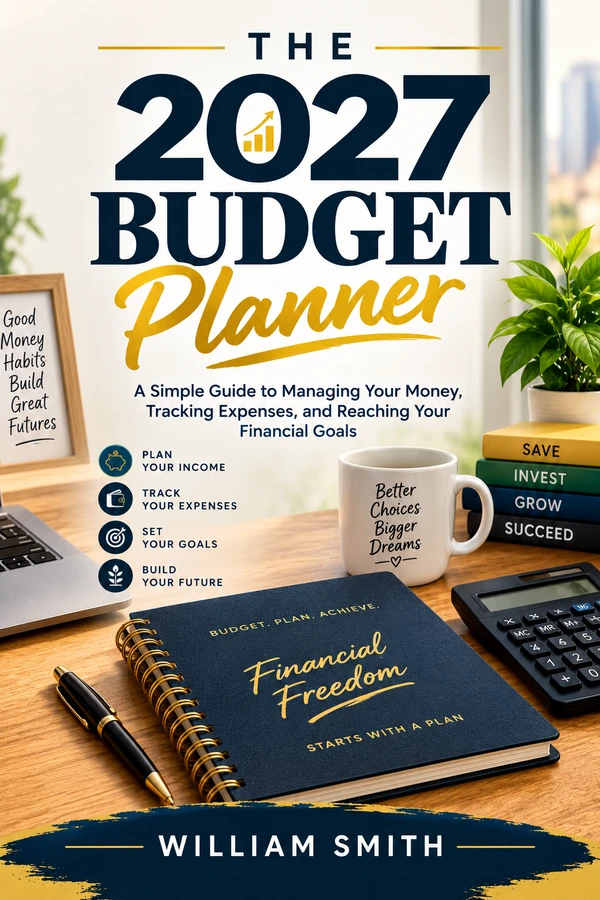
The 2027 budget planner
About This Book
Create a Realistic Budget: Learn how to build a budget around your income, expenses, and financial priorities.
Track Your Spending: Identify where your money goes and find opportunities to reduce unnecessary expenses.
Set Meaningful Financial Goals: Turn your financial ambitions into manageable steps you can work toward throughout 2027.
Develop Better Saving Habits: Discover practical ways to save consistently, even when your income is limited.
The 2027 Budget Planner offers a straightforward approach to budgeting, helping readers create realistic budgets, track spending, and set meaningful financial goals. This workbook guides you through understanding your financial situation and developing better saving habits throughout the year.
Who this book is for
- Anyone wanting financial control
- Students managing limited income
- Individuals with irregular earnings
- Families planning budgets
- Anyone looking to save money
What you'll learn
- How to create a realistic budget
- Ways to track spending effectively
- Setting achievable financial goals
- Developing better saving habits
- Understanding different income sources
- Managing bills and regular payments
- Planning for emergencies
Read a free sample 8 pages from the book
T H E 2 0 2 7 B U D G E T P L A N N E RFront Matter Disclaimer This book is written for general education and personal organisation. It is not financial, investment, tax, accounting, or legal advice, and it is not a substitute for guidance from a qualified professional who understands your individual circumstances. The examples, figures, and scenarios used throughout this planner are simplified illustrations. They use round numbers in no particular currency so that the ideas are easy to follow. They are not predictions, recommendations, or promises of any result. Financial rules, interest rates, fees, and taxes differ from one country, lender, and institution to another, and they change over time. Always confirm the terms of your own accounts, loans, and contracts directly with the provider before making decisions. Every person’s situation is different. The author and publisher make no guarantee that using this planner will lead to any particular financial outcome, and accept no liability for decisions made, or losses incurred, as a result of using the information in this book. If you are struggling with debt, or if money worries are affecting your health or wellbeing, please consider speaking with a qualified financial counsellor or a trusted professional in your area. iii
T H E 2 0 2 7 B U D G E T P L A N N E RFront Matter Introduction Most people do not struggle with money because they are careless. They struggle because money moves quickly, bills arrive on their own schedule, and almost nobody is ever shown a simple way to keep track. This planner is that simple way. The 2027 Budget Planner is a workbook, not a lecture. Each chapter explains one idea in plain language, shows a small example, and then asks you to do something with it: fill in a table, tick off a checklist, or answer a few honest questions. By the end of the year you will have a written record of what you earned, what you spent, what you saved, and what you learned — all in your own handwriting. What a budget really is A budget is a plan for your money, made before you spend it. It is not a punishment, and it is not a test you can fail. It simply answers one question: given what I have coming in, what do I want my money to do? Who this planner is for This planner is for anyone who wants more control over their money in 2027 — whether you are employed, self-employed, a student, running a household, earning an irregular income, or starting from nothing. You do not need spreadsheets, apps, or any financial background. A pen and a little honesty are enough. What this planner will not do It will not make decisions for you, and it cannot promise results. Your income, costs, and circumstances are your own. What the planner offers is structure: a clear, repeatable way to look at your money so that your decisions are better informed. Progress comes from small actions repeated over many weeks. How the book is organised StageChaptersWhat you will do Understand1 – 3 Take stock of where you stand, understand your income, and discover where your money really goes. Plan4 – 5 Build a realistic monthly budget and organise your bills and regular payments. Strengthen6 – 9 Create savings, manage debt, trim unnecessary spending, and prepare for emergencies. Direct and review10 – 12 Set goals, review every month of 2027, and finish the year with a clear picture of your progress. A word before you begin Aim to be honest rather than perfect. Estimates are fine at the start, and you can improve them as you go. If you miss a week, simply pick up where you left off. A half-completed planner that you actually use is worth far more than a perfect one left in a drawer. iv
T H E 2 0 2 7 B U D G E T P L A N N E RFront Matter How to Use This Planner The planner follows the 2027 calendar year, from Friday 1 January to Friday 31 December. You can start at the very beginning of the year or at any point during it; the worksheets work the same either way. Work in order at first Chapters 1 to 5 build on one another, so complete them in order during your first month. After that, the chapters become reference and tracking tools you return to as the year goes on. Chapter 11 is the one you will use most often: it contains a review section for every month of 2027. Your money rhythm WhenTime neededWhat to do Daily About 5 minutes Write down what you spent and what you received. Weekly About 15 minutes Add up the week, check which bills are due soon, and note anything unexpected. Monthly 45 – 60 minutes Complete the monthly review in Chapter 11 and adjust next month’s plan. Yearly1 – 2 hoursComplete the Year-End Review in Chapter 12 and set your goals for 2028. The kinds of pages you will meet Page typeHow to use it Explanation pagesRead these once. They are short and practical, and they come with an example. WorksheetsFill these in carefully. They gather the numbers your budget is built on. Trackers and logsReturn to these regularly. They record what happens over time. ChecklistsTick each box when the task is done: ☐ Reflection pagesWrite freely. There are no right or wrong answers, only useful ones. Simple rules that make the planner work •Write in pencil if you like. Numbers can be corrected; blank pages cannot. •Round to the nearest whole number to keep things quick. •Always write the date, so you can see how things change. •Keep the planner somewhere you will see it, such as on a desk or by your bed. •If you fall behind, do not start over. Restart from today. v
T H E 2 0 2 7 B U D G E T P L A N N E RFront Matter What You Need Before You Begin A little preparation makes the first chapters much faster. Spend 30 to 45 minutes gathering the items below. Where something does not apply to you, simply skip it, and where something is missing, make a note and track it down later. You can use paper statements, online banking, or mobile money and wallet apps. Item to gatherWhy it helps ☐ Bank or mobile money statements (last 3 months) Shows what you actually spent, not what you remember spending. ☐Payslips or income recordsConfirms your real take-home income. ☐ Income records for side work or business Helps you estimate irregular income fairly. ☐A list of regular bills and due datesPrevents missed payments; used in Chapter 5. ☐ Loan, credit, or instalment statements Gives accurate balances and monthly payments. ☐Current savings and account balancesSets your starting point for Chapter 6. ☐Receipts and subscription detailsReveals small, recurring costs. ☐Calendar or diaryLets you mark due dates and key events in 2027. ☐ Pen or pencil, calculator, and highlighter Basic tools for filling in the pages. ☐ A folder or envelope for receipts and statements Keeps your money paperwork in one place. Set aside a calm hour Choose a time when you will not be interrupted. Many people find it easier to do their first money session with a drink, a quiet room, and no distractions. If you share finances with someone, consider doing the first session together. vi
T H E 2 0 2 7 B U D G E T P L A N N E RFront Matter 2027 Financial Starting Point This page is a quick “before” picture. Fill in the first column now, using your best estimates. Chapter 12 asks you to fill in the second column at the end of the year, so you can…
End of sample. The full book is 168 pages on Afri KDP.
Questions about this book
What if I have a limited income?
The planner emphasizes that budgeting is even more crucial when income is limited, as it helps you see your choices clearly and make informed decisions.
Loading reviews...

Loading…
A download link appears on this page as soon as your payment is confirmed, and a permanent copy of the link is emailed to you.
By card from anywhere. In Nigeria you can also pay by bank transfer, USSD or mobile money. Your card details are entered on Paystack's secure page, never on AfriKDP.
Yes. The file opens on phones, tablets, computers and eReaders.
Yes, with an AfriKDP reading plan, which opens every book in the online reader and pays the author for every page you read.
Write to [email protected] with your email address and we will help. See our return policy.