 AfriKDP
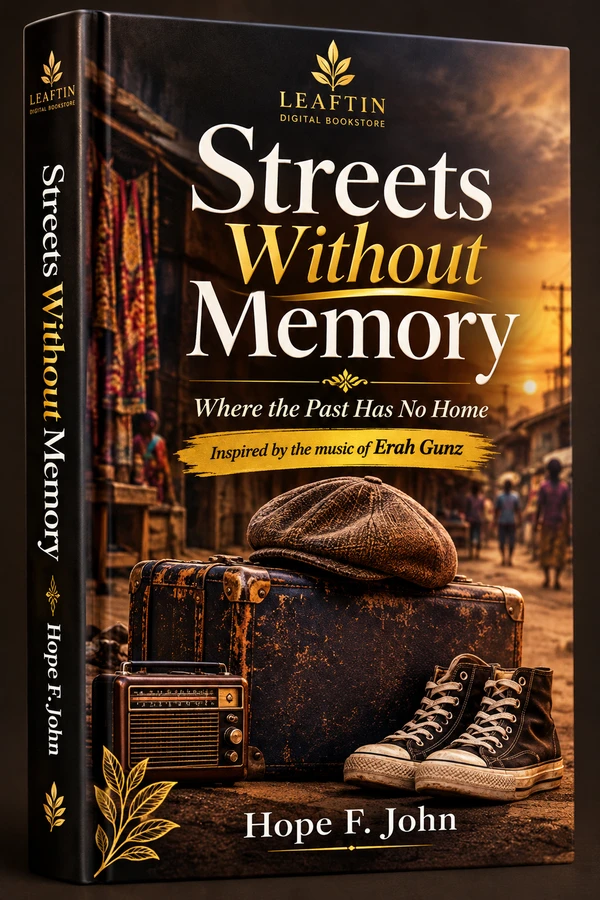
Streets Without Memory
About This Book
Where the Past Has No Home
by Hope F. John
Inspired by the music of Erah Gunz
Some streets remember everything.
Others forget on purpose.
In the restless alleys and fading corners of a city that never quite stands still, memory is a dangerous thing. People carry their pasts like heavy luggage some try to leave it behind, others are hunted by it. A worn suitcase, an old radio playing songs that no longer belong to anyone, a pair of shoes that have walked too far… these are the quiet witnesses to lives that refuse to stay buried.
Streets Without Memory is a story of displacement and belonging, of the things we abandon and the things that refuse to abandon us. Through lyrical, street-level storytelling, Hope F. John explores what happens when the past has no home left to return to and what it costs to keep walking anyway.
For readers who love atmospheric fiction, music-driven narratives, and stories that feel like they were lived before they were written.
'Streets Without Memory' delves into the lives of those who navigate a city that forgets its own. Through the intertwined stories of Kofi, a night rider, and Amara, a woman searching for her brother, the novel examines the weight of names and the impact of erasure in urban life.
Who this book is for
- Young adult readers
- Fans of atmospheric fiction
- Those interested in real-life stories
- Readers who enjoy music-driven narratives
- Anyone exploring themes of memory and belonging
What you'll learn
- The significance of memory in urban life
- How personal histories shape identity
- The impact of erasure on individuals
- The importance of remembering names and stories
- The complexities of returning home after displacement
Read a free sample 5 pages from the book
STREETS WITHOUT MEMORY Where the past has no home HOPE F. JOHN A Novel
3 For the ones the street tried to forget, and for the ones who still write their names.
4 About the Author Hope F. John is a storyteller whose work is rooted in the rhythms, struggles, and quiet truths of African street life. The idea for this novel began as a script titled Street Has No Memory, written in response to the music of the artist Erah Gunz from the heart of Africa scene. The musician’s work, released on 30 October 2025, carried the theme of memory in a way that stayed with Hope for a full year. That year of writing, reflection, rewriting, and listening produced the novel you now hold. Hope writes about the things cities try to forget and the people who refuse to be erased. This is a first novel, born from careful attention to the streets and to the music that refused to let the past stay silent. The author believes that every name written against forgetting is a small act of resistance, and that stories remain one of the few places where the erased can still speak and be heard. In a time when silence is often safer than speech, Hope F. John chooses the harder path of remembering.
5 About the Book Streets Without Memory is a story about what a city chooses to keep and what it chooses to lose. In the crowded, restless streets of a West African city that never truly sleeps, memory is a dangerous thing. People come, people go, names are forgotten, faces blur, and the asphalt itself seems to swallow the past. This novel follows those who live inside that forgetting - the ones who carry private histories the streets refuse to honour, and the ones who try to outrun what the streets have already erased. At the centre of the story is Kofi Mensah, a young night rider who keeps a secret notebook of the names the city discards, and Amara Diallo, a woman who returns after seven years to search for a brother the street has already tried to erase. Around them move the quiet survivors, the old men who refuse to forget, the dealers in silence, and the ordinary people who must decide whether remembering is worth the cost it demands. The story began as a script inspired by the music of Erah Gunz. Over the course of one full year, that script grew into a complete novel about survival, love, silence, betrayal, and the quiet violence of being forgotten. It is a book about the weight of names, the cost of silence, and the stubborn human need to be remembered even when the street itself has no memory. This is a story for anyone who has ever watched a city move on without them, and for anyone who has ever refused to let a name disappear completely.
6 Prologue The Night the Street Forgot a Name The rain came down the way it always did in the city - sudden, heavy, and without apology. It turned the streets into dark mirrors and forced people under the leaking roofs of shops that had closed hours earlier. On the corner of Market Road and the road that led down to the lagoon, a body lay face-down in the gutter. Water ran around it, carrying leaves and plastic and the small debris of a city that never stopped shedding parts of itself. No one stopped for long. A few people glanced, muttered under their breath, and kept walking with their heads down against the water. The rain washed the blood into the stream that ran toward the open drain. By the time the first light of morning touched the wet tar, the body was gone. Someone had taken it. Or the street had simply closed over it the way it closed over everything else that did not have a powerful name attached to it. Later, when the sun was high and the city was loud again with generators and car horns and the calls of hawkers selling what they could, a young man on a motorcycle slowed as he passed the place. He looked at the gutter for a long moment. There was nothing left except a faint dark stain that the rain had not completely erased. He reached into the pocket of his worn jacket, pulled out a small black notebook, and wrote something with a pencil that was almost too short to hold. Then he rode on into the moving heat of the morning. The street did not remember the name. It never did. The street had no interest in names that did not come with money or power or the kind of noise that forced attention. But the notebook did. And for as long as the notebook existed, the forgetting was not yet complete.
7 That was the beginning of everything that followed - not the body itself, which the city had already begun to forget, but the decision of one young man to write the absence down before the rain finished its work.
8 Chapter One The Boy Who Still Remembered Kofi Mensah had been riding the streets at night for four years. He knew the shortcuts that cut through compounds where the dogs barked at anything that moved after dark. He knew the places where the police liked to wait with their flashlights and their questions that were never really questions. He knew which generators still ran when the power failed across whole districts, and which corners felt thicker with darkness than the rest of the city. He carried packages, people, and sometimes messages that were not written down because paper could become evidence. The city paid him just enough to keep the motorcycle running and to rent a small room above a shop that sold second-hand phones and cracked screen protectors. Every night, before he allowed himself to sleep, he opened the black notebook. It was not a diary. He did not write about himself or his hopes or the things that frightened him when the engine was off and the room was quiet. He wrote names. Sometimes only a first name. Sometimes a description when the name was unknown or had never been offered. A woman who sold oranges near the junction and then stopped coming. A boy who used to wash cars at the filling station and disappeared after a fight that everyone claimed not to have seen. An old man who sat outside the church every Sunday until one Sunday he was simply not there and no one asked where he had gone. Kofi wrote them down because the street would not. He did not know exactly why he had started. Maybe it was the first time he saw a body that no one claimed, left like rubbish at the side of a road that people still used the next morning as if nothing had happened. Maybe it…
End of sample. The full book is 100 pages on Afri KDP.
Questions about this book
What are the main themes of the book?
The book explores themes of memory, belonging, displacement, and the struggle against erasure in a city that forgets its own.
Loading reviews...

Loading…
A download link appears on this page as soon as your payment is confirmed, and a permanent copy of the link is emailed to you.
By card from anywhere. In Nigeria you can also pay by bank transfer, USSD or mobile money. Your card details are entered on Paystack's secure page, never on AfriKDP.
Yes. The file opens on phones, tablets, computers and eReaders.
Yes, with an AfriKDP reading plan, which opens every book in the online reader and pays the author for every page you read.
Write to [email protected] with your email address and we will help. See our return policy.