 AfriKDP
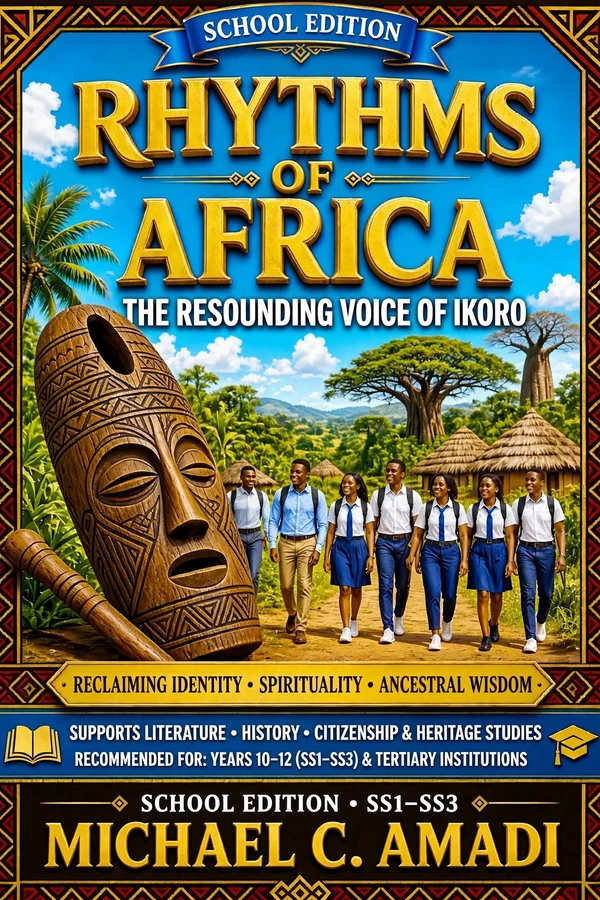
Rhythms of Africa
About This Book
Reclaiming identity, spirituality, and the forgotten wisdom of a continent.
Written for senior secondary students, colleges of education, introductory tertiary courses, teachers, and general readers, this School Edition offers an engaging exploration of Africa's heritage.
Combining cultural memory, historical reflection, and storytelling, the book examines colonisation, African resistance, missionary encounters, post-colonial challenges, communal institutions, moral order, proverbs, and the living voice of the Ikoro. Drawing on Igbo and wider Alkebulan traditions, it encourages readers to rediscover dignity, responsibility, and cultural continuity.
The opening chapters explore colonial expansion, the struggle for independence, and contemporary challenges involving health, security, education, industrial development, and local capacity building.
Central chapters examine communal life through the Ezi and the Obu, farming cycles, the sacred relationship with the land, traditional law, coming of age, dispute resolution, festivals such as Iri Ji Ohuo, and community service through the Ozi Obodo. Proverbs and cultural symbols reveal the moral and spiritual wisdom of African traditions.
Narrative chapters bring these values to life through stories of Queen Oruka, Iheajuru, herbalist traditions, the Ikoro's public voice, Egwu Onwa folklore, merchants, reformers, and households facing difficult choices. They illuminate courage, integrity, communal responsibility, and care for future generations.
Designed for teaching and learning, each chapter features learning objectives, comprehension checks, key terms, reflection prompts, and practical activities. A glossary of Igbo and Alkebulan terms, teacher's guide, figures of speech, sample assessment tasks, and further reading support classroom and independent learning.
Igbo words and proverbs are retained in their original forms, making language central to the learning experience. The book complements History, Cultural Studies, Literature, and Citizenship and Heritage Studies.
Historical practices are presented for understanding, not imitation. Fictional kingdoms and characters appear alongside real peoples and places. The front matter explains the relationship between lived experience, oral tradition, historical evidence, and imaginative reconstruction.
Africa's past is more than an archive. It offers enduring lessons in leadership, justice, work, belonging, and the courage to remain human under pressure.
This School Edition invites a new generation of readers and educators to hear Africa's wisdom again.
This book offers an engaging exploration of Africa's history, culture, and traditions, focusing on the Igbo and wider Alkebulan heritage. It combines storytelling with historical reflection, encouraging readers to rediscover their identity and cultural continuity.
Who this book is for
- Senior secondary students
- Teachers
- Colleges of education
- General readers interested in African culture
- Introductory tertiary courses
What you'll learn
- Understanding the impact of colonisation
- Exploring Igbo traditions
- Learning about communal life and values
- Examining African resistance to colonial rule
- Discovering the significance of proverbs
- Gaining insight into post-colonial challenges
- Engaging with historical narratives and storytelling
Read a free sample 10 pages from the book
Rhythms of Africa: The Resounding Voice of Ikoro “Okwuru miara m’ mia kwara nwunye dim.” May my okra yield, and may my co-wife’s okra yield also; live and let live. Igbo proverb HOW TO USE THIS BOOK This School Edition of Rhythms of Africa: The Resounding Voice of Ikoro is designed as a reader in African history, culture, and narrative literature for senior secondary and introductory tertiary study. It supports teachers and students of History, Cultural Studies, Literature, and related courses in Nigeria and internationally, and aligns with relevant areas of senior secondary curricula while remaining usable in colleges of education and first-year university modules. Each chapter opens with a Learning Objectives box listing what students should be able to do by the end of the chapter. These objectives correspond to measurable competencies and can be used by teachers for lesson planning and assessment. Within chapters, sub-section headings guide readers through the material. Discussion prompts appear at points where the text raises questions worth pausing over. These are intended for classroom use and do not require written responses unless the teacher chooses to assign them. Each chapter closes with a Conclusion, a Chapter Summary, a Reflection Prompt, and (where appropriate) a Looking Ahead bridge to the next chapter, followed by the Chapter Review. The Review contains three sections: Check your understanding (Section A), Key Terms (Section B), and Apply (Section C). The Apply activity is designed for group work and oral presentation, reflecting the oral traditions that are central to this book’s subject matter. Igbo words and proverbs are preserved in their original form throughout the text. A Glossary of Igbo and Alkebulan Terms at the back of the book provides definitions and context for all specialised vocabulary. Students are Michael C. Amadi · 3 · Rhythms of Africa
Rhythms of Africa: The Resounding Voice of Ikoro encouraged to consult the Glossary as they read rather than waiting until the end. Teachers will also find additional support in the appendices: Appendix A (Figures of Speech by Chapter), Appendix B (Teacher’s Guide), and Appendix C (Sample Assessment Tasks). A Further Reading section at the back of the book suggests titles that any reader wishing to explore this history more deeply will find rewarding. They are offered as companions to this book, not as sources it draws from. The book can be used as a standalone text or alongside other approved History and Cultural Studies materials. CONTENTS How to Use This Book About This Book Preface Author’s Note A Note on Sources and Originality Author’s Method A Note on Historical Practices A Note on the Term Alkebulan Chapter 1: Africa’s Colonisation: The Impact Chapter 2: The Post-Colonial Era Chapter 3: The Medieval Alkebulan Chapter 4: The Ezi and the Obu Chapter 5: A Second Harvest: Proverbs and the Moral Order Chapter 6: Cultural Practices: Beliefs and the Sacred Order Michael C. Amadi · 4 · Rhythms of Africa
Rhythms of Africa: The Resounding Voice of Ikoro Chapter 7: Cultural Practices: Law, Order and Coming of Age Chapter 8: Disputes and Wars Chapter 9: The Warrior Queen Chapter 10: The Footprints Chapter 11: The Orphaned Boy Chapter 12: The Herbalist Chapter 13: The Hero’s Reward Chapter 14: Iri Ji Ohuo: The New Yam Festival Chapter 15: The Ozi Obodo: Community Service Chapter 16: Oruka’s Dream Chapter 17: The Lion in the Cave Chapter 18: The Ikoro Chapter 19: Queen Oruka Returns Home Chapter 20: The Magic Fires Chapter 21: The Warrior Merchant Chapter 22: Egwu Onwa: The Folklore Chapter 23: The Deadly Headhunter Chapter 24: The Challenged Culture Chapter 25: Zuluike and Liyana Chapter 26: The Unwanted Guests Chapter 27: The Embers of Dawn Glossary of Igbo and Alkebulan Terms Michael C. Amadi · 5 · Rhythms of Africa
Rhythms of Africa: The Resounding Voice of Ikoro Bibliography Further Reading Acknowledgements About the Author Appendix A: Figures of Speech by Chapter Appendix B: Teacher’s Guide Appendix C: Sample Assessment Tasks Index ABOUT THIS BOOK This book is written for students at senior secondary and introductory tertiary levels, educators, researchers, policymakers, cultural institutions, and international general readers seeking an informed and engaging understanding of Africa’s heritage. Recommended Audience Recommended for: senior secondary (Years 10–12 / SS1–SS3, roughly ages 15–19); colleges of education; introductory tertiary courses in African history, literature, and cultural studies; teachers; and international general readers. The School Edition is a reader in African history, culture, and narrative literature. It supports Literature, History, and Citizenship and Heritage Studies, developing close reading, critical analysis, and comparative response consistent with internationally recognised secondary and introductory tertiary curricula. See Appendix C for sample assessment tasks. PREFACE This book is born of two impulses: the need to remember, and the duty to speak plainly. Michael C. Amadi · 6 · Rhythms of Africa
Rhythms of Africa: The Resounding Voice of Ikoro I was born in 1975 in Ohafia, Abia State, Nigeria, and from a very early age lived with my grandmother and mother in a compound where the practices described in these pages were not lessons in a book but the texture of ordinary life. In the course of growing up, I followed the processes described here from building and food preparation to storytelling under the moon. What is written is therefore both research and recollection. Africa’s precolonial history is not a prologue to someone else’s story. It is a civilisation with its own moral order, institutions, and voice. This book invites readers to hear that voice again. The stories gathered here are not relics. They are living instruction: in leadership, in justice, in the care of community, and in the courage required to remain human under pressure. Read them with an open heart. Michael C. Amadi Ohafia / Abuja, 2026 AUTHOR’S NOTE A note on language: Igbo words and proverbs throughout this book are rendered as faithfully as possible. Standard or alternative spellings are noted where helpful. A note on history: the historical sections of this book draw on established scholarship alongside oral tradition. Where the narrative moves into fictional reconstruction, that is stated plainly. A NOTE ON SOURCES AND ORIGINALITY This is a work of historical reconstruction and cultural storytelling. While certain historical events, places, and public figures are referenced, the kingdoms, principal characters, dialogue, and many incidents in the narrative sections are fictional reconstructions created to explore historical and cultural themes. Michael C. Amadi · 7 · Rhythms of Africa
Rhythms of Africa: The Resounding Voice of Ikoro The author’s own upbringing and family background, described in the Preface, are the foundation of the cultural texture of the work. AUTHOR’S METHOD This book draws from five interwoven methods, each acknowledged on its own terms. 1. Lived Experience. The author’s own upbringing in an Igbo compound in Ohafia. 2. Oral Accounts. The moral tales, proverbs, moonlight stories and histories heard at Egwu Onwa and at his grandmother’s feet, preserved by elders across Ohafia, Abiriba, and the wider Igbo nation, including traditions associated with historical Nri. These are living libraries. 1 3. Observation of Customs and Ceremonies. First-hand witnessing of processes such as festivals, communal labour, and rites of passage. 4. Historical Research. Consultation of established scholarship on African history, colonial rule, and independence. 5. Fictional reconstruction. The kingdoms, characters, dialogue, and many incidents in the narrative are creative reconstructions used to illustrate cultural and historical themes. Living peoples and places. Some names in this book belong to real and living peoples and communities, including Ohafia, Abiriba, Abam, and Aru (Aro). Their appearance here draws on reputation, oral history, and public cultural memory; it is not a claim to speak officially for those communities. Fictional characters and events set among or beside them remain fiction. A NOTE ON HISTORICAL PRACTICES This book depicts several practices from precolonial African history that caused harm. They are presented for understanding, not for imitation or endorsement. Teachers should handle such material with care appropriate to the age and context of learners. Michael C. Amadi · 8 · Rhythms of Africa
Rhythms of Africa: The Resounding Voice of Ikoro A NOTE ON THE TERM ALKEBULAN This book uses Alkebulan as a literary and cultural name for Africa, associated in some traditions with the sense of ‘Mother of Mankind’. It is used here as a respectful literary frame, not as a claim about a single historical endonym used by all African peoples. 2 CHAPTER 1 AFRICA’S COLONISATION: THE IMPACT LEARNING OBJECTIVES By the end of this chapter, you should be able to: 1. Explain the timeline and key phases of African colonisation. 2. Identify the root causes of European colonial expansion into Africa. 3. Describe the effects of colonisation on African identity, religion and culture. 4. Evaluate arguments for and against the impact of missionary activity. 5. Analyse the forms of African resistance to colonial rule. The Nature of Conflict in Human History Conflict has been a constant companion to human existence. Individuals and societies have clashed throughout history, at varying intensities and with enduring consequences. Left unresolved, conflict escalates into devastating war, yet even the worst wars have, on occasion, given birth to freedom, unity and progress. Kingdoms and empires have been brought low; great men have fallen; bonds between nations and tribes have been severed beyond repair. Yet war is not confined to the battlefield. Psychological domination, the subtle or overt subjugation of the vulnerable, is itself a form of warfare, one that often inflicts deeper and more lasting wounds than any physical assault. Michael C. Amadi · 9 · Rhythms of Africa
Rhythms of Africa: The Resounding Voice of Ikoro The Timeline of African Colonisation and Independence The Timeline of Colonisation The formal annexation of Africa spanned roughly from 1884 to 1960. The pivotal year was 1960, when seventeen African nations, Nigeria among them, gained independence in a single wave. The last to achieve full sovereignty was Namibia. Nigeria’s independence ceremony, 1 October 1960: the Union Jack lowered as the new national flag is raised. Artist’s reconstruction (AI-generated). Not a contemporary photograph. Formerly administered as German South West Africa (1884 to 1915) and subsequently as South West Africa under South African control (1915 to 1990), Namibia’s path to freedom was long and contentious. South African forces had seized the territory from Germany during World War I and continued to govern it under their own authority, in defiance of growing international pressure. 3 The UN Security Council’s Resolution 435 of 1978 formally demanded South Africa’s withdrawal and Namibia’s right to self-determination. Yet it was not until 1990 that Namibia gained full diplomatic independence. South Africa’s path was scarcely less troubled. It became a formal union in 1910 and a republic in 1961, yet apartheid, the institutionalised racial Michael C. Amadi · 10 · Rhythms of Africa
Rhythms of Africa: The Resounding Voice of Ikoro segregation of the indigenous majority, took hold from 1948 and did not collapse until 1994, when Nelson Mandela became the country’s first democratically elected president. For decades, the black majority was ruled in their own land. This is among the most telling examples of psychological warfare: no army or heavy military arsenal was deployed in most cases, yet an entire people were made strangers in their homeland. Root Causes and the Colonial Adventure Greed, the desire to dominate the weak, and, occasionally, the distorted pursuit of justice, these are the perennial engines of conflict. Africa’s colonisation was no exception. Colonial adventurism intensified African suffering in ways that were unprecedented. The invaders wielded firearms and industrial power against peoples who had long settled their disputes with spears, shields and traditional blades. The contest was never equal. More significantly, it was never invited. The Berlin Conference of 1884 to 1885, at which European powers carved up the African continent among themselves, was conducted entirely without African participation. The outcome was predictably lawless: unregulated exploitation, violent suppression of resistance, and mass death. Michael C. Amadi · 11 · Rhythms of Africa
Rhythms of Africa: The Resounding Voice of Ikoro The Berlin Conference, 1884–1885: European powers partitioned Africa without African representation. Artist’s reconstruction (AI-generated). Not a contemporary photograph. The Assault on African Identity and Religion The colonisers arrived knowing little of Africa and understanding less. They questioned the validity of African ancestry, dismissed indigenous genius and attacked the foundations of traditional life. Most consequentially, they suppressed Africa’s traditional religions, the organic systems through which African peoples related to their Creator, their ancestors and their natural world. They replaced them, in the communities this book follows, with Islam and Christianity, imposed rather than freely offered, even though both faiths had already taken root organically in other parts of the continent centuries before any coloniser arrived. Michael C. Amadi · 12 · Rhythms of Africa
Rhythms of Africa: The Resounding Voice of Ikoro The Disruption of Culture and Communal Order Africa, colonially partitioned: the artificial borders imposed between 1885 and 1914. Modern reconstruction (AI-generated) for educational use. Not a historical map from the period. Africa’s social fabric, its layered kinship systems, communal governance and territorial integrity, was deliberately dismantled. The continent was partitioned into artificial colonies using the divide-and-conquer strategy, lumping together peoples who had distinct identities and separating those who were naturally unified. The consequences of this imposed fragmentation still bleed across the continent today, in ethnic conflicts, border disputes and crises of national identity. Anthropologists generally treat culture not as decoration but as the medium through which a people organise meaning, relationships and daily life, comparable to the role language itself plays in thought. Disrupting it as thoroughly as colonial administration did carried consequences closer to social injury than to reform, even where reform was the stated justification. The “Primitive” Stereotype and Its Contradictions The colonisers classified Africa as primitive, uncivilised and in need of rescue. On what grounds? African peoples had developed complex societies suited to their environments and evolving according to their own rhythms. The colonisers measured Africa against their own standard of living, a Michael C. Amadi · 13 · Rhythms of Africa
Rhythms of Africa: The Resounding Voice of Ikoro standard whose wealth had itself been built substantially on colonial extraction elsewhere, rather than against any neutral measure of social organisation or wellbeing. The contradiction was glaring: Africa possessed extraordinary natural wealth, the very wealth the colonisers came to seize. Many of the colonisers who dismissed African societies as backward also professed a Christian faith whose own scriptures spoke of honouring the gifts a people had been given, a tension between stated belief and practice that historians and theologians have long noted. Africa’s Self-Sufficiency Before Colonisation Africa entered the colonial era with substantial natural resources, established systems of governance, and longstanding legal and moral frameworks of its own, imperfect in places, as this book’s treatment of practices such as the Osu caste system and twin-killing makes clear, but functioning. Most historians characterise the primary colonial motivation as economic, access to raw materials, labour and markets, rather than a developmental mission, even where individual colonisers and institutions also brought education, healthcare or infrastructure alongside that extraction. The Kingdom of Benin: A Case of Cultural Assault To grasp what colonial rule could destroy, it is not enough to speak in general terms of African civilisation. Concrete kingdoms make the argument visible. One of the clearest West African examples is the Kingdom of Benin, the Edo state whose capital lay in what is now southern Nigeria. It is not the modern Republic of Benin. It is a distinct historical kingdom whose memory still lives among Edo people and in the wider debate over looted art. Long before the British punitive expedition of 1897, Benin had developed a centralised monarchy under the Oba, a court hierarchy, and specialised guilds. Brass casting and ivory carving were not casual crafts. They were regulated skills tied to palace patronage. The famous plaques and heads did more than decorate. In a polity without a European-style written chronicle, Michael C. Amadi · 14 · Rhythms of Africa
Rhythms of Africa: The Resounding Voice of Ikoro they recorded rank, ceremony, diplomacy and precedent. They were part of how the state remembered itself. Benin City impressed early European visitors with its scale, organisation and artistry. The kingdom traded, negotiated and defended its interests. It was also, like other states, marked by internal conflict and by practices that later reformers would condemn. Honesty does not require a perfect past. It requires refusing the lie that there was no complex past to injure. In February 1897 a British force invaded, captured Benin City, and burned much of the royal palace. Oba Ovonramwen was deposed and later exiled. Thousands of objects were seized from the palace and compounds: brass plaques and sculptures, ivory, regalia and ritual pieces. Many entered Western museums and private collections through official channels, officers’ shares and auction. The guild system that had served the court lost its central patron in a single military season. What was assaulted was not only political independence. It was a cultural archive in metal and ivory, a public language of authority, and the institutional setting in which that language was made. The same pattern appears, in different forms, across Alkebulan under colonial conquest: courts dismantled, sacred and civic objects removed, and local systems of meaning treated as obstacles rather than as inheritance. Benin therefore stands as evidence beside the Igbo and wider West African materials in this book. Distinct peoples; shared…
End of sample. The full book is 334 pages on Afri KDP.
Questions about this book
What themes are explored in this book?
The book explores themes of colonisation, African identity, communal life, spirituality, and the moral wisdom embedded in proverbs and traditions.
Loading reviews...

Loading…
A download link appears on this page as soon as your payment is confirmed, and a permanent copy of the link is emailed to you.
By card from anywhere. In Nigeria you can also pay by bank transfer, USSD or mobile money. Your card details are entered on Paystack's secure page, never on AfriKDP.
Yes. The file opens on phones, tablets, computers and eReaders.
Yes, with an AfriKDP reading plan, which opens every book in the online reader and pays the author for every page you read.
Write to [email protected] with your email address and we will help. See our return policy.