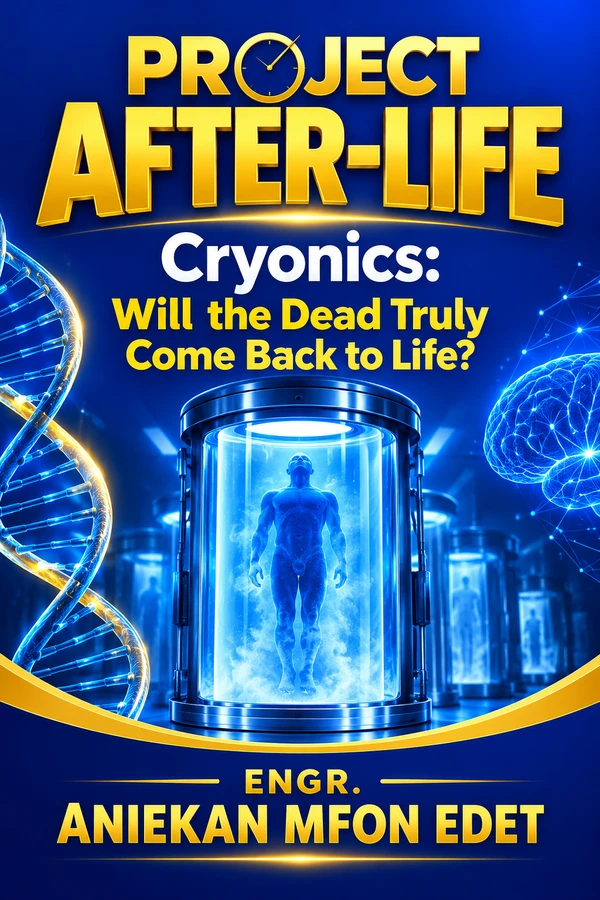
PROJECT AFTER-LIFE
About This Book
PROJECT AFTER-LIFE: Cryonics: Will the Dead Truly Come Back to Life? explores one of humanity's most fascinating and controversial questions: whether scientific advances could someday make the revival of cryonically preserved human beings possible.
Cryonics involves preserving the human body or brain at extremely low temperatures in the hope that future technologies may enable revival. Yet this ambition raises profound scientific, technological, ethical, and philosophical questions.
What does cryonic preservation involve? What challenges must scientists overcome before revival could become possible? Could future technology restore memory, consciousness, and personal identity? And how can we distinguish scientific evidence from speculation about the future?
Engr. Aniekan Mfon Edet invites readers to examine these questions critically and explore the intersection of cryonics, emerging technology, human mortality, and the enduring desire to extend life beyond its natural limits.
This thought-provoking book encourages readers to consider both the possibilities and limitations of cryonics without confusing scientific aspirations with proven achievements.
Whether you are interested in science, technology, human existence, or the future of medicine, PROJECT AFTER-LIFE offers an engaging opportunity to reflect on a question that continues to challenge human understanding.
Could the future bring possibilities that seem impossible today, or will the restoration of cryonically preserved people remain beyond our reach?
Explore the science. Examine the possibilities. Question the future.
PROJECT AFTER-LIFE delves into the scientific and ethical questions surrounding cryonics and the potential for reviving preserved human beings. The author, Engr. Aniekan Mfon Edet, critically examines the current state of cryobiology, the technology needed for revival, and the societal implications of such advancements.
Who this book is for
- Science enthusiasts
- Tech-savvy readers
- Philosophers of life and death
- Medical professionals
- Futurists
What you'll learn
- Understanding of cryonics and its processes
- The scientific challenges of human revival
- Ethical implications of cryonic preservation
- Future technologies related to life extension
- Critical evaluation of scientific claims
Read a free sample 8 pages from the book
PROJECT AFTER-LIFE • 4 Appendix H — Citation and Claim-Checking Protocol Appendix G — Evidence Matrix: What the Literature Does and Does Not Show Appendix F — Reader’s Guide: Discussion and Reflection Appendix E — Glossary of Key Terms Appendix D — Ethical Review Checklist for Hypothetical Human Revival Research Appendix C — Research Roadmap and Stop Conditions Appendix B — Questions to Ask a Cryonics Provider Appendix A — Evidence Ladder for Claims About Cryonic Revival APPENDICES Preface Human beings have long searched for ways to postpone death. We preserve voices in recordings, memories in photographs, and achievements in institutions. Cryonics extends that longing into a scientific and commercial proposition: after legal death, a body or brain is cooled and stored in the hope that future technology may repair damage and restore life. That outcome has not been demonstrated in a human being. This book examines what cryobiology can currently support, what remains an early-stage research question, and what is still speculation. It also considers the legal, social, ethical, religious, and psychological consequences that could follow if revival ever became possible. The final sixteen chapters form a fictional SciXLab thriller; they are not reports of real events. The guiding principle is simple: hope must not be confused with evidence. Scientific possibility is not proof of feasibility, and feasibility is not proof of safety. Introduction: Three Levels of Claim Established science includes findings demonstrated in defined settings, such as the use of cryoprotectants to reduce ice formation in selected biological materials. Early-stage research includes promising but limited findings, such as restoration of certain
PROJECT AFTER-LIFE • 5 cellular functions in post-mortem pig brains without global electrocorticographic activity or demonstrated consciousness (Vrselja et al., 2019). Speculation includes future capabilities not yet demonstrated, such as repairing a cryopreserved human brain and restoring the same person to conscious life. The SciXLab storyline is explicitly fictional. Cryonics is not ordinary freezing. It commonly involves cryoprotectants and very low-temperature storage, with vitrification intended to reduce damaging ice-crystal formation. Yet cryoprotectant toxicity, incomplete perfusion, cooling and rewarming injury, mechanical stress, prior oxygen deprivation, and the challenge of restoring integrated brain function remain major obstacles (Fahy et al., 2004; Manuchehrabadi et al., 2017). A review advocating cryonics presents arguments for possible future repair, but advocacy is not proof that human revival is achievable (Best, 2008).
PROJECT AFTER-LIFE • 6 PART I — THE SCIENCE OF A SECOND CHANCE
PROJECT AFTER-LIFE • 7 1. The Body That Waited Death is both a biological process and a legal determination. When circulation stops, oxygen delivery fails, energy reserves decline, and cells begin to suffer injury. The timing and severity vary by tissue, temperature, cause of death, and the speed of intervention. This complexity does not mean that a legally dead person can currently be restored after cryonic storage. Cryonics providers attempt to slow deterioration and preserve biological structures that future technology might repair. The hope is that future medicine could correct damage now beyond repair. But no human preserved through cryonics after legal death has been revived. The central question is therefore not when revival will happen, but what evidence would justify believing it is possible (Best, 2008; Vrselja et al., 2019). The word death can hide several different events. A clinician may determine that circulation and breathing have irreversibly stopped, or that the brain has irreversibly lost all functions required by the applicable medical and legal standard. Cells do not all fail at the same instant. Some processes continue briefly, while other tissues deteriorate quickly when oxygen and nutrients are unavailable. This uneven timeline is important, but it does not mean that a person remains alive in a recoverable sense after legal death. Cryonics begins from a hope about the future, not from proof that the present process can be reversed. The central question is not simply whether a body can be kept cold. It is whether the information and physical organization necessary for a particular person's memories, personality, and integrated brain function remain present in a condition that future tools could identify and repair. That question is much harder than preserving a recognizable shape. A photograph can retain a face without retaining the person; similarly, visible anatomy alone cannot establish that the structures supporting a mind have survived. The scientific burden is therefore to define what must be preserved, measure how well it is preserved, and show—rather than assume—that repair can restore function.
PROJECT AFTER-LIFE • 8 This distinction also affects the language used in public debate. 'Legal death', 'cellular survival', 'reversible injury', and 'revival' are not interchangeable terms. A cell may retain some biochemical activity after a person has died, but a person is an integrated organism whose brain, circulation, respiration, immune function, and other systems interact. A future technology would have to restore that integration, not merely find surviving components. When evaluating any announcement, readers should ask exactly what was measured, at what scale, and for how long. Without those details, the word 'life' can become a slogan instead of a scientific description. A useful rule for evaluating claims is to ask whether the evidence demonstrates preservation, repair, or restoration of an integrated person. These are separate milestones. A preserved structure may be damaged; a repaired structure may not function; and a functioning organ may not restore consciousness or personal memory. Each milestone needs its own definition and evidence. This framework prevents a promising result at one level from being described as a breakthrough at every level above it. Evidence references: (Vrselja et al., 2019; Best, 2008) The phrase ‘waiting body’ therefore works best as a metaphor, not a diagnosis. A preserved person is not known to be sleeping in the ordinary medical sense, and no evidence shows that cryonic storage maintains a continuing experience of time. If revival ever became possible, the central question would be whether the biological structures that support memory, personality, and integrated function survived or could be reconstructed. Those questions require measurable evidence, independent replication, and honest communication about uncertainty. A responsible account must avoid confusing the persistence of tissue with the persistence of a person. The ethical stakes are high precisely because the outcome is unknown: families may be making decisions during grief, while providers may describe a speculative future with persuasive certainty. A careful reader should ask what is demonstrated today, what is merely plausible in principle, and what remains unsupported.
PROJECT AFTER-LIFE • 9 A useful way to understand the promise of cryonics is to separate the moment of legal death from the much longer biological sequence that follows. A declaration of death does not mean every cell instantly loses every function; different tissues deteriorate at different rates, and temperature, oxygen deprivation, illness, and the quality of emergency care all influence the process. That distinction is scientifically important, but it must not be turned into a promise that a person can later be restored. The preservation challenge is not merely to keep a body cold. It is to retain enough of the structures and information necessary for a functioning organism, especially the brain, while avoiding additional damage during cooling and storage. Research on post-mortem pig brains demonstrated recovery of selected circulation and cellular functions under a specialised laboratory protocol, but it did not restore consciousness or normal brain-wide electrical activity (Vrselja et al., 2019). Further Analysis
PROJECT AFTER-LIFE • 10 2. Inside the Freeze—What Cryonics Actually Does Cryonics is not simply putting a living person into a freezer. Following legal death, a preservation team may cool the body, support circulation for a period, replace some fluids with cryoprotectant solutions, and cool the subject to cryogenic storage temperatures. Vitrification seeks to form a glass-like solid rather than damaging ice crystals. The method involves trade-offs. Cryoprotectants can be toxic at required concentrations; perfusion may be uneven; injury may occur before preservation begins; and cooling or rewarming large structures can create stress and fractures. Research has improved vitrification formulations and explored nanoparticle-assisted warming, but these advances address components of the problem rather than proving whole-human revival (Fahy et al., 2004; Manuchehrabadi et al., 2017). In an idealized preservation pathway, teams act quickly after legal death because warm ischemia—the interval without adequate blood flow at body temperature—can cause substantial injury. Cooling slows many chemical reactions, but it does not erase damage that has already occurred. Cryoprotectant solutions are intended to reduce ice formation by changing how water behaves as temperature falls. In vitrification, the aim is to form a glass-like solid rather than a mass of ice crystals. The process must be controlled carefully: too little protection may permit ice, while too much or too rapid an exposure may injure cells through chemical toxicity and osmotic stress. The scale problem is severe. A small sample can be cooled and warmed more uniformly than a human brain or whole body. Large structures develop temperature gradients; uneven perfusion can leave some regions under-protected; and rapid warming can be as challenging as cooling. Researchers have demonstrated improvements for selected tissues and experimental systems, including inductive warming approaches, but that does not establish safe, reversible preservation of an entire human body (Manuchehrabadi et al., 2017). A responsible account must describe cryonics as a long-term preservation attempt whose
PROJECT AFTER-LIFE • 11 hoped-for endpoint remains unproven, not as a medical procedure with a known return journey. Vitrification also should not be confused with a guarantee that every region has become a perfect glass. Biological tissues differ in water content, vascular supply, and chemical tolerance. A protocol that performs well in one tissue may fail in another. Preservation quality must therefore be assessed using multiple methods, including structural analysis and functional tests where these are possible. Even a beautiful microscopic image cannot establish that all relevant neural connections remain intact. The strongest claims are those that state the limits of the sample and the method, then invite independent groups to reproduce the finding. For readers, the practical conclusion is that the phrase 'stored at very low temperature' describes only one part of the process. The condition before cooling, the method of introducing cryoprotectants, the cooling curve, storage stability, and future warming all affect the result. A credible provider should explain these stages in accessible language and disclose what has not been validated. Where the science is uncertain, the contract should say so plainly rather than relying on technical…
End of sample. The full book is 151 pages on Afri KDP.
Questions about this book
What is cryonics and how does it work?
Cryonics involves preserving the human body or brain at extremely low temperatures after legal death, hoping that future technologies may enable revival. The process includes cooling, circulation support, and the use of cryoprotectants to prevent ice formation.
Loading reviews...
Loading…
A download link appears on this page as soon as your payment is confirmed, and a permanent copy of the link is emailed to you.
By card from anywhere. In Nigeria you can also pay by bank transfer, USSD or mobile money. Your card details are entered on Paystack's secure page, never on AfriKDP.
Yes. The file opens on phones, tablets, computers and eReaders.
Yes, with an AfriKDP reading plan, which opens every book in the online reader and pays the author for every page you read.
Write to [email protected] with your email address and we will help. See our return policy.