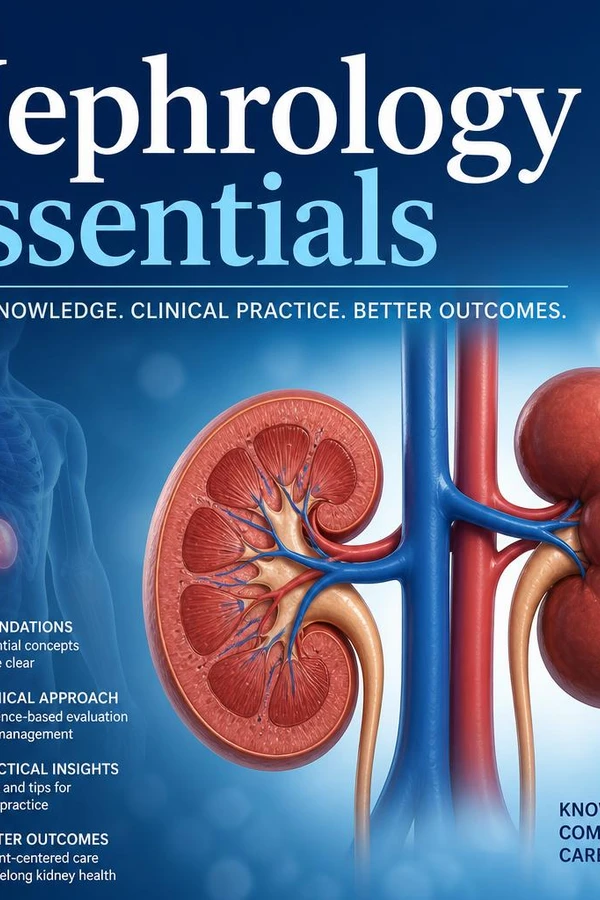
Nephrology Essentials
About This Book
Structure & Features
The text covers ten core topics—from Acute Kidney Injury (AKI) and Chronic Kidney Disease (CKD) through glomerular diseases, tubulointerstitial disorders, electrolyte and acid-base abnormalities, hypertension, dialysis, and common nephrology presentations—followed by a comprehensive practice exam and high-yield rapid review summary tables. Each chapter follows a consistent format: Overview, Pathophysiology, Clinical Presentation, Diagnostic Approach, Management Principles, Clinical Pearls, and Board-Style MCQs with detailed explanations.
Nephrology 2026 offers a structured approach to understanding kidney diseases, covering essential topics such as Acute Kidney Injury and Chronic Kidney Disease. It synthesizes the latest recommendations from major international bodies, making it a vital resource for clinicians and trainees.
Who this book is for
- Clinicians in nephrology
- Medical trainees
- Board examination candidates
- Healthcare professionals
- Lifelong learners in nephrology
What you'll learn
- Core nephrology principles
- Latest KDIGO and AHA/ACC/ADA/ASN guidelines
- Diagnostic approaches for kidney diseases
- Management principles for various nephrology conditions
- Clinical pearls and high-yield summary tables
- Practice questions for exam preparation
Read a free sample 3 pages from the book
2026 EDITION Nephrology 2026 A Comprehensive Clinical Guide
Foundations of Nephrology, Integrated with 2024–2026 KDIGO and Society Guideline Updates Board-Style Practice Questions · Clinical Pearls · Rapid Review Summary Tables By Essam Abdelhakim
Nephrology 2026 — Essam Abdelhakim Page 2 INTRODUCTION A Letter to Our Medical Colleagues Nephrology stands at an extraordinary crossroads. As we enter 2026, the field has undergone a transformation more profound than any in the past two decades. The old paradigms of kidney disease management—once defined by progressive decline, limited therapeutic options, and the inevitable march toward dialysis—have been replaced by an era of unprecedented possibility. We now possess therapies that not only slow but fundamentally alter the trajectory of chronic kidney disease, agents that protect the kidney across disease states, and a unified framework that recognizes the deep interconnection between cardiovascular health, metabolic function, and renal integrity. This book was born from a simple recognition: our colleagues deserve a comprehensive resource that bridges the gap between foundational nephrology principles and the rapidly evolving clinical landscape of 2026. The challenge we face is not a shortage of information but an overwhelming abundance of it. Guidelines update with increasing frequency. New therapeutic classes emerge with stunning regularity. The evidence base expands daily. In this environment, clinicians need more than scattered updates—they need a coherent, integrated framework that places new knowledge within the context of enduring principles. What This Book Offers This text represents a synthesis of classic nephrology with the most current 2024–2026 guidelines from KDIGO, the AHA/ACC/ADA/ASN, the Japanese Society of Hypertension, and other major international bodies. We have structured the content to serve multiple purposes: ▸ For the Busy Clinician: Each chapter presents a logical, stepwise approach to diagnosis and management, with high-yield clinical pearls and practice-changing updates clearly highlighted. ▸ For the Trainee: The text provides a comprehensive foundation in renal pathophysiology, supported by clinical vignettes and board-style questions that reinforce learning. ▸ For the Examination Candidate: The included MCQs and comprehensive practice exam mirror the style and complexity of USMLE and Internal Medicine Board questions, with detailed explanations that illuminate underlying principles. ▸ For the Lifelong Learner: The updated rapid review summary tables offer quick reference for day-to-day practice, while the detailed chapters provide depth when needed.
What Makes This Edition Different The 2026 update represents a significant evolution from previous editions. Key changes that clinicians must now integrate into practice include: ▸ The paradigm shift in blood pressure management: The KDIGO 2024 recommendation for a systolic blood pressure target below 120 mmHg represents a major departure from prior guidelines, with implications for virtually every patient with CKD. ▸ Expanded use of SGLT2 inhibitors: No longer confined to patients with diabetes, these agents are now recommended for a broad spectrum of CKD patients with eGFR as low as 20 mL/min, fundamentally changing how we approach proteinuria reduction. ▸ The emergence of finerenone: This non-steroidal mineralocorticoid receptor antagonist has moved from a niche therapy for diabetic CKD to a broader recommendation that now includes nondiabetic CKD with persistent albuminuria—a major expansion. ▸ The introduction of GLP-1 receptor agonists: Now formally recommended for patients with T2D, CKD, and significant albuminuria, adding another weapon to our therapeutic arsenal.
Nephrology 2026 — Essam Abdelhakim Page 3 ▸ The reframing of AKI: The new AKI-AKD continuum framework and the incorporation of biomarkers like
cystatin C represent a more nuanced understanding of acute kidney injury and its consequences. The unified CKM framework: The recognition of Cardiovascular-Kidney-Metabolic syndrome as a cohesive entity reflects the deep interconnections that define modern nephrology practice. How to Use This Book We have designed this text for flexible use. The chapters can be read sequentially for a comprehensive review or consulted individually when specific clinical questions arise. Each chapter follows a consistent structure— Overview, Pathophysiology, Clinical Presentation, Diagnostic Approach, Management Principles, Clinical Pearls, and Practice Questions—allowing for efficient navigation. The "2026 Update" callouts throughout the text highlight practice-changing recommendations, ensuring that readers can quickly identify what has changed. The integrated practice questions serve both as learning tools and as preparation for examinations, with explanations that emphasize the reasoning behind correct answers. Acknowledging the Dynamic Nature of Medicine We write this introduction with the humility that comes from practicing in a rapidly evolving field. Some recommendations in this book may change as new evidence emerges. We encourage readers to maintain a critical, evidence-based approach and to consult the most recent guidelines when making clinical decisions. Our goal is not to provide a static set of answers but to equip you with a framework for understanding and a foundation for lifelong learning.
Nephrology 2026 — Essam Abdelhakim Page 5 TOPIC 1: ACUTE KIDNEY INJURY (AKI) 1.1 Overview Acute Kidney Injury (AKI) is a sudden episode of kidney failure or kidney damage that occurs within a few hours to a few days. It leads to the accumulation of waste products in the blood and impairs the kidneys' ability to maintain fluid balance. The KDIGO 2026 Clinical Practice Guideline introduces…
End of sample. The full book is 58 pages on Afri KDP.
Questions about this book
What topics are covered in this book?
The book covers ten core topics including Acute Kidney Injury, Chronic Kidney Disease, glomerular diseases, and dialysis, among others.
Loading reviews...

Loading…
A download link appears on this page as soon as your payment is confirmed, and a permanent copy of the link is emailed to you.
By card from anywhere. In Nigeria you can also pay by bank transfer, USSD or mobile money. Your card details are entered on Paystack's secure page, never on AfriKDP.
Yes. The file opens on phones, tablets, computers and eReaders.
Yes, with an AfriKDP reading plan, which opens every book in the online reader and pays the author for every page you read.
Write to [email protected] with your email address and we will help. See our return policy.