 AfriKDP
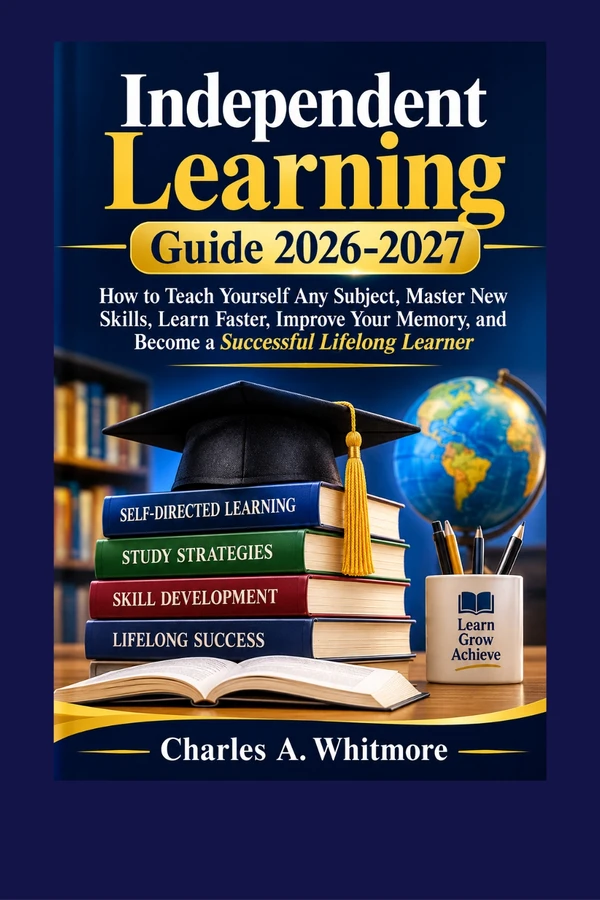
Independent Learning Guide 2026-2027
About This Book
Imagine having the confidence to approach an unfamiliar subject, understand difficult concepts, develop valuable skills, and make meaningful progress using your own learning system.
Independent learning is more than a study technique. It is a powerful ability that can transform how you acquire knowledge, solve problems, develop professionally, and approach opportunities throughout your life.
Whether you are a student seeking better academic performance, a professional looking to expand your expertise, or someone who simply loves discovering new things, this comprehensive guide will help you become a more confident, organized, and effective independent learner.
DISCOVER HOW TO TAKE CONTROL OF YOUR EDUCATION AND LEARN WITH PURPOSE.
Inside this guide, you will discover how to:
• Choose virtually any subject and develop a structured pathway from beginner to advanced understanding.
• Break complicated subjects into manageable topics and understand difficult concepts more effectively.
• Identify reliable textbooks, online courses, educational websites, research materials, and other valuable learning resources.
• Apply proven learning techniques, including active recall, spaced repetition, the Feynman Technique, and effective note-taking.
• Develop concentration, self-discipline, consistency, and the motivation required for long-term learning.
• Create realistic study schedules, establish productive routines, and manage your learning time effectively.
• Overcome procrastination, distractions, information overload, frustration, and other common learning challenges.
• Transform theoretical knowledge into practical abilities through exercises, experimentation, projects, and independent practice.
• Evaluate your progress, identify knowledge gaps, strengthen long-term memory, and develop genuine subject competence.
• Build a lifelong learning system that supports personal growth, professional development, and intellectual independence.
MORE THAN JUST LEARNING INFORMATION
Knowing something and being able to use it are two different things.
This guide emphasizes meaningful understanding, practical application, critical thinking, independent problem-solving, and continuous improvement.
Rather than encouraging endless reading or passive consumption of information, it helps you develop the habits and strategies necessary to become an active participant in your own education.
WHO SHOULD READ THIS BOOK?
This guide is particularly valuable for:
• Students who want to improve their study habits and academic performance.
• University and college learners seeking greater independence in their education.
• Working professionals interested in developing new skills and expanding their knowledge.
• Entrepreneurs and aspiring professionals who want to learn independently.
• Beginners who feel overwhelmed
The Independent Learning Guide 2026-2027 empowers readers to take control of their education through self-directed study. It offers practical strategies for mastering new subjects, enhancing memory, and developing lifelong learning habits.
Who this book is for
- Students seeking academic improvement
- Professionals expanding their skills
- Lifelong learners exploring new topics
What you'll learn
- How to create a structured learning plan
- Effective study techniques like active recall
- Strategies to overcome procrastination
- Methods to evaluate learning progress
- Ways to turn knowledge into practical skills
Read a free sample 10 pages from the book
part may be reproduced without prior written permission. 4
CHAPTER 1: UNDERSTANDING INDEPENDENT LEARNING 1.1 What Is Independent Learning? 1.2 The Meaning of Self-Education and Self-Directed Learning 1.3 Why Independent Learning Matters in the Modern World 1.4 The Difference Between Traditional Education and Independent Learning 1.5 How Independent Learning Transforms Your Personal and Professional Life 5
1.6 The Psychology Behind Successful Independent Learning 1.7 Common Misconceptions About Teaching Yourself 1.8 The Characteristics of Successful Independent Learners 1.9 Developing the Right Attitude Toward Self-Education 1.10 Becoming Responsible for Your Own Education
CHAPTER 2: BUILDING THE FOUNDATION FOR SUCCESSFUL SELF-LEARNING 2.1 Understanding Your Learning Goals 2.2 Identifying What You Want to Learn and Why 2.3 Conducting a Personal Knowledge Assessment 2.4 Identifying Your Current Knowledge Level 2.5 Understanding Different Learning Preferences 2.6 Developing a Growth Mindset 2.7 Building Self-Discipline and Personal Responsibility 2.8 Developing Consistency and Patience 2.9 Overcoming the Fear of Difficult Subjects 2.10 Creating an Environment That Supports Learning
6
CHAPTER 3: HOW TO CHOOSE AND MASTER ANY SUBJECT 3.1 Identifying a subject worth learning 3.2 Understanding the scope of your chosen subject 3.3 Breaking complex subjects into smaller topics 3.4 Identifying prerequisite knowledge 3.5 Understanding learning objectives and expected outcomes 3.6 Creating a subject-specific learning roadmap 3.7 Organizing topics from beginner to advanced levels 3.8 Identifying essential concepts and foundational principles 3.9 Avoiding the trap of learning too many subjects at once 3.10 Measuring your progress toward subject mastery
CHAPTER 4: FINDING HIGH-QUALITY LEARNING RESOURCES 4.1 Understanding the Importance of Learning Resources 4.2 How to Find Reliable Books and Textbooks 4.3 Using Online Courses and Educational Platforms 7
4.4 Learning Through Educational Videos and Lectures 4.5 Using Academic Journals and Research Papers 4.6 Finding Reliable Websites and Digital Libraries 4.7 Learning from Experts, Mentors, and Professionals 4.8 Using Artificial Intelligence as a Learning Assistant 4.9 Evaluating the Accuracy and Credibility of Information 4.10 Building a Personal Digital Learning Library
CHAPTER 5: EFFECTIVE LEARNING TECHNIQUES THAT ACTUALLY WORK 5.1 Understanding how the human brain acquires knowledge 5.2 Active learning versus passive learning 5.3 The power of active recall 5.4 Understanding spaced repetition 5.5 Applying the Feynman technique 5.6 Mind mapping and concept mapping 5.7 The importance of note-taking 5.8 Using the SQ3R reading method 5.9 Interleaving and varied practice 5.10 Learning through teaching others 8
5.11 Using practice tests to strengthen understanding 5.12 Combining learning techniques effectively
CHAPTER 6: CREATING A POWERFUL INDEPENDENT LEARNING SYSTEM 6.1 Why every independent learner needs a learning system 6.2 Setting SMART learning goals 6.3 Creating daily, weekly, and monthly learning plans 6.4 Developing a realistic study timetable 6.5 Managing your time effectively 6.6 Establishing productive learning routines 6.7 Balancing learning with work and personal responsibilities 6.8 Creating a distraction-free study environment 6.9 Tracking your learning activities 6.10 Reviewing and improving your learning system
CHAPTER 7: OVERCOMING LEARNING CHALLENGES AND STAYING MOTIVATED 7.1 Why independent learners sometimes struggle 7.2 Overcoming procrastination 9
7.3 Dealing with information overload 7.4 Understanding and overcoming learning plateaus 7.5 Managing frustration when a subject becomes difficult 7.6 Dealing with distractions and digital addiction 7.7 Overcoming self-doubt and fear of failure 7.8 Maintaining motivation during long-term learning 7.9 Preventing mental exhaustion and learning burnout 7.10 Developing the discipline to continue when motivation disappears
CHAPTER 8: TURNING KNOWLEDGE INTO PRACTICAL SKILLS 8.1 Why knowledge alone is not enough 8.2 The relationship between theory and practice 8.3 Learning through practical exercises 8.4 Using projects to develop real-world competence 8.5 Building a personal portfolio of work 8.6 Learning through experimentation 8.7 Understanding mistakes as learning opportunities 8.8 Seeking constructive feedback 10
8.9 Developing problem-solving and critical-thinking skills 8.10 Measuring your practical competence
CHAPTER 9: EVALUATING YOUR PROGRESS AND ACHIEVING MASTERY 9.1 Understanding what it means to master a subject 9.2 Measuring knowledge and skill development 9.3 Creating personal learning assessments 9.4 Using quizzes and practice examinations 9.5 Identifying knowledge gaps 9.6 Conducting regular learning reviews 9.7 Improving retention and long-term memory 9.8 Moving from beginner to intermediate and advanced levels 9.9 Knowing when you are ready to advance 9.10 Maintaining and updating your knowledge
CHAPTER 10: BECOMING A LIFELONG INDEPENDENT LEARNER 10.1 The importance of lifelong learning 10.2 Developing a personal learning philosophy 11
10.3 Learning multiple subjects without losing focus 10.4 Building an intellectual growth plan 10.5 Using technology to support continuous education 10.6 Learning across different fields and disciplines 10.7 Building a network of knowledgeable people 10.8 Applying independent learning to career development 10.9 Becoming an independent researcher and problem-solver 10.10 Creating your personal 12-month self-education plan 10.11 Final principles for becoming an exceptional independent learner
PRACTICE QUESTIONS AND KNOWLEDGE ASSESSMENT The purpose of assessment How to use the questions Practice questions, answers, and explanations Foundations of independent learning Planning a subject Choosing reliable resources 12
Effective learning methods Managing time and motivation Applying knowledge Evaluating progress Critical thinking and lifelong learning Interpreting your results Turning assessment into improvement
ADDITIONAL EDITORIAL FEATURES INTRODUCTION HOW TO USE THIS GUIDE LEARNING OBJECTIVES CHAPTER SUMMARIES PRACTICAL ACTIVITIES KEY TAKEAWAYS THE FINAL 12-MONTH SELF-EDUCATION BLUEPRINT GLOSSARY OF IMPORTANT TERMS RECOMMENDED FURTHER READING AND EDUCATIONAL RESOURCES 13
INTRODUCTION Imagine being able to learn almost anything you genuinely want to understand without waiting for someone to teach you, without depending entirely on a classroom, and without allowing the absence of formal instruction to become an obstacle to your personal growth. Imagine having the confidence to approach an unfamiliar subject, identify what you need to know, find the right resources, develop the necessary skills, and gradually transform yourself from a complete beginner into a knowledgeable and capable individual. This is the opportunity that independent learning makes possible. Knowledge has always been one of the most powerful instruments of personal development. It influences how people think, make decisions, solve problems, communicate, and understand the world around them. Throughout history, education has opened doors to opportunities that might otherwise have remained 14
inaccessible. However, the traditional understanding of education often creates the impression that meaningful learning must take place within a formal institution, under the direct supervision of a teacher, or through an established academic programme. Although these educational structures remain valuable, they represent only one part of a much broader learning experience. Today, the ability to educate yourself has become increasingly important. Information is more accessible than ever before, educational resources are available across numerous platforms, and people can explore subjects that were once difficult to study independently. Books, digital libraries, online lectures, academic publications, educational communities, and interactive learning tools have created opportunities for individuals to acquire knowledge beyond conventional educational environments. Nevertheless, access to information does not automatically produce understanding. Having thousands of resources available means very little if you do not know how to identify reliable information, organize your learning, understand complicated ideas, 15
retain important knowledge, and apply what you have learned. This is where independent learning becomes essential. Independent learning is the ability to take responsibility for your own educational development. It involves recognizing what you want to learn, establishing meaningful objectives, identifying suitable resources, selecting effective learning strategies, managing your time, evaluating your progress, and making necessary improvements. It does not mean rejecting teachers, ignoring formal education, or attempting to discover everything without assistance. Rather, it means developing the confidence and competence to continue learning whether guidance is immediately available or not. One of the greatest advantages of independent learning is freedom. You are not necessarily restricted by a fixed classroom schedule, a particular institution, or the pace at which other people learn. You can investigate subjects that interest you, spend additional time understanding 16
difficult concepts, revisit information whenever necessary, and progress according to your individual circumstances. You can learn a foreign language, study mathematics, explore history, understand technology, develop writing abilities, acquire professional skills, or investigate an entirely unfamiliar discipline. However, this freedom comes with responsibility. Without a teacher constantly monitoring your progress, you must learn to manage your attention, maintain discipline, establish priorities, and recognize when your understanding is incomplete. You may encounter complicated explanations, contradictory information, disappointing results, or periods when progress seems unusually slow. At such moments, your ability to remain patient, evaluate your approach, and continue working becomes particularly important. Many people begin learning new subjects with considerable enthusiasm but struggle to maintain consistency. Some spend hours collecting books, downloading courses, watching educational videos, and 17
preparing elaborate study schedules without making meaningful progress. Others move from one subject to another whenever something more interesting appears. Some become discouraged when they encounter difficult concepts, while others mistake memorizing information for genuinely understanding it. These experiences reveal an important truth: successful learning is not determined simply by how much information you consume. It depends on how effectively you process, understand, remember, evaluate, and apply that information. You do not necessarily need exceptional intelligence to become an effective independent learner. You need an organized approach, appropriate learning techniques, realistic expectations, consistent effort, and a willingness to improve. Learning is a process that can itself be studied and strengthened. Once you…
End of sample. The full book is 217 pages on Afri KDP.
Questions about this book
What is independent learning?
Independent learning is the process of acquiring knowledge and skills through personal initiative and self-directed study, taking responsibility for your own educational journey.
Loading reviews...
Loading…
A download link appears on this page as soon as your payment is confirmed, and a permanent copy of the link is emailed to you.
By card from anywhere. In Nigeria you can also pay by bank transfer, USSD or mobile money. Your card details are entered on Paystack's secure page, never on AfriKDP.
Yes. The file opens on phones, tablets, computers and eReaders.
Yes, with an AfriKDP reading plan, which opens every book in the online reader and pays the author for every page you read.
Write to [email protected] with your email address and we will help. See our return policy.