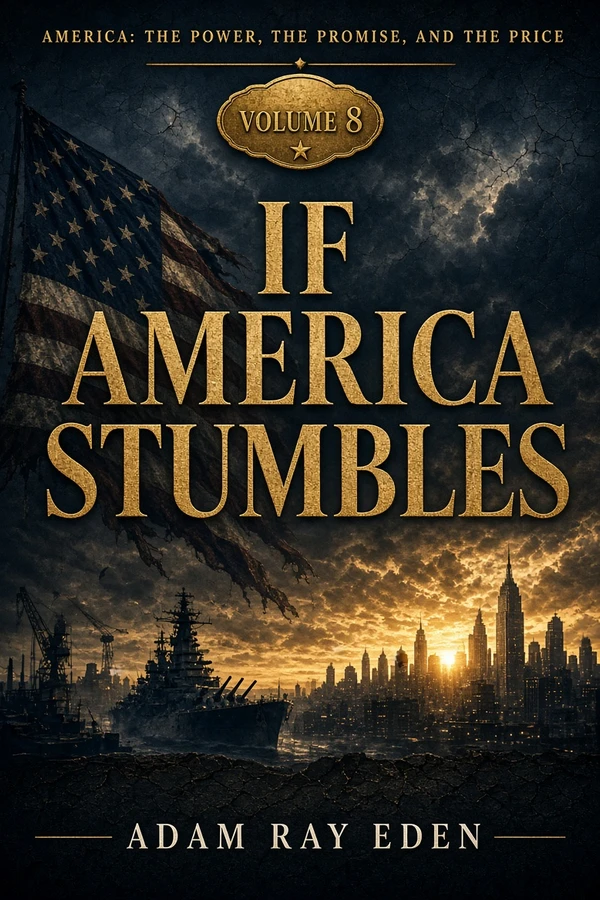
IF AMERICA STUMBLES
About This Book
AMERICA: THE POWER, THE PROMISE, AND THE PRICE — Volume 8
What happens if the United States begins to lose its ability to shape the world—not through sudden collapse, but through a gradual weakening of the foundations that have sustained its global influence?
For generations, American power has rested on more than military strength. Its position has also depended on economic capacity, financial influence, technological leadership, political institutions, industrial production, and an extensive network of international alliances. These sources of power reinforce one another, but none is guaranteed to remain strong indefinitely.
In IF AMERICA STUMBLES, Adam Ray Eden examines the pressures and vulnerabilities that could reshape America's position in the international order.
The book explores six interconnected dimensions of American power:
- Fiscal capacity: Rising public debt, interest costs, budgetary pressure, and the government's ability to respond to future challenges.
- Political and institutional resilience: Polarisation, public confidence, institutional performance, and the capacity to make durable national decisions.
- Military capability: Readiness, logistics, defence production, industrial capacity, and the difference between military spending and actual operational strength.
- Financial influence: The international role of the dollar, the importance of American capital markets, and the conditions that sustain confidence.
- International alliances: The credibility of American commitments, shared security responsibilities, and the possibility that partners may adapt to a changing global balance.
- Technological and industrial capacity: Innovation, strategic supply chains, infrastructure, skilled workers, and the ability to turn technological advantages into productive strength.
But this is not a prediction that America must fall.
The distinction between relative decline and absolute collapse is central to the book. A country can remain wealthy, technologically advanced, militarily powerful, and internationally influential while losing some of its former ability to set the terms of global affairs.
The consequences would depend on how quickly change occurred, which institutions remained resilient, how American leaders responded, and how other countries adapted. A gradual adjustment would present different challenges from a sudden disruption.
Drawing on historical patterns, official data, and measurable indicators, this volume examines possible outcomes without treating uncertainty as certainty. It also offers practical monitoring frameworks to help readers distinguish meaningful changes from isolated statistics and exaggerated claims.
IF AMERICA STUMBLES is an examination of power, vulnerability, adaptation, and the choices that shape a nation's future.
'IF AMERICA STUMBLES' by Adam Ray Eden explores the gradual weakening of America's global influence across various dimensions, including fiscal capacity and political resilience. The book examines how these interconnected factors may affect the future of the United States in the international order.
Who this book is for
- Students of political science
- History enthusiasts
- Policy makers
- General readers interested in American influence
- Those concerned about global affairs
What you'll learn
- The interconnected dimensions of American power
- The difference between relative and absolute decline
- How fiscal capacity impacts national strength
- The role of political institutions in maintaining influence
- The significance of international alliances
- Technological and industrial capacities in global competition
- Possible futures for American power
Read a free sample 9 pages from the book
Independently published.
2
Disclaimer This book is a work of nonfiction examining American power, public finance, political institutions, military capability, international alliances, technological competition, and the possible consequences of changes in the United States' global position.
It is intended for educational and informational purposes. It does not constitute legal, investment, financial, military, or public-policy advice.
The book distinguishes documented events and official statistics from historical interpretation, analytical judgments, and hypothetical scenarios. Economic projections are not guaranteed outcomes, and geopolitical scenarios should not be interpreted as predictions that a particular event will occur.
Statistical information is associated with its relevant reporting period wherever possible. Official figures may be revised, definitions may differ across institutions, and new developments may change the interpretation of earlier evidence.
The author has made reasonable efforts to assess the reliability of the sources used. Nevertheless, no claim of absolute accuracy is made. Readers should consult the cited primary sources when making decisions that depend on current information.
The views expressed in the analysis are intended to encourage informed examination of the evidence rather than to promote hostility toward any country, people, political party, or institution. 3
Series Note AMERICA: THE POWER, THE PROMISE, AND THE PRICE examines the historical development of American influence, the institutions and resources that sustain it, the responsibilities associated with it, and the consequences of decisions made by those who exercise it.
Each volume investigates a distinct aspect of the American experience while contributing to a broader examination of the relationship between power, opportunity, responsibility, and historical change.
Volume 8, IF AMERICA STUMBLES, examines the pressures that could alter America's international position. It considers not only the vulnerabilities of the United States but also the strengths, institutions, relationships, and choices that could help it adapt.
The volume is intended to stand independently. Readers do not need to have completed the preceding volumes to understand its central argument. 4
Author's Note on Methods This book uses a comparative and evidence-based approach.
Official statistical agencies, government reports, international institutions, historical scholarship, and clearly identified research organizations provide the foundation for its factual claims. Where possible, primary sources are preferred over commentary about those sources.
Three distinctions guide the analysis.
First, a documented fact is not the same as an interpretation. A statistic may be established while its implications remain open to debate.
Second, a historical analogy is not proof that the same outcome will occur again. Comparisons are used to identify mechanisms, differences, and possible lessons, not to impose a predetermined historical pattern on the present.
Third, a possible future is not an inevitable future. The scenarios presented in this volume are conditional illustrations of how different combinations of circumstances and decisions could affect American power.
The central question is not whether the United States must rise or fall. It is how its capabilities may change, which pressures deserve attention, and what evidence can help readers distinguish manageable difficulties from more serious structural problems. 5
6
Introduction 1 The Question Behind the Power The United States occupies a position in modern history that few countries have ever held. Its economic scale, military reach, technological institutions, financial markets, international partnerships, and cultural influence have helped shape the world in which billions of people live.
Yet no country's international position is fixed forever.
The question examined in this book is what might happen if American power were to weaken in important areas, lose some of its relative advantage, or become more difficult to sustain. Would such a change produce a crisis? Could it be managed through policy adjustments and cooperation? Would other countries fill the gaps, or would competition for influence create instability?
These questions matter because American power extends beyond America's borders. Its financial decisions affect global markets. Its military commitments influence the security calculations of allies and competitors. Its technological companies and research institutions contribute to developments that shape industries around the world. Its political decisions can affect expectations about international agreements, trade, investment, and security.
A substantial change in American influence would therefore have consequences beyond the United States itself.
But serious analysis requires an important qualification. A decline in relative influence is not the same as national collapse. A country may lose some of its advantages while retaining enormous economic resources, advanced institutions, considerable military capability, and the ability to influence international events.
The central purpose of this book is to understand that distinction.
2 The Difference Between Concern and Prediction Public discussion about America's future often moves between two extremes.
One presents American dominance as virtually permanent. It assumes that the country's 7
economic size, financial markets, military institutions, and technological capacity will continue to protect its international position regardless of political or economic difficulties.
The other imagines an approaching collapse in which debt, political division, foreign competition, or military overstretch inevitably brings the existing order to an end.
Both approaches risk overlooking the complexity of national power.
Historical experience demonstrates that powerful states can adapt to serious challenges. It also shows that accumulated advantages do not eliminate the consequences of poor decisions, expensive commitments, institutional failures, or changing economic circumstances.
The United States has substantial strengths. It also faces pressures that deserve investigation. Recognizing those pressures does not require predicting disaster, just as recognizing American strengths does not require assuming that every existing advantage will endure.
This book therefore examines mechanisms rather than relying on dramatic declarations. It asks how particular pressures could affect national capabilities, what conditions might make them more serious, and which responses could reduce their consequences.
3 Why the Question Matters Beyond America American influence is embedded in a network of relationships.
Governments hold dollar-denominated assets, conduct trade through international financial systems, cooperate with American security institutions, and participate in technological and scientific networks that include American organizations.
These relationships are not all equally dependent on the United States. Some could be maintained through alternative arrangements. Others would be expensive, difficult, or slow to replace.
If American influence changed gradually, governments and businesses might have time to adapt. They could diversify their economic relationships, strengthen regional institutions, invest in domestic capabilities, or negotiate new forms of cooperation.
If change occurred suddenly, however, the adjustment could be more disruptive. Financial markets might reprice risk, allies might question security assumptions, and 8
competing powers might test the limits of existing arrangements.
These outcomes are possibilities, not certainties. Their likelihood and severity would depend on the circumstances, the speed of change, the availability of alternatives, and the decisions made by the United States and other countries.
4 The Evidence Behind the Argument This volume examines six connected dimensions of American power.
The first is fiscal capacity: whether the federal government can finance its obligations while retaining room to respond to emergencies and invest in long-term priorities.
The second is political and institutional resilience: whether the country's institutions can make and sustain decisions despite disagreement and changes in political leadership.
The third is military capability: whether resources, personnel, logistics, industrial production, and alliances can support the commitments the United States chooses to maintain.
The fourth is financial influence: whether the dollar and American capital markets continue to provide advantages that support the country's international position.
The fifth is the alliance system: whether partners continue to view American commitments as sufficiently credible and valuable to justify their own participation.
The sixth is technological and industrial capacity: whether the United States can maintain important advantages in innovation, production, infrastructure, and strategically significant supply chains.
These dimensions interact, but none should be treated as a substitute for the others. A country may remain technologically innovative while experiencing fiscal strain. It may maintain military superiority while confronting logistical weaknesses. Its currency may remain internationally important even as its share of global reserves changes.
A reliable assessment must therefore examine the evidence across several dimensions and acknowledge where the available information remains incomplete.
5 A Note on Time and Uncertainty The book's statistical claims must be read in relation to their reporting dates.
9
6 Congressional Budget Office Projection For example, the Congressional Budget Office's February 2026 outlook projected a federal deficit of $1.9 trillion for fiscal year 2026 and debt held by the public equivalent to 101% of GDP. Those figures were projections based on specified assumptions, not a substitute for final fiscal-year results.
7. International Monetary Fund Reserve Data Similarly, the International Monetary Fund reported that the dollar represented 56.70% of allocated global foreign-exchange reserves in the second quarter of 2026, down from 57.18% in the preceding quarter. That change is evidence of a movement in the measured share; it does not by itself establish an imminent loss of the dollar's international role.
The distinction between observation and inference will remain important throughout this volume.
8 The Central Question If America stumbles, the consequences will depend on what kind of stumble occurs.
A temporary economic slowdown is different from a prolonged inability to manage public finances. A reduction in a currency's reserve share is different from a sudden loss of market confidence. Political disagreement is different from an inability to perform essential constitutional functions. A decline in relative military advantage is different from an inability to defend national interests.
The task is to distinguish these conditions and investigate how one might lead to another.
The future of American power will not be determined by statistics alone. It will also be influenced by political choices, institutional adaptation, technological change, international cooperation, and the actions of other states.
This book does not begin with the conclusion that America must fall, nor with the assumption that it cannot stumble. It begins with a question that deserves careful examination:
What would happen if a country accustomed to shaping the international order found that it could no longer shape that order to the same degree—and what would determine the consequences? 10
That is the question to which the following chapters turn. 11
Chapter 1 The Weight of Expectations 1.1 The Difference Between Power and Primacy A country can remain powerful while losing some of its ability to shape the international system. This distinction is essential to understanding the future of the United States.
Power is not a single possession that can be measured by one number. It includes the capacity to produce goods and services, finance public obligations, develop technology, defend territory, sustain military operations, attract investment, maintain alliances, and influence the decisions of other governments.
These forms of power overlap, but they are not interchangeable.
A large economy may provide resources for defense, research, infrastructure, and international assistance. However, economic size alone cannot guarantee that those resources will be used effectively. Military spending may purchase advanced equipment, but expenditure alone cannot establish whether personnel are trained, equipment is available, or supplies can reach forces when needed.
Technological leadership can create economic and strategic advantages, but inventions must often be translated into reliable production, practical applications, and institutions capable of supporting them. Financial influence can reduce borrowing costs and increase a country's international leverage, but that influence also depends on confidence, liquidity, institutional credibility, and the availability of suitable assets.
National power is therefore better understood as a combination of capabilities and relationships.
Primacy is a more specific condition. It describes a position in which one state possesses an unusually extensive ability to shape international rules, institutions, security arrangements, and economic relationships.
A state may retain considerable wealth and military strength even after other countries acquire greater influence. It may continue to participate in international institutions without being able to determine their outcomes as frequently as before.
12
The question examined in this volume is not simply whether America will become weak. It is whether the United States will continue to exercise the same degree of international influence, across the same range of activities, under the same financial and political conditions.
1.2 Relative Decline and Absolute Decline Relative decline occurs when a country's capabilities grow more slowly than those of competitors, or when other countries develop capabilities that reduce its comparative advantages.
Suppose a country increases its industrial output, improves its military equipment, and continues to develop new technologies. If several competitors improve their capabilities at a faster rate, the first country may become less dominant even though its own capabilities have increased.
That is relative decline.
Absolute decline is different. It involves a reduction in a country's own capabilities or resources. This could include a sustained contraction in productive capacity, deterioration in important institutions, a loss of essential skills, or a reduced ability to carry out tasks that the country previously performed.
The two processes can occur together, but they do not have to.
A country might become wealthier while losing market share in a strategic industry. Its armed forces might remain formidable while becoming more expensive to maintain. Its currency might continue to dominate international reserves while its share of those reserves gradually falls.
These distinctions matter because different problems require different responses.
End of sample. The full book is 175 pages on Afri KDP.
Questions about this book
What is the main focus of the book?
'IF AMERICA STUMBLES' examines the pressures and vulnerabilities that could reshape America's position in the international order, focusing on fiscal, political, military, financial, alliance, and technological dimensions.
Loading reviews...
Loading…
A download link appears on this page as soon as your payment is confirmed, and a permanent copy of the link is emailed to you.
By card from anywhere. In Nigeria you can also pay by bank transfer, USSD or mobile money. Your card details are entered on Paystack's secure page, never on AfriKDP.
Yes. The file opens on phones, tablets, computers and eReaders.
Yes, with an AfriKDP reading plan, which opens every book in the online reader and pays the author for every page you read.
Write to [email protected] with your email address and we will help. See our return policy.