 AfriKDP
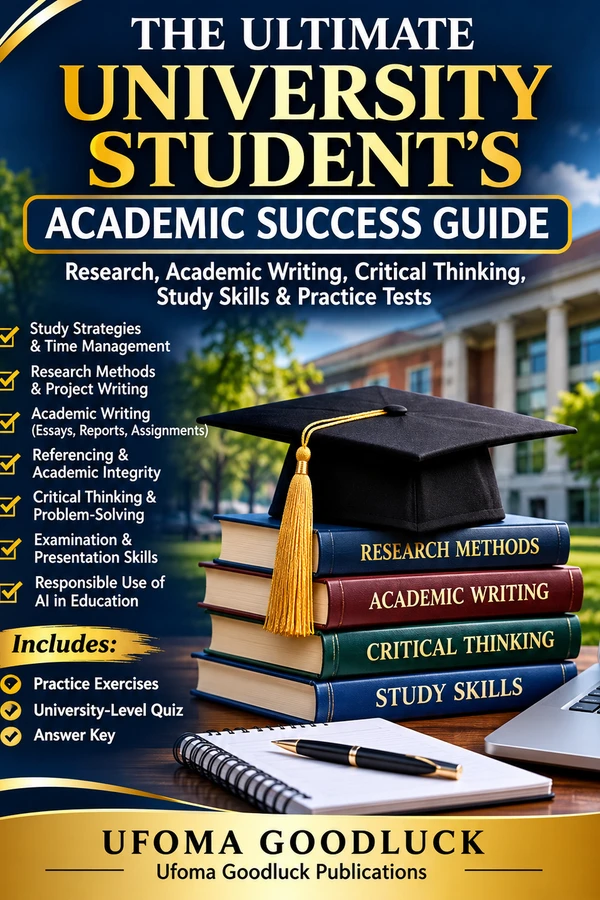
THE ULTIMATE UNIVERSITY STUDENT’S ACADEMIC SUCCESS GUIDE
About This Book
Are you a university student who wants to improve your academic performance, develop stronger research skills, and become more confident in your studies?
The University Student’s Complete Academic Guide is a practical handbook designed to help students understand the essential skills needed to succeed in higher education.
Inside this guide, you will learn about:
- Effective study habits and time management.
- Academic reading and note-taking techniques.
- Critical thinking and problem-solving.
- Research methods and developing research questions.
- Academic writing and essay organisation.
- Referencing, citations, and academic integrity.
- Understanding and presenting data.
- Preparing for examinations and presentations.
- Responsible use of artificial intelligence in education.
The book also includes practical templates, learning exercises, a university-level practice quiz, and an answer section to help you test your understanding.
Whether you are a new undergraduate or an existing university student looking to strengthen your academic skills, this guide provides useful knowledge you can apply throughout your educational journey.
Learn smarter. Research better. Write with confidence. Prepare for academic success.
Author: Ufoma Goodluck
This book is an independent educational resource and is not an official university textbook.
This comprehensive guide equips university students with essential skills for academic success, covering effective study habits, research methods, and academic writing. It includes practical templates and exercises to reinforce learning.
Who this book is for
- University students
- New undergraduates
- Students seeking to improve academic performance
- Those looking to enhance research skills
- Individuals preparing for examinations
What you'll learn
- Effective study habits and time management
- Academic reading and note-taking techniques
- Critical thinking and problem-solving skills
- Research methods and question development
- Academic writing and essay organization
- Referencing and academic integrity
- Preparing for examinations and presentations
Read a free sample 3 pages from the book
THE UNIVERSITY STUDENT’S COMPLETE ACADEMIC GUIDEPage 3 Contents 1. Understanding university-level learning 2. Planning, time management and productive study 3. Reading academic texts and taking notes 4. Critical thinking and evaluating evidence 5. Research questions, literature and methods 6. Academic writing and paragraph structure 7. Referencing, academic integrity and plagiarism 8. Working with data and presenting findings 9. Presentations, teamwork and communication 10. Digital literacy and responsible use of AI 11. Preparing for examinations and assessments 12. Practical templates and learning activities 13. University-level practice quiz 14. Answer key and explanations 15. Glossary and further reading A note on scope The examples in this guide are general. A laboratory report, legal essay, design portfolio and humanities dissertation may follow different conventions. Use the principles here as a foundation, then adapt them to the expectations of your field.
THE UNIVERSITY STUDENT’S COMPLETE ACADEMIC GUIDEPage 4 1. Understanding university-level learning What changes at university? University study usually requires more independent judgement than earlier stages of education. Students are expected to interpret questions, locate and evaluate evidence, connect ideas, explain reasoning and manage longer projects. Remembering information matters, but strong academic work also demonstrates how and why a conclusion follows from evidence. Learning actively Active learning means doing something purposeful with information rather than only rereading it. Examples include summarising a concept from memory, explaining it to another person, comparing two theories, solving a problem, or applying an idea to a new case. Retrieval practice—trying to recall information before checking notes—helps reveal what you genuinely understand. A practical learning cycle Before a class, preview the topic and write down one question. During the class, record key ideas and examples rather than attempting to copy every sentence. After class, spend a short period reconstructing the main points from memory, checking gaps, and deciding what needs further study. Measure understanding, not hours Time spent studying is not the same as learning achieved. A useful check is whether you can define a concept accurately, explain it in your own words, identify an example and recognise when it does not apply. If you cannot do these things yet, return to the material with a more focused question.
THE UNIVERSITY STUDENT’S COMPLETE ACADEMIC GUIDEPage 5 2. Planning, time management and productive study Start with fixed commitments Put lectures, work shifts, travel, meals, sleep and important responsibilities into a weekly calendar first. Then add realistic study blocks. Planning around actual available time is more reliable than creating an ideal timetable that ignores daily life. Break large tasks into actions “Write my assignment” is too broad to begin easily. Replace it with actions such as: interpret the prompt, identify key terms, locate five relevant sources, draft a working thesis, outline sections, write a first draft and revise citations. Small actions make progress visible. Use focused study sessions Choose one specific outcome for each session. Work for a manageable period, take a short break, and return if concentration remains useful. A 25-minute focus period can help some students; others work better in 40- or 50-minute blocks. Adjust the length to the task and your attention. Prioritise intelligently Urgent tasks have near deadlines; important tasks contribute significantly to learning or assessment. Begin major assignments early because research, drafting and revision take longer than expected. Leave buffer time for technical problems, illness or unexpected responsibilities. A weekly review At the end of each week, ask: What did I complete? What is overdue? What is the next physical action for each major task? Which topic remains unclear? Use the answers to revise the coming week rather than blaming yourself for an unrealistic plan. Quick application: Write one action you can take this week to apply the ideas in this chapter. Make the action specific enough that you can tell whether you completed it.
THE UNIVERSITY STUDENT’S COMPLETE ACADEMIC GUIDEPage 6 3. Reading academic texts and taking notes Read with a purpose Before reading, inspect the title, abstract, headings, conclusion, tables and references. Identify why the text matters to your question. Then read the relevant sections more carefully. This two-stage approach helps you avoid spending equal time on every page. Interrogate the argument As you read, ask: What question is the author addressing? What is the central claim? What evidence supports it? What assumptions are being made? What are…
End of sample. The full book is 21 pages on Afri KDP.
Questions about this book
What skills does this guide help me develop?
The guide helps you develop effective study habits, critical thinking, research skills, and academic writing techniques essential for university success.
Loading reviews...

Loading…
A download link appears on this page as soon as your payment is confirmed, and a permanent copy of the link is emailed to you.
By card from anywhere. In Nigeria you can also pay by bank transfer, USSD or mobile money. Your card details are entered on Paystack's secure page, never on AfriKDP.
Yes. The file opens on phones, tablets, computers and eReaders.
Yes, with an AfriKDP reading plan, which opens every book in the online reader and pays the author for every page you read.
Write to [email protected] with your email address and we will help. See our return policy.