 AfriKDP
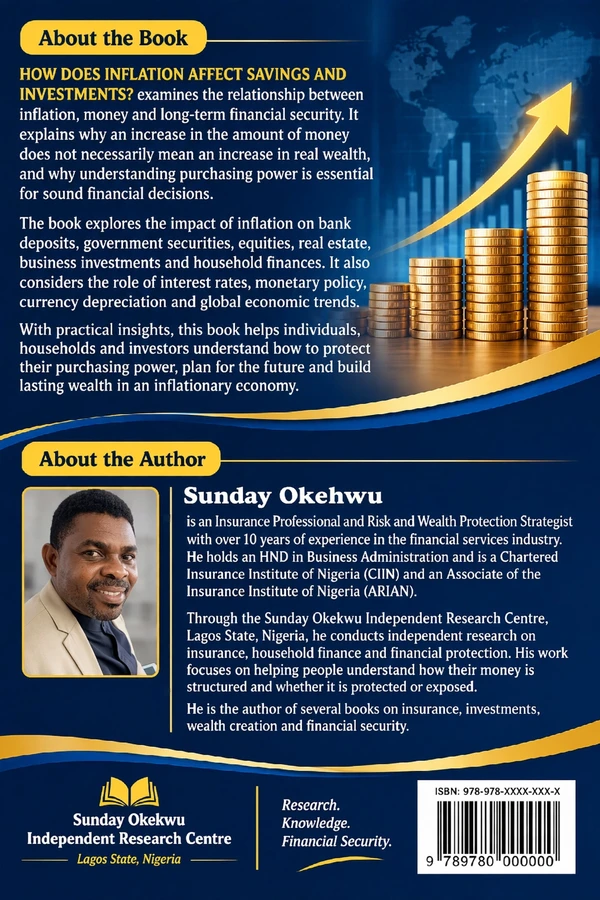
HOW DOES INFLATION AFFECT SAVINGS AND INVESTMENTS?
About This Book
You save money. You invest. You earn interest or returns. Yet, as prices continue to rise, the money you have today may buy considerably less tomorrow. This is one of the biggest financial challenges facing individuals, families, and investors.
HOW DOES INFLATION AFFECT SAVINGS AND INVESTMENTS? explains why inflation matters to your financial future and how it can quietly undermine the value of your savings and investment returns.
In this book, Sunday Okekwu examines the relationship between inflation, purchasing power, savings, investments, interest rates, and wealth preservation. You will gain a clearer understanding of why nominal financial growth does not always translate into real wealth growth, how to assess investment returns after inflation, and why protecting purchasing power should be an important part of financial planning.
Whether you are a student, salary earner, business owner, investor, saver, or financial professional, this book will help you think more critically about the value of money and the long-term consequences of financial decisions.
Discover why earning more, saving more, or investing more does not automatically mean becoming wealthier.
Understand inflation. Evaluate real returns. Make more informed financial decisions. Protect the purchasing power of your wealth.
This book explores the impact of inflation on purchasing power and the real value of savings and investments. It provides insights into evaluating financial growth and making informed financial decisions in the face of rising prices.
Who this book is for
- Students
- Salary earners
- Business owners
- Investors
- Financial professionals
What you'll learn
- The relationship between inflation and purchasing power
- How to assess real returns on investments
- Strategies for managing inflation risk
- The importance of financial planning
- Evaluating different asset classes
Read a free sample 10 pages from the book
HOW DOES INFLATION AFFECT SAVINGS AND INVESTMENTS? Understanding Purchasing Power, Real Returns, Wealth Preservation, and Household Financial Decisions Sunday Okekwu Sunday Okekwu Independent Research Centre
HOW DOES INFLATION AFFECT SAVINGS AND INVESTMENTS? HOW DOES INFLATION AFFECT SAVINGS AND INVESTMENTS? Understanding Purchasing Power, Real Returns, Wealth Preservation, and Household Financial Decisions By Sunday Okekwu Sunday Okekwu Independent Research Centre Lagos State, Nigeria BOOK FOCUS This book examines how inflation affects the purchasing power of money and the real economic value of savings, investments, insurance benefits, and household wealth. Its central concern is the distinction between nominal financial growth and real financial progress. An individual may accumulate more money while experiencing a decline in purchasing power if prices rise faster than the value of those savings. Consequently, evaluating financial outcomes requires more than examining account balances, interest rates, investment returns, or projected maturity benefits. It requires assessing what accumulated money can purchase after inflation and relevant costs are considered.
The book develops a framework for understanding inflation, measuring real returns, evaluating asset classes, and making household financial decisions under changing economic conditions. It examines the roles of monetary policy, interest rates, public debt, exchange rates, imported inflation, and other economic forces, with particular attention to African economies and Nigeria. It also compares cash, bonds, equities, real estate, businesses, commodities, and insurance-based savings products. These asset classes are examined according to their return mechanisms, risks, costs, liquidity characteristics, and potential responses to inflation. The purpose is not to identify one universally superior investment or promise a guaranteed inflation-beating strategy. Rather, the book establishes a disciplined method for evaluating financial choices according to purchasing power, risk, costs, time horizons, liquidity needs, and household circumstances. KEYWORDS Inflation; purchasing power; nominal returns; real returns; real interest rates; savings; investments; wealth preservation; household finance; compounding; inflation risk; asset allocation; portfolio diversification; financial planning; monetary policy; interest rates; public debt; exchange rates; imported inflation; inflation-adjusted returns; insurance-based savings; guaranteed maturity benefits; reversionary bonuses; liquidity risk; investment costs; Nigeria; African economies. EXECUTIVE SUMMARY The Problem of Nominal Growth and Real Wealth A saver may accumulate more money in nominal terms while losing purchasing power in real terms. This situation illustrates a fundamental problem in household finance: an increase in the amount of money accumulated does not necessarily
represent an improvement in financial well-being. When prices rise faster than savings grow, a saver may have more money but be able to purchase fewer goods and services with it. Inflation therefore affects not only the cost of living but also the economic value of accumulated savings, investment income, future financial benefits, and household wealth. Its effects extend across short-term financial decisions and long-term objectives, including education funding, home ownership, business development, retirement planning, and the preservation of family resources. This book examines inflation as both a macroeconomic phenomenon and a practical household financial concern. It connects changes in the general price level with the decisions individuals make about earning, saving, investing, protecting, and preserving money. Understanding Inflation and Purchasing Power The opening part establishes the conceptual foundations of inflation analysis. It explains the relationship between inflation, purchasing power, nominal wealth, real wealth, compounding, and real returns. A central distinction is that nominal returns measure financial performance in monetary terms, whereas real returns account for changes in purchasing power. The relationship between nominal returns and inflation is essential for determining whether an investment has increased or decreased in real terms. The analysis also considers why inflation affects households differently. Differences in expenditure patterns, income growth, borrowing arrangements, savings behaviour, and financial obligations can produce different experiences of inflation, even within the same economy. Examining the Macroeconomic Drivers of Inflation The book investigates economic forces that can influence inflation, including monetary policy, interest rates, public debt, exchange-rate
movements, supply constraints, energy prices, and imported inflation. Particular attention is given to African economies and Nigeria, where exchange-rate movements, dependence on imported inputs, food supply conditions, transportation expenses, and energy costs can influence household budgets and business operating costs. The discussion distinguishes general economic mechanisms from country- specific outcomes. Claims about actual economic conditions should be supported by credible evidence, with the relevant country, period, currency, and data source identified. Evaluating Savings and Investment Options The book examines major asset classes and their potential roles in preserving or increasing real wealth. Cash may provide liquidity and nominal stability while losing purchasing power during inflationary periods. Bonds may offer contractual payments, but their real performance depends on inflation, interest rates, maturity, credit risk, and market prices. Equities, real estate, businesses, and commodities have different economic characteristics and may respond differently to changing prices. Insurance-based savings products require additional distinctions. Guaranteed maturity benefits, reversionary bonuses, policy expenses, surrender conditions, and contractual terms can affect the amount eventually received and its purchasing power. No asset class is assumed to be a universal hedge against inflation. Its suitability must be assessed in relation to its characteristics, costs, risks, time horizon, and the investor's financial circumstances. Developing a Practical Framework for Household Decisions The final part translates the book's analysis into a practical decision-making framework.
It emphasises the importance of measuring real returns, considering the full costs of financial products, maintaining appropriate liquidity, diversifying where suitable, and matching financial decisions to household obligations and investment horizons. It also distinguishes between preserving nominal capital and preserving purchasing power. These objectives may overlap, but they are not identical. A financial strategy that prioritises immediate access to money may produce a different outcome from one designed for long-term growth. The framework does not promise that inflation can always be eliminated as a financial risk. Instead, it helps readers identify the risks they face, compare available alternatives, and evaluate whether their financial arrangements remain suitable as economic conditions change. Central Conclusion Financial progress should not be measured exclusively by the amount of money accumulated. The purchasing power of that money is equally important. A sound assessment of savings and investments must therefore examine not only how much money has been gained, but also what that money can buy after inflation and relevant costs are considered. ABSTRACT Inflation affects the real economic value of savings and investments by changing the purchasing power of money over time. Although an individual may accumulate a greater nominal balance or receive positive nominal investment returns, the purchasing power represented by those financial gains may decline when the nominal growth rate is below the inflation rate. This distinction has important implications for household financial planning, investment evaluation, insurance-based savings, and long-term wealth preservation.
Approach to Evidence and Financial Examples Structure of the Book Concluding Perspective PART I: UNDERSTANDING INFLATION AND PURCHASING POWER Chapter 1: Understanding Inflation and Its Economic Meaning Chapter 2: Purchasing Power and the Changing Value of Money Chapter 3: Nominal Returns, Real Returns, and Real Wealth Chapter 4: Compounding, Inflation, and the Long-Term Value of Savings PART II: THE ECONOMIC DRIVERS OF INFLATION Chapter 5: Monetary Policy, Money Supply, and Inflation Chapter 6: Interest Rates, Credit Conditions, and Inflation Chapter 7: Public Debt, Fiscal Policy, and Price Stability Chapter 8: Exchange Rates, Imported Inflation, and International Prices Chapter 9: Food Supply, Energy Costs, and Structural Inflation in African Economies Chapter 10: Nigeria's Inflation Environment and Household Financial Pressures PART III: INFLATION AND THE PERFORMANCE OF ASSET CLASSES Chapter 11: Cash, Bank Deposits, and the Risk of Purchasing-Power Loss Chapter 12: Bonds, Fixed-Income Investments, and Real Returns Chapter 13: Equities, Business Earnings, and Inflation Chapter 14: Real Estate, Rental Income, and Property Values Chapter 15: Businesses, Productive Capital, and Rising Costs
Chapter 16: Commodities and Other Potential Inflation Hedges Chapter 17: Insurance-Based Savings, Guaranteed Benefits, and Reversionary Bonuses PART IV: HOUSEHOLD FINANCIAL DECISIONS UNDER INFLATION Chapter 18: Measuring Real Investment Performance and the Effects of Costs Chapter 19: Diversification, Risk Management, and Asset Allocation Chapter 20: Inflation, Household Budgets, and Long-Term Financial Obligations Chapter 21: Liquidity, Emergency Reserves, and Financial Flexibility Chapter 22: Retirement Planning, Education Funding, and Long- Term Purchasing Power Chapter 23: A Practical Framework for Inflation- Aware Financial Decisions CONCLUSION Inflation, Real Wealth, and the Discipline of Financial Decision-Making REFERENCES APPENDICES Appendix A: Real-Return Calculation Formulae Appendix B: Worked Examples of Inflation-Adjusted Returns Appendix C: Household Inflation and Financial Decision Checklist Appendix D: Guide to Interpreting Economic and Inflation Data INTRODUCTION 1. Inflation as a Household Financial Problem Money is commonly used to measure financial progress. Individuals assess their savings by examining account balances, investors consider the monetary value of their portfolios, and households evaluate their financial positions by comparing current resources with future obligations. These measures are useful, but they do not provide a complete account of financial progress.
The reason is that the purchasing power of money changes over time. When the general price level rises, a given amount of money generally purchases fewer goods and services than before. Consequently, an increase in nominal savings does not automatically translate into an improvement in the saver's real economic position. Consider an individual whose savings increase from $1,000 to $1,100 over one year. The nominal balance has grown by 10%. If the relevant price level increases by 15% over the same period, however, the savings have not kept pace with inflation. The individual has more money in nominal terms but less purchasing power in real terms. The example illustrates why inflation is an important consideration in household finance. Financial decisions must account for both the monetary amount accumulated and the goods and services that the accumulated money can purchase. 2. The Difference Between Nominal Growth and Real Wealth Nominal financial values express amounts in monetary units without adjusting for changes in the general price level. Real financial values account for the effects of price changes on purchasing power. This distinction applies to savings, investment returns, insurance benefits, retirement income, and other financial resources expected to support future expenditure. A positive nominal return can coexist with a negative real return. Similarly, an increase in the nominal value of an asset does not necessarily mean that the asset has generated an equivalent increase in purchasing power. The relationship between nominal return, inflation, and real return can be expressed using the following formula: Real Return = [(1 + Nominal Return) / (1 + Inflation Rate)] − 1 In mathematical notation:
r = [(1 + i) / (1 + π)] − 1 Where: r = real rate of return i = nominal rate of return π = inflation rate over the same period All rates must be expressed as decimals when inserted into the formula. For example, 12% is written as 0.12, and 15% is written as 0.15. Consider an investment that earns a nominal return of 12% while inflation is 15%. Real Return = [(1 + 0.12) / (1 + 0.15)] − 1 Real Return = (1.12 / 1.15) − 1 Real Return ≈ 0.973913 − 1 Real Return ≈ −0.026087 Real Return ≈ −2.61% The investment has produced a positive nominal return but a negative real return. Its purchasing power has declined by approximately 2.61%, before any additional costs not already included in the return calculation. This relationship provides a fundamental tool for evaluating financial performance. It also demonstrates why nominal interest rates and advertised investment returns should not be interpreted in isolation. 3. Why Inflation Matters for Household Financial Decisions Households make financial decisions under different circumstances. Some prioritise immediate access to cash, while others seek long-term capital
growth, retirement security, education funding, or protection against financial emergencies. Inflation can affect each objective differently. A household saving for a near-term expense may place greater importance on liquidity and nominal stability. A household accumulating retirement resources over several decades may be more concerned about the long-term relationship between investment returns and the cost of living. A family…
End of sample. The full book is 806 pages on Afri KDP.
Questions about this book
How does this book help with financial planning?
The book explains the significance of understanding inflation in relation to savings and investments, helping readers make better financial decisions.
Loading reviews...

Loading…
A download link appears on this page as soon as your payment is confirmed, and a permanent copy of the link is emailed to you.
By card from anywhere. In Nigeria you can also pay by bank transfer, USSD or mobile money. Your card details are entered on Paystack's secure page, never on AfriKDP.
Yes. The file opens on phones, tablets, computers and eReaders.
Yes, with an AfriKDP reading plan, which opens every book in the online reader and pays the author for every page you read.
Write to [email protected] with your email address and we will help. See our return policy.