 AfriKDP
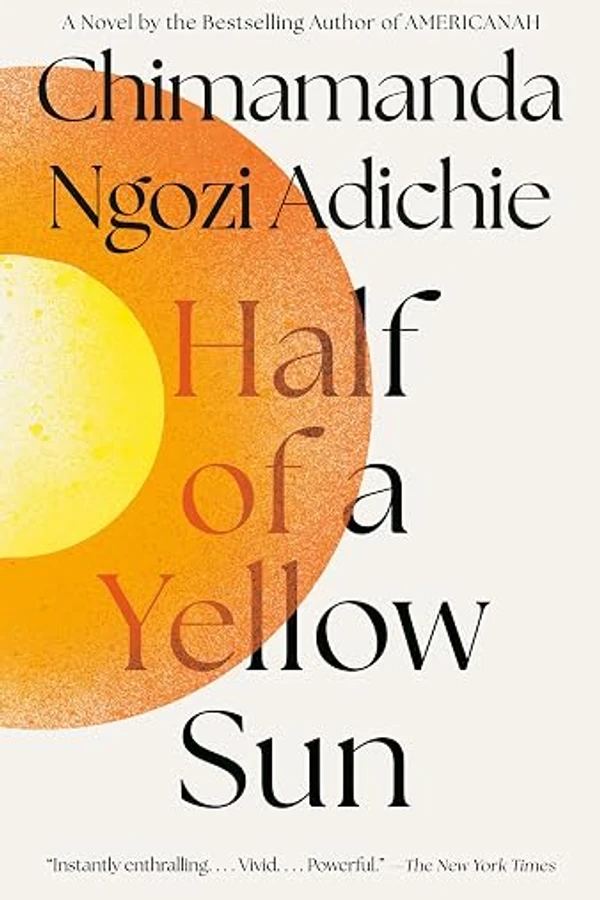
Half of a Yellow Sun
About This Book
With effortless grace, celebrated author Chimamanda Ngozi Adichie illuminates a seminal moment in modern African history: Biafra's impassioned struggle to establish an independent republic in southeastern Nigeria during the late 1960s. We experience this tumultuous decade alongside five unforgettable characters: Ugwu, a thirteen-year-old houseboy who works for Odenigbo, a university professor full of revolutionary zeal; Olanna, the professor’s beautiful young mistress who has abandoned her life in Lagos for a dusty town and her lover’s charm; and Richard, a shy young Englishman infatuated with Olanna’s willful twin sister Kainene.
Half of a Yellow Sun is a tremendously evocative novel of the promise, hope, and disappointment of the Biafran war.
Half of a Yellow Sun by Chimamanda Ngozi Adichie delves into the Biafran War in Nigeria, intertwining the lives of five characters against a backdrop of conflict and love. The novel captures the complexities of relationships and the harsh realities of war, providing a poignant look at a significant moment in African history.
Who this book is for
- Readers interested in African history
- Fans of literary fiction
- Those exploring themes of love and war
- Students of sociology and culture
- Anyone seeking a deep emotional narrative
What you'll learn
- The historical context of the Biafran War
- The personal impact of war on individuals
- Cultural dynamics within Nigeria
- The intersection of love and conflict
- The experiences of both peasants and intellectuals
Read a free sample 10 pages from the book
Half of a Yellow Sun Chimamanda Ngozi Adichie Anchor (2006) Rating:★★★★☆ Tags:Political, General, Literary, Historical, Nigeria, Fiction Politicalttt Generalttt Literaryttt Historicalttt Nigeriattt Fictionttt From Publishers Weekly Starred Review. When the Igbo people of eastern Nigeria seceded in 1967 to form the independent nation of Biafra, a bloody, crippling three-year civil war followed. That period in African history is captured with haunting intimacy in this artful page-turner from Nigerian novelist Adichie (Purple Hibiscus). Adichie tells her profoundly gripping story primarily through the eyes and lives of Ugwu, a 13-year-old peasant houseboy who survives conscription into the raggedy Biafran army, and twin sisters Olanna and Kainene, who are from a wealthy and well-connected family. Tumultuous politics power the plot, and several sections are harrowing, particularly passages depicting the savage butchering of Olanna and Kainene's relatives. But this dramatic, intelligent epic has its lush and sultry side as well: rebellious Olanna is the mistress of Odenigbo, a university professor brimming with anticolonial zeal; business-minded Kainene takes as her lover fair-haired, blue-eyed Richard, a British expatriate come to Nigeria to write a book about Igbo-Ukwu art—and whose relationship with Kainene nearly ruptures when he spends one drunken night with Olanna. This is a transcendent novel of many descriptive triumphs, most notably its depiction of the impact of war's brutalities on peasants and intellectuals alike. It's a searing history lesson in fictional form, intensely evocative and immensely absorbing. (Sept. 15)
Half of a Yellow Sun Adichie, Chimamanda Ngozi Anchor (2008)
Praise for Chimamanda Ngozi Adichie's Half of a Yellow Sun
“At once historical and eerily current.... Like Nadine Gordimer, [Adichie] likes to position her characters at crossroads where public and private allegiances threaten to collide.... [Half of a Yellow Sun] speaks through history to our war-racked age.” —The New York Times Book Review “Destined to become a classic.... This book confirms the notion that if you want to understand a country's soul, read its fiction.” —Minneapolis Star Tribune “[Half of a Yellow Sun] is Tolstoyan in its grasp of history and in its ability to traverse various ends of the social spectrum from a village manservant to the daughter of wealthy bureaucrats.” —The Denver Post “Adichie's fully realized and finely observed characters hook the reader and carry the story through wrenching events to its sorrowful, tragic conclusion.... By venturing so fearlessly into complex moral territory, Adichie reveals her talents as a novelist as well as her gifts as a perceptive observer of human behavior.” —Newsday “A novel that [uses] fiction to its best advantage, telling the stories of ordinary people—loving, fallible, passionate and vulner-able —ineluctably caught in savage circumstances of chaos, breakdown and violence.... Written with unflinching clarity, what Adichie's novel offers is a compassionate, compelling look at the nearly unfathomable immediacy of war's effect on people.” —Chicago Tribune “We do not usually associate wisdom with beginners, but here is a new writer endowed with the gift of ancient storytellers.... She is fearless, or she would not have taken on the intimidating horror of Nigeria's civil war. Adichie came almost fully made.” —Chinua Achebe “Adichie uses layers of history, symbol and myth ... [and] uses language with relish. She infuses her English with a robust poetry, and
the narrative is cross-woven with Igbo idiom and language.” —The Times (London) “Engrossing.... In its deeply insightful portrayal of one of Ni geria's most traumatic epochs, Adichie's novel affirms a differ ent kind of historical ‘truth'—not the facile truth of facts, figures, and dates— but the deeper truth of throbbing, lived experience.” —The Nation “Adichie is part of a new generation revisiting the history that her parents survived. She brings to it a lucid intelligence and compassion, and a heartfelt plea for memory.” —The Guardian (London) “A sweeping story that provides both a harrowing history lesson and an engagingly human narrative.... Adichie puts a powerfully human face on this sobering story, which is far from over.” —The Seattle Times “Adichie subtly nods at those responsible for the massacre without sliding into polemics. [She] refuses to turn away from the past's ugly reality, mourning not just the lives lost but a time when ‘people believed deeply in something.' Through her dazzling storytelling, that time will not be easily forgotten.” —Newsweek International “Vividly written, thrumming with life, Chimamanda Ngozi Adichie's Half of a Yellow Sun is a remarkable novel. In its compassionate intelligence, as in its capacity for intimate portraiture, this novel is a worthy successor to such twentieth-century classics as Chinua Achebe's Things Fall Apart and V. S. Naipaul's A Bend in the River.” —Joyce Carol Oates “Adichie is far too young for us to declare that she's the Tolstoy of West Africa.... But she's as good as any of her contemporaries, who are a talented lot indeed, at keeping our interest alive in a part of the world that most of us have never visited— until now.” —All Things Considered, NPR “An immense achievement.... As well as freshly re-creating this nightmarish chapter in her country's history, she writes about the slow process by which love, if strong enough, may over come.”
—The Observer (London) “Adichie's powerful second novel retells the shocking story of the ethnic cleansing and mass starvation in this breakaway territory of Nigeria in 1967.... Masterfully, Adichie dissects their reactions as barbarism disrupts their bourgeois comfort and their struggle for survival.” —People “Searing, beautifully written.... What makes [Half of a Yellow Sun] so deeply compelling and involving are [Adichie's] powers of empathy and imagination. She creates memorably distinctive characters and shows how the horrors of persecution, massacre, starvation and war affect their lives.” —San Francisco Chronicle
Chimamanda Ngozi Adichie
Half of a Yellow Sun
Chimamanda Ngozi Adichie was born in Nigeria. Her first novel, Purple Hibiscus, won the Commonwealth Writers' Prize and the Hurston/Wright Legacy Award, and was shortlisted for the Orange Prize and the John Llewellyn Rhys Prize. Her short fiction has appeared in Granta and The Iowa Review among other literary journals, and she received an O. Henry Prize in 2003. She was a 2005–2006 Hodder Fellow at Princeton University and divides her time between the United States and Nigeria.
ALSO BY CHIMAMANDA NGOZI ADICHIE
Purple Hibiscus
My grandfathers, whom I never knew, Nwoye David Adichie and Aro-Nweke Felix Odigwe, did not survive the war. My grandmothers, Nwabuodu Regina Odigwe and Nwamgbafor Agnes Adichie, remarkable women both, did. This book is dedicated to their memories: ka fa nodu na ndokwa. And to Mellitus, wherever he may be.
Today I see it still— Dry, wire-thin in sun and dust of the dry months— Headstone on tiny debris of passionate courage. —Chinua Achebe, From “Mango Seedling” in Christmas in Biafra and Other Poems
The Early Sixties
1
Master was a little crazy; he had spent too many years reading books overseas, talked to himself in his office, did not always return greetings, and had too much hair. Ugwu's aunty said this in a low voice as they walked on the path. “But he is a good man,” she added. “And as long as you work well, you will eat well. You will even eat meat every day.” She stopped to spit; the saliva left her mouth with a sucking sound and landed on the grass. Ugwu did not believe that anybody, not even this master he was going to live with, ate meat every day. He did not disagree with his aunty, though, because he was too choked with expectation, too busy imagining his new life away from the village. They had been walking for a while now, since they got off the lorry at the motor park, and the afternoon sun burned the back of his neck. But he did not mind. He was prepared to walk hours more in even hotter sun. He had never seen anything like the streets that appeared after they went past the university gates, streets so smooth and tarred that he itched to lay his cheek down on them. He would never be able to describe to his sister Anulika how the bungalows here were painted the color of the sky and sat side by side like polite well-dressed men, how the hedges separating them were trimmed so flat on top that they looked like tables wrapped with leaves. His aunty walked faster, her slippers making slap-slap sounds that echoed in the silent street. Ugwu wondered if she, too, could feel the coal tar getting hotter underneath, through her thin soles. They went past a sign, ODIM STREET, and Ugwu mouthed street, as he did whenever he saw an English word that was not too long. He smelled something sweet, heady, as they walked into a compound, and was sure it came from the white flowers clustered on the bushes at the entrance. The bushes were shaped like slender hills. The lawn glistened. Butterflies hovered above. “I told Master you will learn everything fast, osiso-osiso, ” his aunty said. Ugwu nodded attentively although she had already told him this many
times, as often as she told him the story of how his good fortune came about: While she was sweeping the corridor in the mathematics department a week ago, she heard Master say that he needed a houseboy to do his cleaning, and she immediately said she could help, speaking before his typist or office messenger could offer to bring someone. “I will learn fast, Aunty,” Ugwu said. He was staring at the car in the garage; a strip of metal ran around its blue body like a necklace. “Remember, what you will answer whenever he calls you is Yes, sah!” “Yes, sah!” Ugwu repeated. They were standing before the glass door. Ugwu held back from reaching out to touch the cement wall, to see how different it would feel from the mud walls of his mother's hut that still bore the faint patterns of molding fingers. For a brief moment, he wished he were back there now, in his mother's hut, under the dim coolness of the thatch roof; or in his aunty's hut, the only one in the village with a corrugated iron roof. His aunty tapped on the glass. Ugwu could see the white curtains behind the door. A voice said, in English, “Yes? Come in.” They took off their slippers before walking in. Ugwu had never seen a room so wide. Despite the brown sofas arranged in a semicircle, the side tables between them, the shelves crammed with books, and the center table with a vase of red and white plastic flowers, the room still seemed to have too much space. Master sat in an armchair, wearing a singlet and a pair of shorts. He was not sitting upright but slanted, a book covering his face, as though oblivious that he had just asked people in. “Good afternoon, sah! This is the child,” Ugwu's aunty said. Master looked up. His complexion was very dark, like old bark, and the hair that covered his chest and legs was a lustrous, darker shade. He pulled off his glasses. “The child?” “The houseboy, sah.” “Oh, yes, you have brought the houseboy.I kpotago ya.” Master's Igbo felt feathery in Ugwu's ears. It was Igbo colored by the sliding sounds of English, the Igbo of one who spoke English often. “He will work hard,” his aunty said. “He is a very good boy. Just tell him what he should do. Thank, sah!” Master grunted in response, watching Ugwu and his aunty with a faintly distracted expression, as if their presence made it difficult for him to
remember something important. Ugwu's aunty patted Ugwu's shoulder, whispered that he should do well, and turned to the door. After she left, Master put his glasses back on and faced his book, relaxing further into a slanting position, legs stretched out. Even when he turned the pages he did so with his eyes on the book. Ugwu stood by the door, waiting. Sunlight streamed in through the windows, and from time to time a gentle breeze lifted the curtains. The room was silent except for the rustle of Master's page-turning. Ugwu stood for a while before he began to edge closer and closer to the bookshelf, as though to hide in it, and then, after a while, he sank down to the floor, cradling his raffia bag between his knees. He looked up at the ceiling, so high up, so piercingly white. He closed his eyes and tried to reimagine this spacious room with the alien furniture, but he couldn't. He opened his eyes, overcome by a new wonder, and looked around to make sure it was all real. To think that he would sit on these sofas, polish this slippery-smooth floor, wash these gauzy curtains. “Kedu afa gi? What's your name?” Master asked, startling him. Ugwu stood up. “What's your name?” Master asked again and sat up straight. He filled the armchair, his thick hair that stood high on his head, his muscled arms, his broad shoulders; Ugwu had imagined an older man, somebody frail, and now he felt a sudden fear that he might not please this master who looked so youthfully capable, who looked as if he needed nothing. “Ugwu, sah.” “Ugwu. And you've come from Obukpa?” “From Opi, sah.” “You could be anything from twelve to thirty.” Master narrowed his eyes. “Probably thirteen.” He said thirteen in English. “Yes, sah.” Master turned back to his book. Ugwu stood there. Master flipped past some pages and looked up. “Ngwa, go to the kitchen; there should be something you can eat in the fridge.” “Yes, sah.” Ugwu entered the kitchen cautiously, placing one foot slowly after the other. When he saw the white thing, almost as tall as he was, he knew it was the fridge. His aunty had told him about it. A cold barn, she had said, that
kept food from going bad. He opened it and gasped as the cool air rushed into his face. Oranges, bread, beer, soft drinks: many things in packets and cans were arranged on different levels and, and on the topmost, a roasted shimmering chicken, whole but for a leg. Ugwu reached out and touched the chicken. The fridge breathed heavily in his ears. He touched the chicken again and licked his finger before he yanked the other leg off, eating it until he had only the cracked, sucked pieces of bones left in his hand. Next, he broke off some bread, a chunk that he would have been excited to share with his siblings if a relative had visited and brought it as a gift. He ate quickly, before Master could come in and change his mind. He had finished eating and was standing by the sink, trying to remember what his aunty had told him about opening it to have water gush out like a spring, when Master walked in. He had put on a print shirt and a pair of trousers. His toes, which peeked through leather slippers, seemed feminine, perhaps because they were so clean; they belonged to feet that always wore shoes. “What is it?” Master asked. “Sah?” Ugwu gestured to the sink. Master came over and turned the metal tap. “You should look around the house and put your bag in the first room on the corridor. I'm going for a walk, to clear my head, i nugo?” “Yes, sah.” Ugwu watched him leave through the back door. He was not tall. His walk was brisk, energetic, and he looked like Ezeagu, the man who held the wrestling record in Ugwu's village. Ugwu turned off the tap, turned it on again, then off. On and off and on and off until he was laughing at the magic of the running water and the chicken and bread that lay balmy in his stomach. He went past the living room and into the corridor. There were books piled on the shelves and tables in the three bedrooms, on the sink and cabinets in the bathroom, stacked from floor to ceiling in the study, and in the store, old journals were stacked next to crates of Coke and cartons of Premier beer. Some of the books were placed face down, open, as though Master had not yet finished reading them but had hastily gone on to another. Ugwu tried to read the titles, but most were too long, too difficult. Non-Parametric Methods. An African Survey. The Great Chain of Being. The Norman Impact Upon England. He walked on tiptoe from room to room, because his feet felt dirty, and as he did so he grew increasingly determined to please Master, to
stay in this house of meat and cool floors. He was examining the toilet, running his hand over the black plastic seat, when he heard Master's voice. “Where are you, my good man?” He said my good man in English. Ugwu dashed out to the living room. “Yes, sah!” “What's your name again?” “Ugwu, sah.” “Yes, Ugwu. Look here, nee anya, do you know what that is?” Master pointed, and Ugwu looked at the metal box studded with dangerous-looking knobs. “No, sah,” Ugwu said. “It's a radiogram. It's new and very good. It's not like those old gramophones that you have to wind and wind. You have to be very careful around it, very careful. You must never let water touch it.” “Yes, sah.” “I'm off to play tennis, and then I'll go on to the staff club.” Master picked up a few books from the table. “I may be back late. So get settled and have a rest.” “Yes, sah.” After Ugwu watched Master drive out of the compound, he went and stood beside the radiogram and looked at it carefully, without touching it. Then he walked around the house, up and down, touching books and curtains and furniture and plates, and when it got dark he turned the light on and marveled at how bright the bulb that dangled from the ceiling was, how it did not cast long shadows on the wall like the palm oil lamps back home. His mother would be preparing the evening meal now, pounding akpu in the mortar, the pestle grasped tight with both hands. Chioke, the junior wife, would be tending the pot of watery soup balanced on three stones over the fire. The children would have come back from the stream and would be taunting and chasing one another under the breadfruit tree. Perhaps Anulika would be watching them. She was the oldest child in the household now, and as they all sat around the fire to eat, she would break up the fights when the younger ones struggled over the strips of dried fish in the soup. She would wait until all the akpu was eaten and then divide the fish so that each child had a piece, and she would keep the biggest for herself, as he had always done.
Ugwu opened the fridge and ate some more bread and chicken, quickly stuffing the food in his mouth while his heart beat as if he were running; then he dug out extra chunks of meat and pulled out the wings. He slipped the pieces into his shorts pockets before going to the bedroom. He would keep them until his aunty visited and he would ask her to give them to Anulika. Perhaps he could ask her to give some to Nnesinachi too. That might make Nnesinachi finally notice him. He had never been sure exactly how he and Nnesinachi were related, but he knew they were from the same umunna and therefore could never marry. Yet he wished that his mother would not keep referring to Nnesinachi as his sister, saying things like “Please take this palm oil down to Mama Nnesinachi, and if she is not in leave it with your sister.” Nnesinachi always spoke to him in a vague voice, her eyes unfocused, as if his presence made no difference to her either way. Sometimes she called him Chiejina, the name of his cousin who looked nothing at all like him, and when he said, “It's me,” she would say, “Forgive me, Ugwu my brother,” with a distant formality that meant she had no wish to make further conversation. But he liked going on errands to her house. They were opportunities to find her bent over, fanning the firewood or chopping ugu leaves for her mother's soup pot, or just sitting outside looking after her younger siblings, her wrapper hanging low enough for him to see the tops of her breasts. Ever since they started to push out, those pointy breasts, he had wondered if they would feel mushy-soft or hard like the unripe fruit from the ube tree. He often wished that Anulika wasn't so flat-chested—he wondered what was taking her so long anyway, since she and Nnesinachi were about the same age—so that he could feel her breasts. Anulika would slap his hand away, of course, and perhaps even slap his face as well, but he would do it quickly—squeeze and run—and that way he would at least have an idea and know what to expect when he finally touched Nnesinachi's. But he was worried that he might never get to touch them, now…
End of sample. The full book is 462 pages on Afri KDP.
Questions about this book
What themes are explored in Half of a Yellow Sun?
The novel explores themes of love, war, identity, and the complexities of human relationships during a tumultuous historical period.
Loading reviews...
Loading…
A download link appears on this page as soon as your payment is confirmed, and a permanent copy of the link is emailed to you.
By card from anywhere. In Nigeria you can also pay by bank transfer, USSD or mobile money. Your card details are entered on Paystack's secure page, never on AfriKDP.
Yes. The file opens on phones, tablets, computers and eReaders.
Yes, with an AfriKDP reading plan, which opens every book in the online reader and pays the author for every page you read.
Write to [email protected] with your email address and we will help. See our return policy.