 AfriKDP
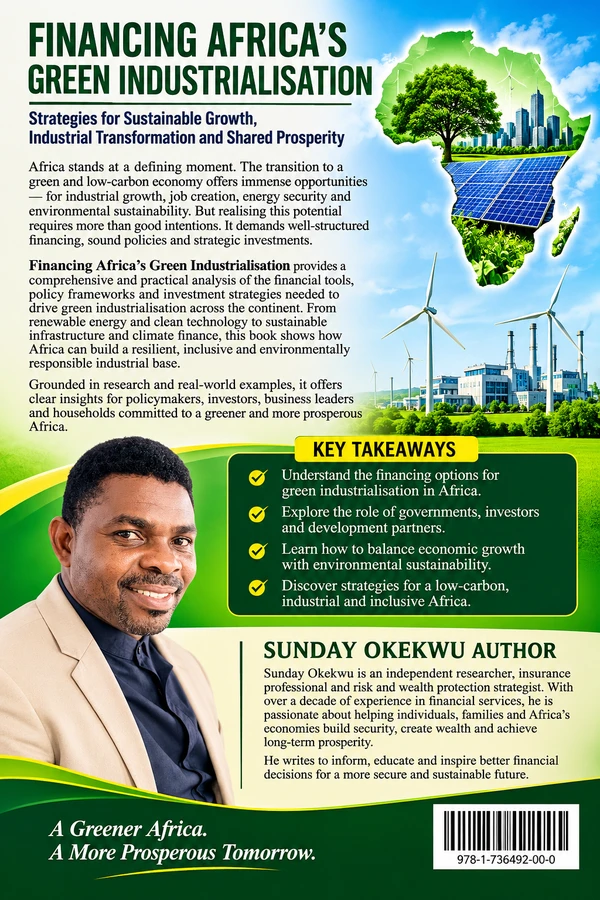
FINANCING AFRICA'S GREEN INDUSTRIALISATION
About This Book
Critical Minerals, International Investment, Risk Protection and the Economics of Local Value Addition
Book Description
Africa stands at a critical moment in the global economic transformation. The transition towards cleaner energy, electric mobility, advanced manufacturing and renewable technologies is increasing international demand for critical minerals such as lithium, cobalt, copper, graphite, manganese and other strategic natural resources.
The continent possesses significant mineral resources, yet the economic benefits derived from these resources remain constrained by limited local processing, inadequate industrial infrastructure, financing challenges, technological gaps and institutional weaknesses.
Why does Africa continue to export valuable raw materials without capturing a greater share of the industrial value created from them? What financial, investment and institutional arrangements are necessary to transform mineral wealth into productive industrial capacity?
FINANCING AFRICA'S GREEN INDUSTRIALISATION examines the economic and financial conditions required to position African economies more effectively within emerging global green industrial value chains.
The book explores the relationship between critical mineral resources, international capital, industrial investment, local value addition, technology transfer, infrastructure financing and investment risk protection.
It provides an analytical examination of:
Africa's strategic position in global critical mineral markets.
International investment and financing for green industrialisation.
Critical mineral extraction, processing and local value addition.
Foreign direct investment and technology transfer.
Industrial infrastructure and energy requirements.
Political, regulatory, commercial and investment risks.
Risk protection mechanisms for long-term industrial investments.
Government policies and institutional frameworks.
Regional economic integration and African industrial cooperation.
The economics of moving from raw material exports to domestic industrial production.
Particular attention is given to the relationship between resource ownership, investment financing and the development of domestic industrial capabilities. The book examines why access to natural resources and foreign capital alone cannot guarantee industrial transformation without appropriate institutions, infrastructure, technology, financing structures and long-term economic planning.
Written for policymakers, government officials, investors, economists, researchers, development finance institutions, industrial professionals and university students, this book offers a framework for understanding the financial and institutional requirements of Africa's green industrial transformation.
Africa's challenge is not simply to supply the minerals required by the global energy transition. It is to capture more of the economic value, industrial capacity, technological advancement
'Financing Africa's Green Industrialisation' explores the challenges and opportunities of transforming Africa's mineral wealth into industrial capacity. The book examines critical minerals, international investment, and the necessary frameworks for local value addition.
Who this book is for
- Policymakers and government officials
- Investors and economists
- Researchers and development finance institutions
- Industrial professionals and university students
What you'll learn
- Economic conditions for industrial transformation
- The role of critical minerals in global markets
- Investment risk protection mechanisms
- Strategies for local value addition
- Infrastructure financing requirements
- The importance of governance and institutional frameworks
Read a free sample 10 pages from the book
substantial and sustainable economic opportunities when resource development is connected to productive investment, competitive processing industries, responsible international partnerships and stronger domestic economic institutions. The purpose of this publication is to examine the financial, commercial and institutional arrangements required to transform Africa's mineral resources into industrial capacity and long-term economic development.
Abstract Africa's critical mineral resources have assumed increasing strategic importance within the global transition towards cleaner energy systems, renewable electricity, electric mobility and advanced industrial technologies. Minerals such as cobalt, copper, lithium, graphite, manganese, nickel and selected rare earth elements serve as important inputs in different energy and industrial applications. However, the availability of these resources does not automatically translate into industrial development, economic diversification or sustainable prosperity. The capacity to mobilise investment, manage financial risks, develop infrastructure and establish commercially competitive processing industries remains central to determining the economic benefits that mineral-producing countries can capture. This research examines the financing requirements and economic conditions associated with Africa's green industrialisation, with particular attention to critical minerals, international investment, investment risk protection and local value addition. The study investigates the roles of domestic and international capital, development finance institutions, commercial banks, capital markets, pension funds, insurance companies and public-private partnerships in supporting mineral development and industrial processing. It also examines the financial and non-financial risks affecting mineral investments, including political and regulatory uncertainty, exchange-rate exposure, infrastructure constraints, construction risks, operational challenges and environmental and social liabilities. The research further considers the economic relationship between mineral
extraction and higher-value industrial activities, including refining, processing, battery-material production and manufacturing. It examines the conditions under which local processing can become commercially competitive, recognising the importance of energy costs, logistics, financing expenses, technological capabilities, economies of scale, industrial skills and international market demand. A comparative perspective examines selected African mineral-producing countries, including the Democratic Republic of Congo, Zambia, South Africa, Namibia and Ghana. Their different mineral resources, industrial capabilities, investment environments and development conditions provide a basis for examining the opportunities and constraints associated with mineral industrialisation. The study brings together mineral economics, investment financing, insurance and risk protection, industrial competitiveness, infrastructure and governance. Its analytical approach considers the relationship between resource endowments, capital mobilisation, investment conditions and the development of productive industrial capacity. The intended contribution is an integrated economic and financial framework for assessing how African countries can strengthen their participation in critical mineral value chains while pursuing commercially viable, institutionally responsible and environmentally sustainable industrial development.
Executive Summary Africa's critical mineral resources present significant economic opportunities within a changing global industrial environment. The transition towards renewable energy, electric vehicles, battery storage, electricity networks and other low-carbon technologies is increasing the strategic importance of minerals used in modern industrial production. However, possessing mineral resources does not necessarily guarantee economic transformation. The extent to which African countries benefit depends on their ability to connect extraction activities with financing, processing, manufacturing, infrastructure, technology development and competitive international trade. The African Union's Africa's Green Minerals Strategy identifies mineral value addition, regional industrialisation, technological capacity and sustainable mineral governance as important elements of the continent's development ambitions (African Union Commission 2025). The International Energy Agency also identifies opportunities for African countries to expand their participation in mineral beneficiation, materials production and clean-energy technology manufacturing (IEA 2025b). This book examines the economic and financial requirements associated with that transformation. The Mineral Opportunity Critical minerals are important inputs in several emerging industrial sectors. Their economic importance extends beyond mining to refining, chemical processing, component manufacturing, technology development and related industrial services. Africa's challenge is to strengthen its position across
these activities rather than remain concentrated in the extraction and export of unprocessed or minimally processed resources. The opportunity must nevertheless be evaluated in relation to actual mineral demand, available reserves, production capacity, technological requirements and international market conditions. The Financing Challenge Mineral industrialisation requires substantial long-term investment. Mining and processing projects often involve high initial capital expenditure, lengthy development periods, uncertain market conditions and significant infrastructure requirements. Potential financing sources include: Domestic commercial banks. International commercial lenders. Development finance institutions. Sovereign and private investment funds. Pension funds. Insurance companies. Capital markets. Public-private partnerships. Strategic international investors. The effectiveness of these financing sources depends on project viability, financing costs, regulatory conditions, institutional capacity, investment duration and the distribution of risks. The central financing question is not simply how much capital can be attracted, but how appropriate financing structures can support productive industrial activities without creating unsustainable financial obligations. Investment Risk and Financial Protection Large-scale mineral projects face several categories of risk. These include political and regulatory uncertainty, currency instability, construction delays, operational disruptions, environmental liabilities, contractual disputes and changes in international market conditions. Appropriate insurance, investment guarantees, contractual protections and risk-sharing arrangements can help
manage specific exposures and improve investment confidence. However, financial protection cannot replace sound project design, responsible governance, commercial feasibility or effective environmental management. International Investment Partnerships International investors can provide capital, technology, technical expertise, market access and industrial experience. Nevertheless, investment partnerships should be evaluated according to their actual economic contribution. Important considerations include: Domestic employment creation. Technology transfer. Local enterprise participation. Infrastructure development. Government revenue. Environmental and social safeguards. Processing and manufacturing capacity. Skills development. Long-term productive capacity. The amount invested is only one measure of partnership performance. The wider economic consequences of an investment arrangement are equally important. Local Value Addition Moving from mineral extraction towards processing and manufacturing requires more than government policy declarations. Processing industries must operate under economically sustainable conditions. Electricity costs, transport expenses, access to technology, financing costs, production capacity, skilled labour and market demand influence commercial competitiveness. Local value addition should therefore be evaluated through both development objectives and commercial realities. The objective is not to establish processing facilities regardless of cost, but to identify opportunities where local and regional production can compete sustainably and contribute to wider economic development. Infrastructure and Regional
Cooperation Reliable electricity, transportation networks, ports, logistics systems and industrial facilities are essential to mineral industrialisation. Regional cooperation can expand market opportunities, improve economies of scale and support cross-border industrial value chains. The African Continental Free Trade Area provides an important regional framework within which these opportunities can be examined. Governance and Institutional Confidence Transparent regulation, predictable investment rules, accountable public institutions and responsible revenue management are essential considerations in mineral development. Weak governance can increase investment uncertainty, undermine public confidence and reduce the economic benefits available to producing countries. Mineral development should also consider environmental protection, community participation, labour conditions and the distribution of economic opportunities. Scope and Analytical Contribution The book brings together six interconnected areas of analysis: Mineral economics. Capital mobilisation. Investment risk protection. Industrial value addition. Commercial competitiveness. Governance and sustainability. Its central argument is that Africa's mineral resources should be examined in relation to the financial, commercial, institutional, infrastructural and technological conditions required for sustainable industrial development. The study does not assume that every mineral should be processed locally or that every investment proposal will generate positive economic outcomes. Instead, it examines the conditions under which local value addition and industrial investment can become commercially sustainable and developmentally beneficial.
RESEARCH QUESTIONS AND OBJECTIVES Research Questions The study is guided by the following questions: What economic opportunities do Africa's critical mineral resources create within the global green transition? What financing constraints limit the development of African mineral-processing and manufacturing industries? How can insurance, investment guarantees and risk-sharing arrangements improve the investment environment for mineral industrialisation? What roles should international investors and development finance institutions play in financing African mineral value chains? Under what economic conditions can local mineral processing become commercially competitive and sustainable? How can infrastructure development and regional economic integration strengthen Africa's participation in mineral value chains? What governance and institutional arrangements are necessary to ensure that mineral development generates sustainable economic benefits? Research Objectives The study seeks to: Examine Africa's position in global critical mineral supply chains. Assess the availability and limitations of domestic and international financing for mineral industrialisation. Investigate the major financial and non-financial risks affecting mineral investments. Evaluate the contribution of insurance, guarantees and other financial protection mechanisms to investment security. Examine international investment partnerships and their implications for African industrial development. Assess the commercial feasibility of local
mineral processing and manufacturing. Examine the importance of infrastructure, technology and regional cooperation. Develop financing and policy recommendations for sustainable African mineral industrialisation. LIST OF ABBREVIATIONS Abbreviation Full Meaning AfCFTA African Continental Free Trade Area AfDB African Development Bank AMV Africa Mining Vision AU African Union DFI Development Finance Institution ECA United Nations Economic Commission for Africa ESG Environmental, Social and Governance EU European Union FDI Foreign Direct Investment GVC Global Value Chain IEA International Energy Agency IFC International Finance Corporation IMF International Monetary Fund MDB Multilateral Development Bank MIGA Multilateral Investment Guarantee Agency OECD Organisation for Economic Co-operation and Development PPA Power Purchase Agreement PPP Public-Private Partnership PRI Political Risk Insurance SME Small and Medium-sized Enterprise UN United Nations UNCTAD United Nations Conference on Trade and Development WTO World Trade Organization
1.6 Analytical Framework Chapter 2: Africa's Critical Minerals in the Global Green Transition 2.1 Global Transition Towards Clean Energy 2.2 Critical Minerals and Their Economic Importance 2.3 Africa's Mineral Resource Potential 2.4 Global Demand and Strategic Competition
2.5 From Resource Ownership to Economic Value Creation Chapter 3: The Geopolitics of Critical Minerals and Africa's International Position 3.1 The Emerging Multipolar Economic Order 3.2 Europe and Critical Mineral Requirements 3.3 China's Position in Global Mineral Supply Chains 3.4 The United States and Other International Partners 3.5 African Agency and Negotiating Power PART TWO: FINANCING AFRICA'S MINERAL INDUSTRIALISATION Chapter 4: Mobilising Domestic and International Capital for Mineral Development 4.1 Financing Requirements 4.2 Domestic Savings and Capital Mobilisation 4.3 International Investment and Development Finance 4.4 Commercial Banks and Capital Markets 4.5 Pension Funds and Institutional Investment 4.6 Insurance Companies as Institutional Investors
4.7 Public-Private Partnerships Chapter 5: Investment Risk, Insurance and Financial Protection 5.1 Political and Regulatory Risks 5.2 Currency and Exchange-Rate Exposure 5.3 Construction and Operational Risks 5.4 Environmental and Social Liabilities 5.5 Political Risk Insurance and Investment Guarantees 5.6 Risk-Sharing Arrangements
5.7 Financial Protection Frameworks Chapter 6: International Investment Partnerships and the Economics of Financing 6.1 Europe–Africa Investment Relationships 6.2 EU Critical Minerals Partnerships 6.3 China's Investment and Mineral Supply Chains 6.4 Gulf-State and Emerging Investment Partners 6.5 Investment Agreements and Financing Conditions 6.6 Measuring Partnership Outcomes PART THREE: FROM MINERAL EXTRACTION TO INDUSTRIAL VALUE CREATION Chapter 7: Local Value Addition, Mineral Processing and Manufacturing 7.1 Economics of Raw Mineral Exports 7.2 Mineral Refining and Processing 7.3 Battery Materials and Manufacturing 7.4 Technology Transfer and Industrial Skills 7.5 Local Content and Domestic Enterprise Participation 7.6 African
Industrial Value Chains Chapter 8: Infrastructure, Energy and Regional Industrial Development 8.1 Electricity and Industrial Competitiveness 8.2 Transport Networks and Mineral Corridors 8.3 Ports and Logistics 8.4 Industrial Parks and Processing Zones 8.5 Regional Integration and Cross-Border Investment 8.6 AfCFTA and Mineral Value Chains Chapter 9: The Commercial Feasibility and Competitiveness of African Mineral Processing 9.1 Capital Requirements and Financing Costs 9.2 Production Costs and Economies of Scale 9.3 Technology and Skills Requirements 9.4 International Market Demand 9.5 Processing Competitiveness 9.6 Commercial Viability and Long-Term Sustainability PART FOUR: GOVERNANCE, ECONOMIC DISTRIBUTION AND SUSTAINABILITY Chapter 10: Mineral Governance, Revenue Management and Institutional Confidence 10.1 Mining Regulation and Investment Confidence 10.2 Transparency in Investment Agreements 10.3 Taxation and Government Revenue 10.4 Mineral Wealth Management 10.5 Institutional Accountability 10.6
Community Participation
10.7 Environmental Responsibility Chapter 11: Comparative Country Studies in African Critical Mineral Development 11.1 Democratic Republic of Congo: Cobalt and Copper 11.2 Zambia: Copper and Industrial Development 11.3 South Africa: Platinum Group Metals 11.4 Namibia: Critical Minerals and Investment 11.5 Ghana: Mineral Resources and Economic Diversification 11.6 Comparative Findings and Lessons PART FIVE: RESEARCH FINDINGS AND THE FUTURE OF AFRICAN INDUSTRIALISATION Chapter 12: Financing Models, Research Findings and Policy Recommendations 12.1 Key Research Findings 12.2 Sustainable Financing Models 12.3 Mobilising Domestic Institutional Capital 12.4 Attracting Responsible International Investment 12.5 Strengthening Investment Protection 12.6 Improving African Negotiating Capacity 12.7 Policy Recommendations 12.8 Framework for Sustainable Industrial Transformation BACK MATTER
Conclusion Glossary References and Bibliography Research Notes Index About the Author About Sunday Okekwu Independent Research Centre Other Publications REFERENCES AND BIBLIOGRAPHY African Union Commission. 2025. Africa's Green Minerals Strategy. Addis Ababa: African Union Commission. https://www.au.int/en/documents/20250318/africas-green-minerals- strategy-agms International Energy Agency (IEA). 2025a. Global Critical Minerals Outlook 2025. Paris: International Energy Agency. https://www.iea.org/reports/global-critical-minerals- outlook-2025 International Energy Agency (IEA). 2025b. Stepping Up the Value Chain in Africa: Minerals, Materials and Manufacturing. Paris: International Energy Agency. https://www.iea.org/reports/stepping-up-the-value-chain-in-africa…
End of sample. The full book is 489 pages on Afri KDP.
Questions about this book
What are the key challenges for Africa in mineral industrialisation?
The book identifies limited local processing, inadequate infrastructure, financing challenges, and institutional weaknesses as key obstacles to capturing greater industrial value from mineral resources.
Loading reviews...

Loading…
A download link appears on this page as soon as your payment is confirmed, and a permanent copy of the link is emailed to you.
By card from anywhere. In Nigeria you can also pay by bank transfer, USSD or mobile money. Your card details are entered on Paystack's secure page, never on AfriKDP.
Yes. The file opens on phones, tablets, computers and eReaders.
Yes, with an AfriKDP reading plan, which opens every book in the online reader and pays the author for every page you read.
Write to [email protected] with your email address and we will help. See our return policy.