 AfriKDP
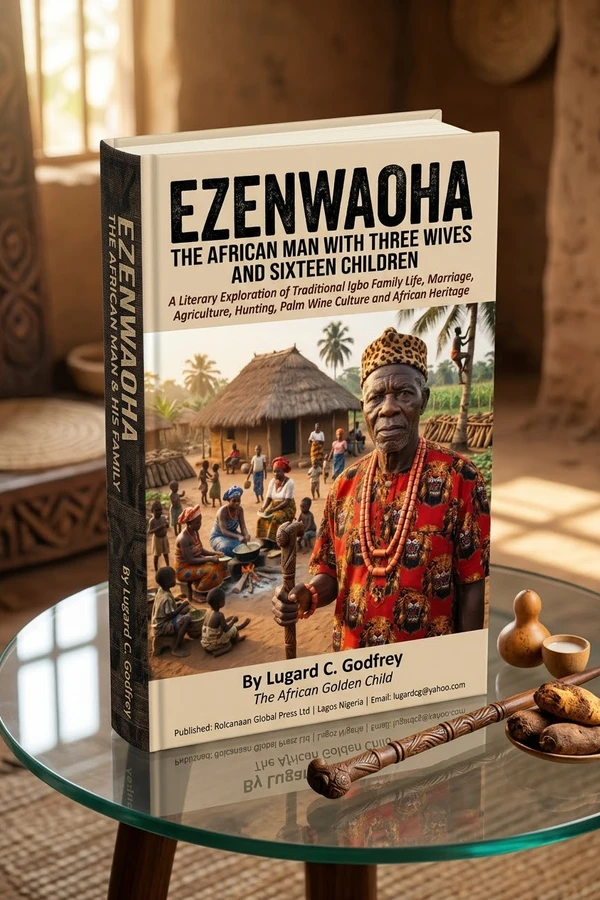
EZENWAOHA THE AFRICAN MAN WITH 3 WIVES AND 16 CHILDREN
About This Book
The narrative introduces the traditional authority of the Onyishi gerontocratic system and the cultural significance of the Ndishi tradition, exploring the relationship between age, wisdom, responsibility, and community leadership.
The Man and His Household
At the centre of the book is Ezenwaoha, a man whose prosperity is built through farming, palm wine tapping, and hunting. His household reflects the organisation and responsibilities of a traditional extended family.
His three wives occupy distinctive positions within the family.
Adanne, the first wife, represents seniority, dignity, and the foundations upon which the household is established.
Chioma, the second wife, brings mediation, cooperation, and resourcefulness, particularly through her agricultural contributions.
Ebere, the youngest wife, represents youthful strength, devotion, and the nurturing responsibilities associated with raising the younger children.
Together, the three women help sustain a household whose unity is continually tested by the demands of family life.
Agriculture, Labour, and Traditional Economy
This book delves into the life of Ezenwaoha, a fictional character representing traditional Igbo values and family structures. Set in Umuosede, it explores themes of marriage, agriculture, and community identity within the rich cultural heritage of the Igbo people.
Who this book is for
- Readers interested in African culture
- Those studying Igbo traditions
- Anyone exploring family dynamics
- Cultural historians
- Fiction enthusiasts
What you'll learn
- Insights into traditional Igbo household life
- Understanding of the Onyishi gerontocratic system
- The roles of women in family and society
- Cultural significance of agriculture and hunting
- The importance of ancestral heritage
- Community relationships and responsibilities
Read a free sample 9 pages from the book
DEDICATION This book is dedicated to the people of Umuosede, Okpo, Enugu Ezike, in Igbo Eze North Local Government Area of Enugu State, Nigeria—the descendants of our ancestral father Osede, from whose name our kindred takes its identity. It is dedicated to our ancestors, our fathers and mothers, our farmers, hunters, palm wine tappers, traders, craftsmen and women whose labour shaped the history and character of our community. It is particularly dedicated to the memory and heritage of Ezenwaoha, to his three wives—Adanne, Chioma and Ebere—and to their sixteen children. And it is dedicated to the generations yet unborn, who will inherit what we preserve. 3
AUTHOR’S NOTE Lugard C. Godfrey: The African Golden Child. From Umuosede, Okpo, Enugu Ezike, in Igbo Eze North Local Government Area of Enugu State, Nigeria. Umuosede is his original ancestral home. It is the kindred of the descendants of Osede, his ancestral father, and it is one of the kindreds of Okpo. This book was born from a simple conviction: that the history of ordinary African people deserves to be written down. His ancestors lived remarkable lives—they cleared forests, planted palm trees, raised large families, preserved traditions, survived wars and famines —and yet so much of what they did survives only in the fading memories of their descendants. When an elder dies, a library burns. He did not want the library of his people to burn. he therefore set out to document, in one extended portrait, the kind of life that shaped communities like his. Ezenwaoha is not a documentary record of one historical individual. He is an illustrative figure—a literary creation through whom the broader realities of traditional Igbo household life can be examined. But the land he stands on is real. Umuosede is real. Okpo is real. Enugu Ezike is real. The farms, the palm trees, the markets, the foods, the customs, the moral codes, the griefs and the celebrations—these are drawn from the living heritage of my people. He wrote as a Nigerian author whose work has been published globally and read beyond our shores, but he wrote first as a son of Umuosede. This book is his offering to the kindred of Osede, and to every family that recognises itself in these pages. Lugard C. Godfrey 4
The African Golden Child 5
PREFACE This is not simply the story of a man with three wives and sixteen children. It is the story of a traditional African household, a farming culture, a hunting tradition and a way of life that deserves to be remembered. Ezenwaoha and his household are entirely fictional creations. They are illustrative representations of a traditional African man and family, rather than a documentary or historical record of any specific individual or real-life household. Although the characters and their experiences are fictional, the cultural setting, social themes and traditional practices explored throughout this book draw inspiration from the broader heritage and historical experiences of Igbo society. It is the story of Ezenwaoha, a great hunter, a renowned palm wine tapper and a farmer whose extensive agricultural holdings sustain a large family. Through his imagined life, we examine marriage, agriculture, fatherhood, the contributions of women, family responsibilities and the social organisation of traditional household life in Umuosede, Enugu Ezike. The book also explores the relationship between people and the land, the importance of farming and traditional occupations, the cultural significance of food and markets, and the values that shaped family and community relationships across generations. Through Ezenwaoha, Adanne, Chioma, Ebere and their sixteen children, readers encounter a fictional household through which broader questions about African identity, heritage, tradition, responsibility and generational continuity can be explored. Ultimately, this book seeks to celebrate the richness of African cultural heritage while reminding us that traditional ways of life deserve thoughtful documentation, interpretation and preservation. 6
Ezenwaoha may be fictional, but the cultural questions his household raises are meaningful and worthy of reflection. 7
HISTORICAL NOTE This book operates on two levels, and the reader is asked to hold both in mind. The first level is the real: Umuosede, Okpo, Enugu Ezike, Igbo Eze North Local Government Area, Enugu State, Nigeria. These are actual places. The kindred of Umuosede is a real kindred of the descendants of Osede. The customs described—the Onyishi institution, the Ndishi tradition, the four-day Igbo week, the New Yam Festival, the bridewealth process, the agricultural calendar—are drawn from the documented and remembered heritage of Enugu Ezike and the wider Igbo world. The second level is the illustrative: Ezenwaoha, Adanne, Chioma, Ebere and their sixteen children. They are fictional. They are not the record of a specific historical family. They are a composite portrait, a literary device through which the real heritage can be explored with warmth, detail and human depth. Where oral accounts differ, where dates are uncertain, where the sixteenth child’s name remains unconfirmed—these gaps are acknowledged honestly. A history that pretends to completeness is not a history; it is a fabrication. 8
Part Five: The Household at Work and at Peace.................................93 26. A Household That Found Its Peace...............................................................94 27. The Cooking Fire and the Vegetable Farms................................................97 28. The Elder and Younger Children.................................................................100 Part Six: The Children and the Inheritance........................................103 29. The Sixteen — A Roll Call of Lives...............................................................104 30. The Firstborn and the Daughters of the Compound.............................106 31. Chioma’s Children and Ebere’s Brood.........................................................109 32. The Education of the Household — Farm, Forest and Fire.................112 33. Marriage Arrangements and the Arrival of Grandchildren................114 34. The Funeral and the Inheritance of Land, Palm Trees and Property........................................................................................................................117 Part Seven: The Widows and Their World..........................................120 35. Adanne in Widowhood — The Senior Widow.........................................121 36. Chioma’s Path and Ebere’s Burden..............................................................123 37. The Widow’s Farm and the Widows’ Council..........................................126 38. The Widow’s House, the Spirit World and the Last Years...................129 Part Eight: The Inheritance and the Future.......................................134 39. The Sons Who Became Men and the Daughters Who Married Out................................................................................................................135 40. The Name That Remains — Ezenwaoha in Family Memory............138 41. The Changing World — From Village to Nation.....................................140 42. Christianity, Education and the Old Ways................................................142 43. The Ones Who Stayed and the Ones Who Left.........................................145 Part Nine: The Wider World....................................................................148 44. Enugu Ezike in the Pre-Colonial Era — The Onyishi and the Ndishi...........................................................................................................................149 45. The Colonial Encounter, Trade and the Land Question.......................153 46. The Biafran War and the Modern Era.......................................................157 Part Ten: Reflections and Legacy...........................................................160 47. The Importance of Documenting Ordinary Lives...................................161 48. The Challenges of Oral History.....................................................................163 10
49. The Family as Historian..................................................................................165 50. Conclusion — A Blessing for the Descendants........................................168 11
PART ONE: THE LAND AND THE PEOPLE 12
C H A P T E R O N E Umuosede — The Children of Osede In the traditional African understanding of existence, land was never merely a physical resource to be exploited. It was a sacred inheritance, a living connection between the ancestors who had walked upon it and the generations yet to be born. A person’s identity was inseparably bound to the soil of their birthplace, to the streams that watered their farms, to the forests that provided their game, to the pathways that connected their compound to the wider world. To be severed from one’s land was to be severed from one’s history, from one’s people, from one’s very self. Among the Igbo, this truth was encoded in names. A people did not simply occupy a place; they bore the name of the ancestor from whom they descended and in whose land they lived. When a community called itself Umu—children of—followed by a personal name, it was making a declaration of identity, lineage and belonging. It was saying: we are not a random gathering of strangers. We are the descendants of one man. We share one blood, one land, one inheritance. Umuosede is such a name, and such a community. The name means the children of Osede. Osede was the ancestral father of the kindred—the man from whom the lineage traces its descent, the founder whose name the generations carry. Every family within Umuosede, whatever its compound or its house, understands itself as belonging to that single ancestral root. The land they farm is the land Osede’s descendants cleared. The shrine they honour is the shrine of Osede’s line. The name they bear in the councils of the community is the name of Osede. Umuosede is a kindred in Okpo, Enugu Ezike, in Igbo Eze North Local Government Area of Enugu State, Nigeria. That sentence contains a whole geography of belonging. Umuosede is the innermost circle—the umunna, the lineage, the kindred of shared descent. Okpo 13
is the wider community, the larger circle of related kindreds and shared institutions. Enugu Ezike is the great multi-clan town, the broad cultural and political landscape of northern Igboland into which Okpo fits. And beyond Enugu Ezike lies Igboland itself, and beyond that Nigeria, and beyond that the world. For the people of Umuosede, this layered identity was not an abstraction. It shaped who one could marry, where one could farm, which disputes one’s elders could settle, which ceremonies one was obliged to attend, and which ancestors one was bound to honour. To be a child of Osede was to have a place in the world that was fixed, known and defended. The geographical setting of Umuosede shaped every aspect of life within it. The rolling hills and fertile valleys of the region provided land for farming, for the cultivation of yams and maize, for the grazing of livestock. Palm trees dotted the landscape, offering sap for palm wine, fronds for thatching, nuts for oil, and trunks for building. The forests that bordered the community provided habitat for the animals that hunters pursued, the plants that healers gathered, the wood that craftsmen shaped into tools and implements. But Umuosede was more than a geographical location. It was a community of people bound together by ties of kinship, by shared traditions, by common history. The families that lived there were interconnected through marriage, through descent, through the countless small obligations and reciprocities that made traditional society function. A man was not simply an individual; he was a member of a lineage, a participant in a network of relationships that extended backward to Osede and forward to the descendants yet unborn. The agricultural life of Umuosede was the foundation upon which everything else rested. The people understood the seasons, knew when to plant and when to harvest, recognised the signs that indicated the coming of rain or the approach of the dry season. They worked the 14
land with tools that their ancestors had used, following methods refined over generations. The yam, that king of crops, received special attention, its cultivation surrounded by ritual and meaning. But yam was not the only crop; maize, groundnuts, cocoyam and water yam each had their place in the agricultural calendar. The land of Umuosede also held the memories of the people. Every field had a history, every path a story. The oldest men could point to particular trees and remember the ancestors who had planted them. They could describe the events that had taken place on particular plots —the disputes settled there, the ceremonies performed, the funerals mourned. The land was a living archive, a repository of memory that supplemented and reinforced the oral traditions passed down through the generations. For the people of Umuosede, the connection to their land was not simply economic or practical. It was spiritual. The ancestors were believed to remain present in the land they had worked, watching over their descendants, blessing those who honoured them, correcting those who neglected their obligations. The earth itself was sacred. The agricultural cycle was not merely a matter of production; it was a ritual observance, a way of maintaining the relationship between the living and the dead. This was the world into which Ezenwaoha was imagined to be born. This was the land that shaped him, that taught him the skills he would need to survive and thrive, that connected him to a heritage stretching back through countless generations. Umuosede was not simply a place on a map; it was the ground of his being, the source of his identity, the foundation of his life. And it is the ground of this book. For the author of these pages is himself a son of Umuosede, a descendant of Osede, writing from within the very lineage whose life he describes. That is the peculiar privilege and the peculiar responsibility of this work: it is not an outsider’s 15
study of an exotic community, but a child…
End of sample. The full book is 176 pages on Afri KDP.
Questions about this book
What cultural aspects does this book cover?
The book covers traditional customs, agricultural practices, social institutions, and communal values of the Igbo people.
Loading reviews...

Loading…
A download link appears on this page as soon as your payment is confirmed, and a permanent copy of the link is emailed to you.
By card from anywhere. In Nigeria you can also pay by bank transfer, USSD or mobile money. Your card details are entered on Paystack's secure page, never on AfriKDP.
Yes. The file opens on phones, tablets, computers and eReaders.
Yes, with an AfriKDP reading plan, which opens every book in the online reader and pays the author for every page you read.
Write to [email protected] with your email address and we will help. See our return policy.