 AfriKDP
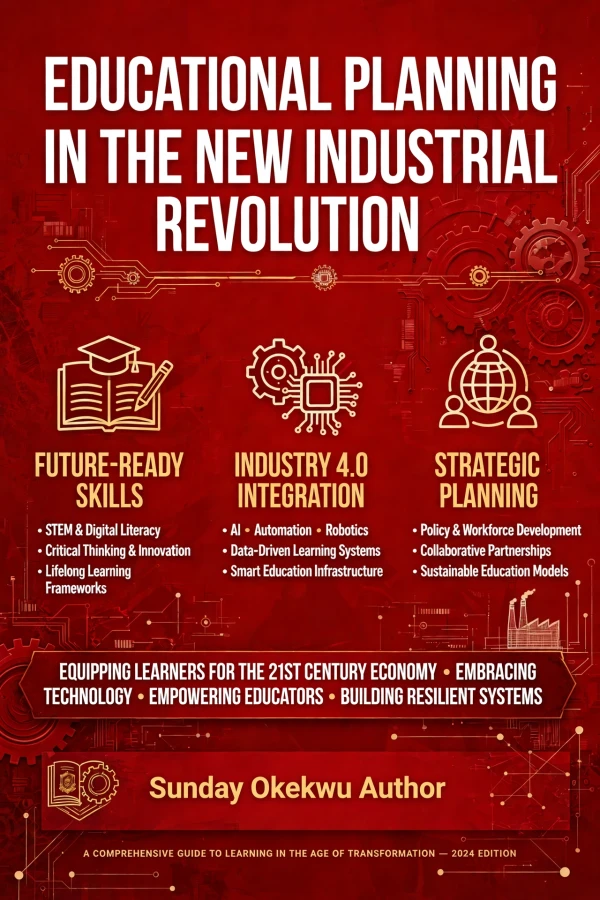
EDUCATIONAL PLANNING IN THE NEW INDUSTRIAL REVOLUTION
About This Book
Book Description
The Industrial Revolution is transforming the relationship between education, technology, employment and economic development. Artificial intelligence, automation, digital technologies and emerging industries are changing the knowledge, skills and institutional capabilities required for individuals, businesses and national economies to remain productive.
Educational Planning in the New Industrial Revolution examines how education systems must respond to these structural changes. It explores the relationship between educational investment, technological advancement, human capital development, labour-market transformation and national economic competitiveness.
The book investigates important questions:
How should governments plan education for an economy increasingly shaped by artificial intelligence and automation?
How can educational institutions align curricula with emerging industrial requirements?
What happens when educational expansion produces graduates without corresponding productive opportunities?
How can countries connect technical education, research, innovation and industrial development?
What institutional reforms are necessary to make education a productive investment in national development?
Moving beyond conventional discussions of educational access and academic qualifications, this book examines education as an economic and institutional system that must convert knowledge, skills and public investment into productive human capabilities.
It provides an analytical perspective on educational financing, workforce preparation, technological adaptation, institutional coordination and the changing economics of employment.
Particular attention is given to developing economies, where the challenge is not simply adopting new technologies but building the educational foundations, industrial capabilities and institutional arrangements required to participate meaningfully in the emerging global economy.
This book is intended for policymakers, education administrators, researchers, economists, development professionals, institutional leaders, investors and readers interested in the future of education and economic transformation.
Its central argument is that the future competitiveness of nations will depend not merely on how much they invest in education, but on how effectively they organise educational systems to produce the capabilities their economies need.
Education must become more than the preparation of individuals for existing employment. It must become a foundation for creating new productive capabilities.
This book examines the impact of the New Industrial Revolution on education, focusing on the need for educational systems to adapt to technological advancements and changing economic conditions. It provides insights into how educational planning can better align with the demands of the future workforce and the financial realities faced by families.
Who this book is for
- Policymakers
- Education administrators
- Researchers
- Economists
- Development professionals
What you'll learn
- The relationship between education and economic development
- How to align curricula with industrial needs
- The impact of financial shocks on educational continuity
- Strategies for effective educational planning
- The importance of human capital in the modern economy
Read a free sample 3 pages from the book
IDENTIFICATION CHALLENGES 24.1 Socioeconomic Status 24.2 Parental Education 24.3 Household Preferences 24.4 Labour-Market Conditions 24.5 Selection into Insurance 24.6 Reverse Causality 24.7 Geographic Differences 24.8 Household Structure 24.9 Technology Adoption 25. TESTABLE PROPOSITIONS 26. EMPIRICAL TESTING PATHWAYS 26.1 Cross-Sectional Household Survey 26.2 Longitudinal Household Study 26.3 Learner-Level Capability Study 26.4 Institutional Study 26.5 Natural Experiments 26.6 Mixed-Methods Research 27. OPERATIONALISATION 27.1 Educational Planning Lag 27.2 Educational Capability Gap 27.3 Family Educational Continuity Risk 28. FALSIFICATION CONDITIONS 29. BOUNDARY CONDITIONS 30. IMPLICATIONS FOR NIGERIA 31. IMPLICATIONS FOR FAMILIES 32. CHILDREN'S EDUCATION PLANNING AS FAMILY FINANCIAL ARCHITECTURE 33. THE MACROECONOMIC CONNECTION 34. POSITION WITHIN THE BROADER RESEARCH ECOSYSTEM 35. CONTRIBUTION OF THE FRAMEWORK 35.1 Integration of Educational Planning and Household Finance 35.2 Shift from Occupation Prediction to Capability Planning 35.3 Three-Level Construct Architecture 35.4 Protection and Educational Continuity 35.5 A Researchable Integrated Framework 36. LIMITATIONS 37. FUTURE RESEARCH AGENDA 38. POTENTIAL LONGITUDINAL RESEARCH MODEL 39. IMPLICATIONS FOR INSURANCE RESEARCH 40. FROM INSURANCE OWNERSHIP TO PROTECTION ADEQUACY 41. CONCLUSION 42. RESEARCH STATUS 43. RESEARCH DEVELOPMENT PATHWAY REFERENCES AUTHOR ABSTRACT The New Industrial Revolution, characterized by artificial intelligence, automation, robotics, digital platforms, advanced data systems, and other frontier technologies, is changing the capabilities required for economic participation. These changes raise an important question for educational planning: should families, educational institutions, and policymakers continue to plan primarily around known occupations, or should educational planning increasingly focus on capabilities that enable individuals to adapt across changing economic environments? This conceptual and theoretical research paper examines educational planning as both a human-capital development process and a long-duration household financial commitment. It argues that educational planning cannot be adequately understood only through curriculum, school attendance,
qualifications, or occupational preparation. For many households, children's education represents a multiyear financial commitment whose continuity may be affected by income loss, illness, disability, unemployment, business failure, inflation, debt distress, and other household shocks. The paper proposes an Educational Capability and Family Continuity Framework (ECFCF) connecting two pathways. The first is a capability-development pathway: Foundational Capability → Technological Capability → Adaptive Capability → Economic Participation → Income Capacity. The second is a household-continuity pathway: Household Financial Configuration → Risk Exposure and Financial Vulnerability → Protection Adequacy → Shock Absorption Capacity → Educational Continuity. Three proposed constructs are introduced: Educational Planning Lag (EPL), Educational Capability Gap (ECG), and Family Educational Continuity Risk (FECR). EPL refers to the gap between changing capability requirements and the adaptation of educational planning at the institutional or system level. ECG refers to the difference between capabilities required for changing economic participation and capabilities actually developed by learners or populations. FECR refers to the vulnerability of an educational trajectory to defined household financial or economic shocks. The framework integrates Human Capital Theory, capability approaches, theories of technological change and task transformation, household finance, life-cycle perspectives, and insurance economics. It develops seven testable propositions, specifies possible operational measures, identifies alternative explanations and identification challenges, and outlines empirical pathways through which the framework can be tested. Nigeria provides an important contextual setting because educational capability, household financial constraints, technological inequality, employment conditions, and protection mechanisms interact within a rapidly changing economic environment. However, the framework is not limited to Nigeria. Its broader purpose is to provide a researchable architecture for examining how families can develop human capital while maintaining continuity under technological and financial uncertainty. The paper is conceptual and theoretical. The proposed constructs, relationships, and framework require empirical validation. KEYWORDS Educational Planning; Human Capital; New Industrial Revolution; Artificial Intelligence; Household Finance; Financial Protection; Educational Continuity; Insurance; Family Financial Security; Educational Capability Gap; Educational Planning Lag; Family Educational
Continuity Risk; Nigeria; Wealth Creation; Intergenerational Continuity. 1. INTRODUCTION Education has traditionally been understood as a mechanism for developing knowledge, skills, qualifications, social capabilities, and occupational opportunities. Human capital theory established education as an investment capable of increasing productive capacity and influencing economic outcomes (Schultz, 1961; Becker, 1964). Over time, however, the economic environment in which education operates has changed substantially. Artificial intelligence, automation, robotics, digital platforms, advanced analytics, and other technologies are altering the organization of work and the composition of tasks performed by humans. The question is therefore no longer simply whether education prepares an individual for employment. A broader question is whether educational systems and household educational plans develop capabilities that remain useful as economic conditions change. This distinction is important because occupations are not static. Tasks within occupations can change, some tasks can become automated, new tasks can emerge, and workers may move between roles. Consequently, an educational strategy focused too narrowly on predicting a particular future occupation may become less robust when technological conditions change. Educational planning therefore requires a broader conceptualization. The central argument of this paper is that educational planning should be examined simultaneously as a human- capital development problem and a household financial continuity problem. A child's educational trajectory may extend over many years. During this period, household circumstances can change. Income may increase or decrease. A parent may lose employment. A business may fail. A household may experience a major health expenditure. Inflation may increase education costs. A breadwinner may die or become disabled. Debt obligations may rise. Such events can affect the family's capacity to maintain the educational plan. This creates two related but analytically distinct challenges. The first is whether educational planning develops capabilities appropriate for a changing economy. The second is whether the household possesses sufficient financial resilience and protection to maintain the educational trajectory when adverse events occur. The proposed framework in this paper brings these dimensions together without assuming that education automatically produces wealth or that insurance automatically guarantees educational…
End of sample. The full book is 21 pages on Afri KDP.
Questions about this book
What is the main focus of the book?
The book focuses on how educational planning must adapt to the changes brought about by the New Industrial Revolution, particularly in relation to technology and economic participation.
Loading reviews...

Loading…
A download link appears on this page as soon as your payment is confirmed, and a permanent copy of the link is emailed to you.
By card from anywhere. In Nigeria you can also pay by bank transfer, USSD or mobile money. Your card details are entered on Paystack's secure page, never on AfriKDP.
Yes. The file opens on phones, tablets, computers and eReaders.
Yes, with an AfriKDP reading plan, which opens every book in the online reader and pays the author for every page you read.
Write to [email protected] with your email address and we will help. See our return policy.