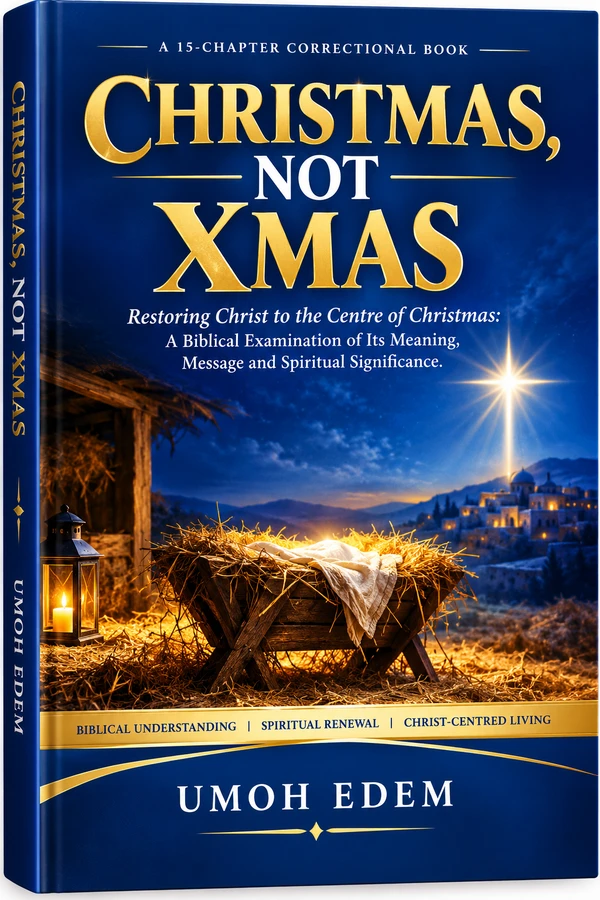
CHRISTMAS NOT XMAS
About This Book
CHRISTMAS NOT XMAS.
Restoring Christ to the Centre of Christmas.
AUTHOR: UMOH EDEM
Are we truly celebrating Jesus Christ, or have we allowed traditions, commercialisation, entertainment, and materialism to overshadow the real meaning of Christmas?
Christmas is more than beautiful decorations, expensive gifts, special meals, fashionable clothes, and annual celebrations. It is an opportunity to reflect on the coming of Jesus Christ, God's redemptive plan, and the salvation He offers to humanity.
📖 CHRISTMAS NOT XMAS is a thought-provoking, Bible-centred book written to correct misconceptions, challenge misplaced priorities, and restore the true biblical significance of Christmas.
WHY SHOULD YOU GET THIS BOOK?
This book will help you:
✅ Understand the true biblical meaning and identity of Christmas.
✅ Discover why Jesus Christ came into the world.
✅ Understand the fulfilment of Old Testament prophecies concerning His birth.
✅ Examine the dangers of commercialising Christmas and allowing material things to replace Christ.
✅ Understand the historical meaning of the abbreviation "Xmas" and separate facts from misconceptions.
✅ Teach your children the true meaning of Christmas.
✅ Restore Christ-centred values in your home, church, and community.
✅ Celebrate Christmas without compromising your Christian identity.
✅ Understand the responsibility of the Church in preserving the Christmas message.
✅ Renew your commitment to remembering, receiving, and proclaiming Jesus Christ.
WHO SHOULD READ THIS BOOK?
This book is highly recommended for:
- Pastors, ministers, evangelists, and Christian leaders.
- Sunday school teachers and Bible study coordinators.
- Christian parents and families.
- Youth leaders and Christian students.
- Churches and Christian organisations.
- Every believer who desires a deeper biblical understanding of Christmas.
A MESSAGE EVERY CHRISTIAN SHOULD CONSIDER.
You can celebrate Christmas without understanding its true meaning. You can participate in every Christmas activity without giving Jesus Christ His rightful place.
But Christmas should never become a celebration in which the Saviour is forgotten.
This book challenges us to look beyond the festivities and return our attention to the person, purpose, and mission of Jesus Christ.
Do not merely celebrate Christmas. Understand Christ. Honour Christ. Proclaim Christ!
📚 GET YOUR COPY TODAY!
Read it personally. Share it with your family. Recommend it to your church leaders. Make it part of your Christian teaching resources.
CHRISTMAS NOT XMAS — LET CHRIST REMAIN AT THE CENTRE!
✍️ AUTHOR: UMOH EDEM
🌐 www.umohedem.com
📧 [email protected]
Restoring biblical understanding. Strengthening Christian faith. Proclaiming the truth of God's Word.
'Christmas Not Xmas' explores the biblical significance of Christmas, challenging contemporary misconceptions and materialism. This thought-provoking book emphasizes the importance of placing Christ at the heart of the celebration.
Who this book is for
- Pastors and church leaders
- Christian parents and families
- Sunday school teachers
- Youth leaders and students
- Every believer seeking deeper understanding
What you'll learn
- The true biblical meaning of Christmas
- The significance of Christ's birth
- The dangers of commercializing Christmas
- How to teach children about Christmas
- Practical steps for a Christ-centered celebration
Read a free sample 10 pages from the book
CHRISTMAS, NOT XMAS Restoring the True Meaning, Identity and Spiritual Significance of Christmas A 15-Chapter Christian Correctional Book Author: UMOH EDEM IMPORTANT MESSAGE BEFORE READING This book addresses an important issue within contemporary Christian communication: the use of the word Xmas instead of Christmas. However, biblical and historical accuracy is essential. The letter X in Xmas historically represents the Greek letter Chi (Χ), the first letter of Christos, meaning Christ. Therefore, Xmas was not originally created to remove Christ from Christmas. It has been used as a Christian abbreviation for centuries. Nevertheless, this book makes a pastoral and spiritual argument for deliberately using the complete word CHRISTMAS, especially in Christian communication, so that the identity of Jesus Christ remains immediately recognizable to everyone. The objective is not to condemn people who write Xmas but to encourage believers to understand, preserve and communicate the true meaning of the celebration. BOOK TITLE CHRISTMAS, NOT XMAS Subtitle: Restoring Christ to the Centre of Christmas: A Biblical Examination of Its Meaning, Message and Spiritual Significance. AUTHOR: UMOH EDEM PREFACE Christmas is one of the most widely recognized celebrations in the world. Every year, millions of people celebrate it through family gatherings, decorations, music, gift exchanges, religious services and various social activities. Yet, beneath all these activities lies a fundamental question that deserves serious Christian attention: Have we preserved the true identity and purpose of Christmas, or have we allowed the activities surrounding the celebration to overshadow the Person being celebrated? Christmas is not fundamentally about decorations, expensive clothing, parties, food, entertainment or commercial activities. Its central Christian message concerns the coming of Jesus Christ into the world. The birth of Jesus represents the manifestation of God's redemptive purpose for humanity. It reminds us that God did not abandon humanity in its fallen condition but provided a Saviour through whom reconciliation, forgiveness and eternal life become available. Unfortunately, many people participate in Christmas celebrations without understanding the spiritual significance of Christ's coming. Others concentrate more on the celebration than on the Saviour. Even our language deserves attention. Words communicate meaning, and Christians should be deliberate about how they communicate the message of their faith.
Although the abbreviation Xmas has a historical Christian origin, I believe that writing the complete word Christmas provides an excellent opportunity to emphasize the name of Christ in our everyday communication. This book is therefore a call to biblical understanding, spiritual consciousness and Christ-centred celebration. It is not written to create unnecessary religious arguments but to encourage believers to examine their practices in the light of God's Word. My prayer is that every reader will discover that the greatest gift of Christmas is not something placed under a decorated tree but Someone who came to give humanity eternal life. His name is Jesus Christ! May this book strengthen your understanding and deepen your relationship with the Lord. UMOH EDEM Author INTRODUCTION THE CHRIST WHO MUST NEVER BE FORGOTTEN There is something spiritually significant about remembering the Person behind a celebration. Imagine organizing a birthday celebration, inviting hundreds of guests, preparing delicious meals, decorating the venue and distributing gifts, only to discover that everybody has forgotten the person whose birthday is being celebrated. Would such a celebration fulfil its purpose? Unfortunately, something similar happens during Christmas. People decorate their homes, purchase expensive gifts, organize parties, travel long distances and exchange greetings. Yet, many celebrations give little attention to the spiritual significance of Jesus Christ. The question is not whether Christians should celebrate Christmas with joy. The question is whether Christ remains central to that celebration. WHAT IS CHRISTMAS? Christmas is the Christian celebration commemorating the birth of Jesus Christ. The Bible records the circumstances surrounding His birth in Matthew 1–2 and Luke 1–2. His coming was not an ordinary historical event. It was connected to God's eternal redemptive plan. Matthew 1:21 reveals the purpose of His birth: He would save His people from their sins. John 1:14 explains that the Word became flesh and dwelt among humanity. These Scriptures establish the spiritual foundation of Christmas. WHY THIS BOOK IS NECESSARY
CHAPTER TWELVE: The True Spirit of Christmas: Love, Giving and Sacrifice CHAPTER THIRTEEN: Celebrating Christmas Without Losing Our Spiritual Identity CHAPTER FOURTEEN: Bringing Christ into Our Homes, Communities and Nations CHAPTER FIFTEEN: CHRISTMAS: A Call to Remember, Receive and Proclaim Jesus Christ CONCLUSION GENERAL PRAYER POINTS FINAL DECLARATION ABOUT THE AUTHOR PART ONE. UNDERSTANDING THE CHRIST OF CHRISTMAS CHAPTER ONE THE TRUE MEANING AND IDENTITY OF CHRISTMAS Key Scriptures Luke 2:10–11 Matthew 1:18–23 John 1:1–14 Isaiah 9:6–7 Galatians 4:4–5 John 3:16–17 Philippians 2:9–11 1.1 INTRODUCTION: BEYOND THE CELEBRATION Every year, as December approaches, something remarkable happens across the world. Streets become decorated, shopping centres are illuminated, families begin preparing for celebrations, churches organize special programmes, and people exchange gifts and greetings. The atmosphere changes. Music fills the air, businesses increase their promotional activities, and millions of people prepare to celebrate Christmas. But beneath all these activities lies a fundamental question that deserves the attention of every Christian: DO WE TRULY UNDERSTAND THE CHRIST WE ARE CELEBRATING? It is possible to participate in Christmas celebrations without understanding their spiritual significance. A person may purchase Christmas decorations without knowing the biblical account of Jesus' birth. Someone may exchange expensive gifts without understanding God's greatest gift to humanity. A family may organize an elaborate Christmas party without giving attention to the Saviour whose birth the celebration commemorates.
This reveals an important spiritual concern: celebration without understanding can gradually turn a meaningful occasion into an ordinary social activity. Christmas must therefore be examined beyond its decorations, traditions, commercial activities and cultural expressions. At its Christian foundation, Christmas commemorates the birth of Jesus Christ, the promised Messiah and Saviour of humanity. It reminds the world that God did not abandon fallen humanity but demonstrated His love through the coming of His Son. Christmas is not fundamentally about what humanity gives to itself; it is about what God gave to humanity through Jesus Christ. This is where our understanding must begin. 1.2 WHAT IS CHRISTMAS? Christmas is the Christian celebration commemorating the birth of Jesus Christ. The word Christmas developed from the expression Christ's Mass, referring to a Christian worship service celebrating Christ's birth. Although the Bible does not explicitly state that Jesus was born on December 25, the date became established in the Western Christian tradition and is widely observed by Christians around the world. It is important to distinguish between the historical date of a celebration and the biblical event being commemorated. The absence of an explicitly recorded birth date in Scripture does not erase the historical and spiritual significance of Jesus' birth. The Gospel accounts of Matthew and Luke provide the principal biblical narratives concerning His birth. Matthew emphasizes the fulfilment of prophecy, Joseph's obedience, the visit of the wise men and the significance of Jesus as the promised King. Luke gives considerable attention to the angelic announcements, Mary's response, the birth in Bethlehem and the shepherds who received the heavenly announcement. Together, these accounts reveal that the birth of Jesus was not an ordinary event. It was the entrance of God's promised Messiah into human history. Biblical Foundation: Luke 2:10–11 The angel announced to the shepherds that good news of great joy had come to all people because a Saviour had been born in the city of David. Consider the significance of this announcement. The angel did not announce the birth of an ordinary child. He announced the birth of the Saviour. The message was not restricted to Bethlehem, Israel or one particular generation. It concerned humanity and God's redemptive purpose. This is why Christmas must be understood through the identity and mission of
Jesus Christ. 1.3 CHRIST IS THE CENTRAL IDENTITY OF CHRISTMAS The word CHRISTMAS contains the name CHRIST. This should remind Christians that the celebration is fundamentally associated with Jesus Christ. However, understanding the name is only the beginning. We must understand the Person represented by that name. Who is Jesus Christ? He is: The promised Messiah (John 4:25–26). The Son of God (Matthew 3:17). The Saviour of the world (Luke 2:11). The Word who became flesh (John 1:14). The Lamb of God who takes away the sin of the world (John 1:29). The King of kings and Lord of lords (Revelation 19:16). These descriptions reveal that Jesus is not merely a historical figure whose birthday Christians commemorate. He is central to God's plan of salvation. A Fundamental Spiritual Lesson If Christians celebrate Christmas without understanding the identity of Christ, they risk reducing a significant biblical truth to a seasonal tradition. The celebration must continually direct our attention to the Person of Jesus. Our decorations may be beautiful, our meals may be delicious, and our family gatherings may be enjoyable, but none of these things should replace the Saviour. The identity of Christmas is inseparable from the identity of Jesus Christ. 1.4 THE BIRTH OF JESUS WAS GOD'S DEMONSTRATION OF LOVE One of the greatest truths revealed through Christmas is the love of God. Humanity's relationship with God had been damaged by sin. The consequences of the fall affected humanity's spiritual condition and relationship with the Creator. But God did not abandon His redemptive purpose. John 3:16 declares that God loved the world and gave His only begotten Son so that whoever believes in Him should not perish but have everlasting life. Notice the relationship between love and giving. God's love was not merely expressed through words. It was demonstrated through action.
He gave His Son. This gives Christmas a meaning that goes beyond exchanging material gifts. When we exchange gifts during Christmas, we should remember the greatest gift God gave humanity. That gift is Jesus Christ. However, we must understand that Jesus was not merely given to make humanity temporarily comfortable. He came to accomplish the work of redemption. His birth was connected to His earthly ministry, His sacrificial death and His resurrection. The Christmas Message of Divine Love God's love teaches us several important lessons: Love must be demonstrated through action. Genuine giving requires a willing heart. Humanity's greatest need is spiritual reconciliation with God. God's salvation is offered through Jesus Christ. Christian celebration should produce compassion towards others. A Christmas celebration that includes expensive gifts but excludes compassion for the suffering around us has missed an important opportunity to demonstrate the love of Christ. 1.5 THE MANGER REVEALS THE HUMILITY OF CHRIST One of the remarkable features of the biblical Christmas account is the humble circumstance surrounding Jesus' birth. Luke 2:7 records that Mary gave birth to her firstborn Son, wrapped Him in swaddling clothes and laid Him in a manger because there was no room for them in the inn. Consider the spiritual significance of this account. The One through whom all things were created entered the world in humility. John 1:3 teaches that all things were made through Him. Yet, when He entered human history, He did not arrive through the display of worldly power, political influence or material extravagance. He came in humility. This teaches us that God's greatness is not measured by human standards. People often associate greatness with wealth, expensive possessions, social recognition and influential positions. But the birth of Jesus challenges such assumptions. The King of kings entered the world in circumstances that demonstrated humility. What the Manger Teaches Us
First, humility is not weakness. Jesus' humble entrance into the world did not reduce His divine identity. Second, God's purpose is not controlled by human expectations. People may expect greatness to arrive with public recognition, but God can accomplish His purposes through circumstances that appear ordinary. Third, material possessions do not determine spiritual value. The absence of luxury surrounding Jesus' birth did not diminish His significance. Fourth, humility must remain part of Christian character. Philippians 2:5–8 calls believers to embrace the humility demonstrated by Christ. Deep Insight The manger was not evidence that Jesus lacked greatness. It was a demonstration that divine greatness does not depend on worldly luxury. This is a lesson every Christian must remember during Christmas. Do not allow the desire to impress people to become more important than the desire to honour God. 1.6 CHRISTMAS IS ABOUT THE INCARNATION: GOD BECAME FLESH One of the deepest theological truths associated with Christmas is the incarnation. The incarnation refers to the coming of the eternal Son of God into human existence as Jesus Christ. John 1:14 declares: "And the Word was made flesh, and dwelt among us." This statement is central to understanding Christmas. Jesus did not merely appear as a messenger carrying information from God. He came into the world as the Word made flesh. He entered human history and experienced genuine human existence. He knew hunger, tiredness, sorrow and physical suffering. Hebrews 4:15 teaches that He was tempted in every respect as we are, yet without sin. Why is this important? Because the incarnation demonstrates that God did not remain distant from humanity's condition. Through Jesus Christ, God entered human history to accomplish the work of salvation. The Spiritual Significance of the Incarnation
It reveals God's willingness to come near to humanity. It demonstrates the reality of Christ's humanity. It reveals the divine identity of Jesus. It establishes the foundation for understanding His redemptive mission. It reminds believers that salvation is God's initiative. The incarnation is not simply a Christmas doctrine to be discussed during December. It is a foundational truth of Christianity. Without understanding who Jesus is, we cannot fully understand why He came. 1.7 CHRISTMAS IS NOT JUST ABOUT A BABY; IT IS ABOUT A SAVIOUR Sometimes people concentrate so much on the image of baby Jesus that they fail to understand the mission of the child. The child in the manger was the promised Saviour. Matthew 1:21 records the angel's instruction to Joseph that the child should be named Jesus because He would save His people from their sins. This verse reveals the purpose of His birth. Jesus came to address humanity's deepest problem. The world has many problems: Poverty. Insecurity. Disease. Corruption. Unemployment. Family breakdown. Injustice. Violence. These challenges require attention, compassion and responsible action. However, Scripture reveals that humanity's fundamental spiritual problem is sin. Jesus came to provide redemption and reconciliation with God. His mission did not end in Bethlehem. It continued through His ministry, His teachings, His miracles, His death on the cross and His resurrection. Therefore, a complete understanding of Christmas must include the cross and the empty tomb.
Bethlehem reveals His coming. Calvary reveals His sacrifice. The empty tomb reveals His victory. This is the complete redemptive message Christians must proclaim. 1.8 CHRISTMAS AND THE QUESTION OF XMAS An important issue addressed in this book is the use of the expression Xmas instead of Christmas. Some Christians believe that the letter X was introduced to remove Christ from Christmas. However, historical evidence does not support this conclusion. The letter X represents the Greek letter Chi (Χ), the first letter of the Greek word Christos, meaning Christ. The abbreviation Xmas has therefore been used historically as a Christian abbreviation. This means that using Xmas does not automatically indicate rejection of Jesus Christ. Nevertheless, Christians may reasonably prefer writing the complete word Christmas. Why? 1. Clarity of communication: Writing Christmas in full immediately communicates the word Christ to readers who may not understand the historical abbreviation. 2. Christian identification: The complete expression visibly emphasizes the connection between the celebration and Jesus Christ. 3. Teaching opportunity: Using the complete word can provide an opportunity to explain the biblical significance of Christ's birth. 4. Avoiding misunderstanding: Some people interpret Xmas negatively because they are unfamiliar with its historical background. Writing Christmas in full can help avoid unnecessary confusion. However, we must never turn this preference into an accusation against fellow Christians. Romans 14:4 reminds believers not to assume the position of judging another person's servant. The greater issue is not simply how someone abbreviates a word. The greater issue is whether Jesus Christ occupies His rightful place in that person's life. A Necessary Correction Let us establish this truth: A person can write CHRISTMAS and still live without Christ. Another person can write Xmas while genuinely believing in Jesus. Therefore, our correction must be based on biblical truth rather than assumptions.
My encouragement is simple: Let us write CHRISTMAS in full when communicating the Christian celebration, not because the abbreviation Xmas is historically anti-Christian, but because we want the name of Christ to remain clear and recognizable in our communication. 1.9 THE DANGER OF CELEBRATING WITHOUT KNOWING CHRIST One of the greatest spiritual dangers associated with religious celebrations is familiarity without transformation. People can become familiar with Christian language, songs, programmes and traditions without developing a genuine relationship with Jesus. This is not limited to Christmas. It can happen during Easter, church anniversaries, religious conferences and other Christian activities. A person may attend church regularly but remain unwilling to obey God's Word. Someone may sing about Jesus but refuse to forgive others. Another person may preach about love but demonstrate hatred and bitterness. This contradiction should concern the Church. James 1:22 encourages believers to become doers of the Word rather than hearers only. The purpose of Christian knowledge is transformation. Five Signs That Christ Is Becoming Secondary in Christmas Celebrations 1. When material possessions become more important than spiritual growth. People become more concerned about what they will wear, eat and purchase than about developing their relationship with God. 2. When entertainment becomes the dominant attraction. The entire celebration revolves around parties and pleasure without meaningful reflection on Christ. 3. When generosity is limited to personal relationships. People remember their friends and relatives but ignore vulnerable individuals in their communities. 4. When religious activities lack genuine spiritual commitment. Church programmes become performances rather than opportunities for worship, teaching and evangelism. 5. When the celebration produces no lasting spiritual impact. After the festivities, there is no renewed commitment to righteousness, love, forgiveness or service. These are matters Christians must prayerfully examine. 1.10 HOW SHOULD CHRISTIANS CELEBRATE CHRISTMAS? A Christ-centred Christmas does not mean Christians must…
End of sample. The full book is 200 pages on Afri KDP.
Questions about this book
What is the main focus of this book?
'Christmas Not Xmas' focuses on restoring the true meaning of Christmas by emphasizing the identity and mission of Jesus Christ, encouraging readers to celebrate with a Christ-centered perspective.
Loading reviews...

Loading…
A download link appears on this page as soon as your payment is confirmed, and a permanent copy of the link is emailed to you.
By card from anywhere. In Nigeria you can also pay by bank transfer, USSD or mobile money. Your card details are entered on Paystack's secure page, never on AfriKDP.
Yes. The file opens on phones, tablets, computers and eReaders.
Yes, with an AfriKDP reading plan, which opens every book in the online reader and pays the author for every page you read.
Write to [email protected] with your email address and we will help. See our return policy.