Science & Nature
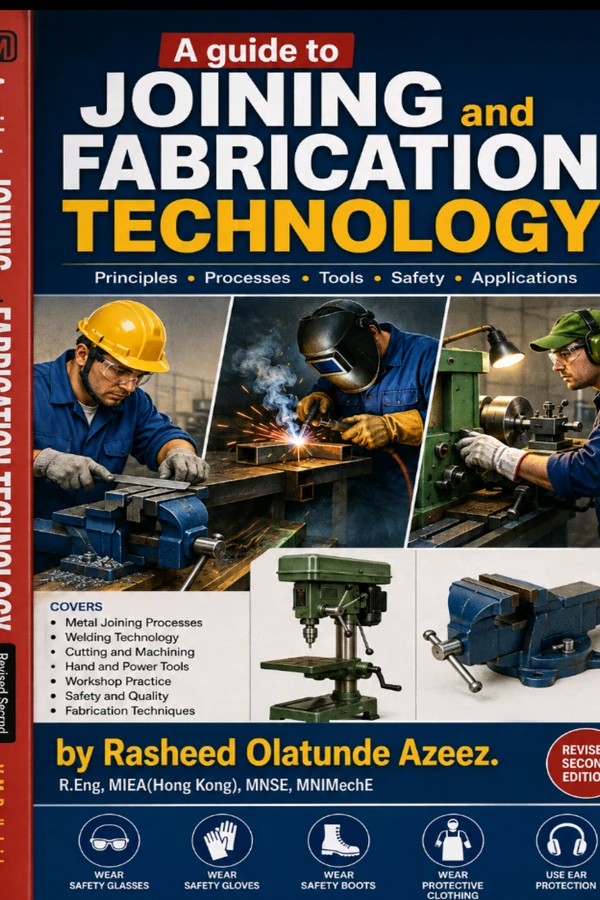
A Guide to Joining and Fabrication Technology
Principles, Processes, Tools, Safety and Applications
Instant DownloadGet access immediately
Secure CheckoutPowered by Paystack
Read AnywherePDF, eReader, Mobile
Creator SupportedDirectly supports the author
About This Book
A complete, classroom-tested guide to metal joining and fabrication technology, written for HND technical college trainees, workshop instructors, apprentice welders and practising fabricators.
Now in its Revised Second Edition, this book takes the reader from first principles through to workshop practice. It explains weldability and what makes one metal easier to join than another, then works systematically through the major joining methods — welding, brazing, soldering, adhesive bonding, mechanical fastening and riveting — with the advantages, limitations and real applications of each.
Full chapters cover electric arc welding equipment (AC transformers, rectifiers and DC generators), straight and reverse polarity, the six standard welding positions from 1G to 6G, electrode coatings and their functions, and the procedure for multirun welds. Gas welding and cutting are treated in detail: equipment components, safety precautions, regulators and blowpipes, the correct procedure for lighting and shutting down a torch, the three flame types and their uses, fluxes, cutting nozzles and nozzle sizes for different plate thicknesses.
Later chapters deal with the problems welders actually meet on the job — distortion, porosity, undercut, slag inclusion, lack of fusion and penetration, cracks, spatter, overlap, warpage and burn-through — each with its causes and the practical countermeasures. The book also covers weld symbols and drawing interpretation to ANSI/AWS A2.4, the five main weld joint types and their variations, machines used in fabrication (shearing machines, guillotines, nibbling machines, cropping machines and sawing machines), bending action and forming machines (fly press, hydraulic press, press brake, folding machines, rolling machines and bending rolls), stiffening of sheets and plates, marking out procedures, and the intersection of cylinders and hollow solids.
Written by Rasheed Olatunde Azeez (R.Eng, MIEA Hong Kong, MNSE, MNIMechE), the text follows the standard national curriculum sequence, uses clear diagrams and tables, and gives step-by-step procedures that can be taken straight onto the shop floor.
What you get:
Twelve structured chapters following the HND syllabus
Step-by-step working procedures for welding, cutting and forming operations
Weld defect identification with causes and corrective action
Nozzle size, plate thickness and electrode selection tables
Safety precautions for oxy-fuel and arc welding
Weld symbol interpretation for engineering and fabrication drawings
Loading reviews...
Loading…
How do I get my book after paying?
A download link appears on this page as soon as your payment is confirmed, and a permanent copy of the link is emailed to you.
How do I pay?
By card from anywhere. In Nigeria you can also pay by bank transfer, USSD or mobile money. Your card details are entered on Paystack's secure page, never on AfriKDP.
Can I read it on my phone?
Yes. The file opens on phones, tablets, computers and eReaders.
Can I read it without buying it?
Yes, with an AfriKDP reading plan, which opens every book in the online reader and pays the author for every page you read.
What if something goes wrong?
Write to [email protected] with your email address and we will help. See our return policy.